


 Aperçu en situation
 Envoyer
 Partager
 Détails de l'œuvre

 Télécharger
 Articles similaires
 Radiographie
 Diaporama
 Statistiques
Bara III, prova de taller

 Lire la suite
Giclées et impressions d'art
Impressions giclées ou sur toile de qualité musée, avec une production rapide et des finitions au choix. ( Commander la reproduction peinte à la main Passer à l'image numérique)




P118B $10

P118H $10

P118W $10

P438Z $10

P508JH $12

P508YH $12

P805H $10

P805Z $10

P919BZ $10

P919G $10

P919XJ $10

P959ZH $10

P968JZ $12

W106C $8

W218G $10

W218JH $8

W218Y $10

W307PJ $10

W316G $10

W316PJ $8

W316Y $10

W398PJ $8

W4111J $10

W500HY $15

W500JH $15

W692G $12

W849H $8

W940BG $15

W953PJ $8




Choisissez parmi nos formats prédéfinis qui respectent les proportions originales de l’œuvre.

Vous pouvez saisir vos propres dimensions pour vous adapter à un cadre ou à un espace spécifique. Si la taille sélectionnée ne correspond pas aux proportions de l'image originale, nous recadrerons l'œuvre ou étendrons l'image avec une bordure en miroir ou une couleur unie. Une maquette numérique vous sera envoyée pour approbation avant le début de la production.
Veuillez noter que l'aperçu à l'écran ne reflète pas le recadrage ou l'extension réelle. Seule la maquette montrera avec précision la composition finale.
Bien que des tailles personnalisées soient disponibles, nous vous recommandons de choisir une dimension dans la liste prédéfinie afin de préserver les proportions originales.
Livraison dans le monde entier () en 2 semaines au lieu des 4/5 semaines habituelles. (10 septembre)

Livraison express gratuite dans le monde entier

Toile de lin de haute qualité

Assurance transport complète

Garantie de remboursement des droits de douane

Garantie de fidélité des couleurs

Garantie de retour de 100 jours (uniquement en cas de défaut)

Garantie de remboursement à 100%

Tarifs dégressifs sur quantité
 L'option verre n'est disponible que pour les dimensions inférieures à 110 cm.

Bara III, prova de taller
Giclées et impressions d'art
Format de la reproduction
-


Prix total final
$ 62
Joan Miró’s “Bara III, prova de taller”: A Catalan Dreamscape
A Catalan Visionary: The Life and Art of Joan Miró Joan Miró i Ferrà, born in Barcelona in 1893, stands as one of the most significant figures in 20th-century art. His journey was not merely a progression through styles but an exploration of inner worlds, translating dreams, memories, and Catalan identity onto canvas with a uniquely poetic visual language. From humble beginnings marked by illness and initial parental reservations about his artistic pursuits, Miró persevered, driven by an innate need to express the intangible—the emotions, sensations, and subconscious currents that lie beneath the surface of reality. His early life was steeped in the traditions of Barcelona, a city brimming with architectural marvels thanks to Antoni Gaudí, whose organic forms would subtly influence Miró’s later abstractions. The goldsmithing profession of his father instilled an appreciation for meticulous craftsmanship, while the rugged Catalan landscape became a recurring motif and source of inspiration.Subject Matter and Composition
“Bara III, prova de taller” plunges viewers into a fantastical realm populated by vibrant flora—primarily scarlet poppies—and enigmatic arrows. These arrows aren’t merely decorative elements; they represent a powerful symbol of direction, aspiration, and perhaps even confrontation. Miró meticulously arranges these arrows throughout the canvas, creating a dynamic composition that defies conventional perspective. Instead of striving for realism, he prioritizes conveying feeling—a sense of movement, energy, and disorientation—that captures the essence of the subconscious mind. The overall effect is akin to peering into a dreamscape where logic yields to intuition.Style and Technique: Surrealist Abstraction
Miró’s artistic style firmly resides within the realm of Surrealism, pioneered by André Breton in 1924. However, Miró transcends categorization, forging his own distinctive path that blends abstraction with organic forms—a hallmark of Gaudí's architectural vision. He employs a technique characterized by bold brushstrokes and vibrant color palettes—primarily reds, yellows, and blues—to achieve textural richness and visual impact. The paint is applied in layers, building up surface irregularities that contribute to the painting’s tactile quality. Miró deliberately avoids precise rendering, opting instead for expressive marks that convey emotion rather than accurately depicting the observable world.Historical Context: Catalonia Under Franco
“Bara III” was created during a period of significant political upheaval in Spain—the dictatorship of Francisco Franco (1936-1975). Miró’s art served as a form of resistance against oppression, reflecting Catalan identity and cultural heritage amidst the homogenizing forces of nationalist ideology. The painting's dreamlike imagery speaks to the anxieties and aspirations of a generation grappling with trauma and yearning for freedom—a sentiment deeply rooted in Catalonia’s history of struggle for autonomy. Miró’s refusal to conform to prevailing artistic trends underscores his commitment to artistic integrity and his unwavering belief in the power of imagination as a tool for confronting injustice.Symbolism: Dreams, Instincts, and Catalan Identity
The poppies symbolize rebirth and resilience—themes prevalent throughout Miró's oeuvre. Their fiery hue embodies passion and vitality, mirroring the spirit of Catalonia’s cultural traditions. The arrows represent not only movement but also intention—a desire to break free from constraints and pursue one’s goals with unwavering determination. Collectively, these symbols encapsulate Miró’s exploration of universal human instincts and his celebration of Catalan heritage as a source of creative inspiration.Emotional Impact: A Journey Into the Psyche
Ultimately, “Bara III” invites viewers on an emotional odyssey—a contemplation of the subconscious mind and its capacity for transforming experience into art. The painting's unsettling beauty evokes feelings of wonder, disorientation, and exhilaration—challenging us to embrace ambiguity and accept that truth resides beyond the realm of rational comprehension. Like all great Surrealist artworks, it lingers in the memory long after viewing, prompting reflection on our own inner landscapes and reminding us of the transformative potential of artistic expression.Œuvres similaires


Biographie de l'artiste
**jeune vie et carrière**
joan miró, un peintre, sculpteur et céramiste espagnol renommé, est né le 20 avril 1893 à Barcelone, en Espagne. Sa famille, aux origines juives (marrano ou converti), a eu une influence significative sur sa jeunesse. Le père de Miró, Miquel Miró Adzerias, était orfèvre et horloger, ce qui peut avoir inspiré l'intérêt de l'artiste pour les détails complexes.**développement artistique**
Miró a commencé des cours de dessin à l'âge de sept ans dans une école privée à Barcelone. Il s'est ensuite inscrit à l'Académie des Beaux-Arts La Llotja, malgré le désaccord de son père. Cela marque le début du parcours artistique de Miró, qui mènera finalement à devenir un pionnier du surréalisme et de l'art abstrait.**œuvres notables et collaborations**
* la ferme (1922), une peinture qui présente la transition de Miró vers un style plus individualiste, avec des qualités nationalistes. * Collaboration avec Max Ernst sur les conceptions pour le ballet de Sergueï Diaghilev en 1926, pionnière de la technique du grattage. * les intérieurs néerlandais (1928), une série de peintures inspirée par Hendrick Martenszoon Sørgh et Jan Steen, mettant en valeur le style unique de Miró.**musées et héritage**
* La Fundació Joan Miró à Barcelone, établie en 1975, dédiée à la présentation des œuvres de Miró. * La Fundació Pilar i Joan Miró à Palma de Majorque, établie en 1981, consolidant davantage l'héritage de Miró.**œuvres clés et leur signification**
- peinture (1933), une peinture à l'huile abstraite, exemplifiant la vision surréaliste de Miró.
- pintura 11, une autre œuvre abstraite notable, mettant en valeur le style unique de Miró.
- l'oreille de blé (37 x 46 cm), une œuvre surréaliste, présentant des détails complexes.
- la naissance du jour, une œuvre d'art abstraite, consolidant davantage les contributions de Miró à l'art abstrait.
**conclusion**
L'héritage de Joan Miró en tant que pionnier du surréalisme et de l'art abstrait est indéniable. Ses œuvres, présentées dans divers musées, dont la Fundació Joan Miró, continuent d'inspirer les artistes et les amateurs d'art du monde entier. Pour plus d'informations sur les œuvres de Miró, visitez [https://ArtsDot.com/@/joan-miro](https://ArtsDot.com/@/joan-miro) ou explorez ses œuvres notables à [https://ArtsDot.com/@@/8ewky5-joan-miro-painting](https://ArtsDot.com/@@/8ewky5-joan-miro-painting).- Consultez d'autres œuvres par Joan Miró sur ArtsDot.com
- Découvrez le musée Fundació Joan Miró à Barcelone, en Espagne
- Explorez la biographie de l'artiste et ses œuvres notables sur [https://en.wikipedia.org/wiki/joan_mir%c3%b3](https://en.wikipedia.org/wiki/joan_mir%c3%b3)

Joan Miró
1893 - 1983 , Espagne
En bref
- Artistes Influents:
- Vincent van Gogh
- Paul Cézanne
- Date De Décès: 1983
- Date De Naissance: 20 avril 1893
- Lieu De Naissance: Barcelone, Espagne
- Mouvement Artistique: Surréalisme, Art abstrait
- Nationalité: Espagnole
- Nom Complet: Joan Miró i Ferrà
- Oeuvres Notables:
- La Ferme
- Intérieurs néerlandais
- Peinture (1933)
- L'Oreille de blé
Articles similaires

Joan Miró : Les 25 Œuvres Maîtresses d'un Artiste Catalan Visionnaire | ArtsDot
Plongez dans l'univers vibrant de Joan Miró ! Découvrez les 25 œuvres majeures du maître catalan, explorant le surréalisme et ses formes abstraites. Reproductions de qualité muséale & inspiration déco sur ArtsDot.com.
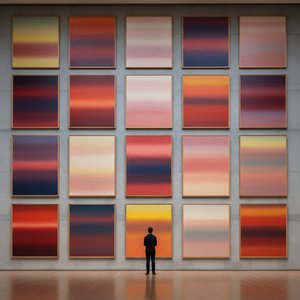
Mark Rothko : Les 25 Œuvres Maîtresses de l'Abstraction Coloriste | ArtsDot
Plongez dans l'univers émotionnel de Mark Rothko avec les 25 œuvres clés du maître de l'abstraction. Découvrez l'histoire, la technique et le pouvoir des couleurs de ces tableaux iconiques. Reproductions d'art de qualité musée sur ArtsDot.com

Expressionnisme Abstrait : Les 10 Chefs-d'Œuvre Incontournables pour Décorer avec Art et Histoire
Plongez au cœur de l'Expressionnisme Abstrait avec ! Découvrez les 10 œuvres majeures de Pollock, Rothko et De Kooning. Histoire, techniques & inspiration déco. Explorez la collection complète en ligne.

Abstraction Géométrique : Les 10 Chefs-d'œuvre qui ont Marqué l'Histoire de l'Art
Plongez au cœur de l'abstraction géométrique avec ArtsDot.com ! Découvrez les 10 œuvres majeures de Mondrian, Malevitch et Kandinsky qui ont révolutionné l'art moderne. Inspirez votre décoration intérieure avec des reproductions de tableaux exceptionnelles. Explorez la collection en ligne !

Kandinsky : Les 25 Œuvres Maîtresses d'un Pionnier de l'Art Abstrait | ArtsDot
Plongez dans l'univers vibrant de Kandinsky ! Découvrez les 25 œuvres majeures du pionnier de l'art abstrait. Explorez son expressionnisme, ses couleurs audacieuses et l'histoire fascinante derrière chaque tableau. Reproductions d'exception sur ArtsDot.com.


