
- Accueil

- Reproduction de peinture à l'huile
- Jean-Baptiste-Camille Corot
- Landscape Studies, Italy

 Commander l'impression Acheter l'image haute résolution
 Partager
 Partager
 Details
 Ajouter aux favoris

 Télécharger
 Articles similaires
 X-Ray
X-Ray
 Diaporama
Landscape Studies, Italy
 Oil On Canvas
- WallArt
- Impressionist Landscape
 1833
1833 32.0 x 20.0 cm
 Université du Michigan - Musée d'art
Reproduction à l'huile faite à la main
Huile sur toile peinte à la main, avec cadre et dimensions personnalisés, réalisée sur commande par nos artistes.




P118B $10

P118H $10

P118W $10

P438Z $10

P508JH $12

P508YH $12

P805H $10

P805Z $10

P919BZ $10

P919G $10

P919XJ $10

P959ZH $10

P968JZ $12

W106C $8

W218G $10

W218JH $8

W218Y $10

W307PJ $10

W316G $10

W316PJ $8

W316Y $10

W398PJ $8

W4111J $10

W500HY $15

W500JH $15

W692G $12

W849H $8

W940BG $15

W953PJ $8




 En savoir plus
Choisissez parmi nos formats prédéfinis qui respectent les proportions originales de l’œuvre.

Vous pouvez saisir vos propres dimensions pour l'adapter à un cadre ou à un espace spécifique. Si la taille sélectionnée ne correspond pas aux proportions de l'image d'origine, nous recadrerons l'œuvre ou prolongerons la peinture avec des éléments peints à la main supplémentaires. Une maquette numérique vous sera envoyée pour approbation avant le début de la production.
Veuillez noter que l'aperçu à l'écran ne reflète pas le recadrage ou l'extension réels. Seule la maquette montrera fidèlement la composition finale.
Bien que des tailles personnalisées soient disponibles, nous vous recommandons de sélectionner une dimension dans la liste prédéfinie afin de préserver les proportions d'origine.
Après la commande, l’équipe ArtsDot.com contactera le client par e-mail pour obtenir ses instructions et lui fournira une maquette d’aperçu.
Livraison dans le monde entier () en 3 à 4 semaines au lieu des 5 semaines habituelles. (1 juillet). Aucune concession sur la qualité.

Livraison express gratuite dans le monde entier

Toile de lin de haute qualité

Assurance transport complète

Garantie de remboursement des frais de douane

Garantie de fidélité des couleurs

Politique de retour de 60 jours (uniquement en cas de défaut)

Garantie de remboursement à 100%

Réduction sur les achats groupés
 L'option verre n'est disponible que pour les dimensions inférieures à 110 cm.

Landscape Studies, Italy
Technique de reproduction
Format de reproduction
-


Prix total final
-
Description de l'œuvre
A Moment Frozen in Light: Jean-Baptiste-Corot’s “Landscape Studies, Italy”
Jean-Baptiste-Camille Corot's "Landscape Studies, Italy," painted in 1833, isn’t merely a depiction of a mountain vista; it’s an invitation to linger within the very essence of light and atmosphere. Born into a comfortable Parisian family, Corot initially pursued a conventional path before surrendering to his profound connection with nature, nurtured during his childhood spent amidst the tranquility of the countryside. This early immersion profoundly shaped his artistic vision, leading him to prioritize capturing the fleeting qualities of light and shadow—a pursuit that would define his entire career. This particular work, rendered in charcoal or pencil on paper, embodies this philosophy perfectly, offering a glimpse into Corot’s meticulous approach to translating the natural world onto canvas.
The composition immediately draws the eye into a vast, rolling landscape dominated by gently sloping hills and distant peaks. The arrangement follows a loosely pyramidal structure, with the highest point of the mountains acting as a focal point, yet it avoids rigid formality. Lines are predominantly sketchy and gestural—not precise outlines, but rather suggestive marks that define forms and imbue the scene with texture. Shapes are organic and irregular, mirroring the natural contours of the terrain, creating an immediate sense of depth and movement. The overall effect is one of quiet contemplation, inviting the viewer to lose themselves in the vastness of the Italian countryside.
The Language of Light: Corot’s Technique
Corot's mastery lies not in detailed representation but in his ability to evoke atmosphere through subtle shifts in tone and texture. The painting is characterized by a diffused, even lighting—a deliberate choice that avoids dramatic contrasts and emphasizes the soft, hazy quality of the air. Perspective is achieved through layering, with distant elements gradually diminishing in size and detail, creating an illusion of immense depth. The artist’s technique involves loose sketching and careful shading to build up form and establish a delicate interplay between light and shadow. Notice how he uses short, broken strokes to suggest the roughness of the terrain, while broader areas of tone create a sense of distance and atmospheric perspective. The visible pencil marks themselves contribute to the painting's tactile quality, inviting close inspection.
Echoes of the Past: Corot’s Context
“Landscape Studies, Italy” emerged during a pivotal moment in art history—the rise of plein air painting. Inspired by artists like Constable and Turner, Corot embraced the practice of working directly outdoors, capturing the fleeting effects of light and atmosphere as they occurred before his eyes. This approach represented a departure from the traditional studio-based method, which prioritized meticulous detail and idealized representations. Corot’s work reflects this shift towards a more spontaneous and expressive style, while still retaining elements of Neo-Classical influence—a testament to his deep understanding of artistic tradition. The painting's subject matter – a simple landscape study – is deliberately understated, allowing the focus to remain on Corot’s innovative technique and evocative use of light.
A Breath of Tranquility: Symbolism and Emotional Impact
Beyond its technical brilliance, “Landscape Studies, Italy” possesses a profound emotional resonance. The scene evokes a sense of tranquility and solitude—a feeling of being utterly immersed in the beauty and grandeur of nature. The muted colors and hazy atmosphere create a dreamlike quality, inviting the viewer to escape the pressures of everyday life. Corot’s deliberate avoidance of explicit detail encourages personal interpretation, allowing each observer to project their own emotions and experiences onto the landscape. It's not simply a representation of a place; it’s an invitation to contemplate the sublime—the awe-inspiring beauty that can be found in the simplest of natural scenes. The painting whispers of timelessness, suggesting a connection between humanity and the enduring power of the earth.
Further Exploration
For a deeper understanding of this remarkable work, we encourage you to explore the Google Arts & Culture page linked below: Landscape Studies, Italy - Jean-Baptiste-Camille Corot. Additionally, ArtsDot offers a wealth of information on Corot and his artistic legacy: Landscape Studies, Italy - Jean-Baptiste-Camille Corot.
Œuvres apparentées


Biographie de l'artiste
Jeunesse et Formation
Jean-Baptiste-Camille Corot, peintre français renommé des paysages et des portraits, est né le 16 juillet 1796 à Paris. Issu d'une famille de la bourgeoisie parisienne, il a bénéficié d'un environnement favorable au développement de ses talents artistiques. Initialement intéressé par d’autres domaines, Corot découvre sa passion pour la peinture vers 1821, marquant le début d'une carrière prolifique qui influencera grandement l'Impressionnisme.Carrière Artistique et Œuvres Notables
Le parcours artistique de Corot se caractérise par une fusion du classicisme néo-classique et des innovations en plein air. Son œuvre est vaste et variée, témoignant d’une constante évolution stylistique. Parmi ses œuvres les plus notables figurent :- Le Repos (huile sur toile, vers les années 1860), une œuvre captivante illustrant la maîtrise de Corot dans la capture de l'essence de la sérénité.
- Lecture interrompue (réalisme, huile, vers les années 1850), un exemple poignant de la capacité de Corot à représenter la vie quotidienne avec profondeur et émotion.
- Agostina (réalisme, huile, vers les années 1860), un portrait saisissant qui témoigne de son habileté à saisir l'essence de ses sujets.
Influences et Développement Artistique
Corot a été influencé par plusieurs artistes et courants artistiques. Il admire les maîtres anciens comme Nicolas Poussin et Claude Lorrain, dont il s'inspire pour la composition et l’atmosphère de ses paysages idéalisés. Son travail en plein air le rapproche des peintres du Barbizon, qui privilégient l'observation directe de la nature. Il est considéré comme un précurseur de l'Impressionnisme grâce à son approche novatrice de la lumière et de la couleur, ainsi qu’à sa volonté de capturer l'instant présent. Son style évolue au fil du temps, passant d'une phase plus classique à une approche plus libre et spontanée, caractérisée par des touches plus rapides et une palette de couleurs plus vibrante.Héritage et Importance Historique
La production abondante de Corot a eu un impact durable sur le développement de la peinture de paysage. Son approche innovante, combinant les techniques traditionnelles avec l'innovation du plein air, a ouvert la voie aux générations futures d’artistes. Il est reconnu comme une figure clé de l'art français et son œuvre continue d'inspirer et d'influencer les artistes du monde entier. Corot a contribué à légitimer le paysage comme genre artistique majeur et a influencé des peintres tels que Monet, Renoir et Pissarro. Découvrez davantage sur les peintures de Jean-Baptiste-Camille Corot sur ArtsDot.com : https://ArtsDot.com/@/jean-baptiste-camille-corot Pour en savoir plus sur le musée Courbet, consultez Wikipedia : https://en.wikipedia.org/wiki/mus%c3%a9e_courbet_(ornans,_france)
Jean-Baptiste-Camille Corot
1796 - 1875 , France
En bref
- Artistes Influents: ['École classique']
- Date De Naissance: 16 juillet 1796
- Influence Sur Les Artistes: ['Impressionnisme']
- Lieu De Naissance: Paris, France
- Mouvement Artistique: Réalisme, Paysage
- Nationalité: Française
- Nom Complet: Jean-Baptiste-Camille Corot
- Oeuvres Notables:
- La Repose
- Lecture interrompue
- Agostina
Articles connexes

Evoking Nature's Sublime: A Comprehensive Exploration of 19th-Century Landscape Painting
Explore the captivating world of 19th-century landscape painting! Discover renowned artists like Friedrich & Monet, key movements, and find the perfect artwork to bring nature's serenity into your home. Expert insights at ArtsDot.


Albert Goodwin: Capturing Victorian Light & Atmosphere – A Study in Landscape Painting
Explore the captivating landscapes of Albert Goodwin (1845-1932), a celebrated Victorian watercolourist influenced by Turner & Ruskin. Discover his techniques, prolific collection, and lasting legacy in British art history.

Alfred East: Pioneering Plein Air & Evoking Atmospheric Landscapes
Explore the life & work of Alfred East, a pioneer of British plein air painting. Discover his techniques for capturing atmospheric landscapes, Barbizon influences, and lasting legacy. Learn more at ArtsDot.

Capturing Ephemeral Light: A Comprehensive Exploration of Plein Air Painting's History & Enduring Legacy
Explore the rich history of plein air painting, from its origins to Impressionism & beyond. Discover key artists, techniques, and the enduring legacy of capturing light in landscape art. Find museum-quality reproductions at ArtsDot.
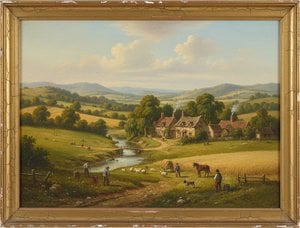
Evocations of Rural Life: A Historical Journey Through Landscape Painting
Explore the rich history of rural life in painting! Discover Impressionist masterpieces, Italian Macchiaioli scenes & the enduring appeal of pastoral landscapes. Find your perfect artwork at ArtsDot.



