


 Aperçu en situation
 Envoyer
 Partager
 Détails de l'œuvre

 Télécharger
 Articles similaires
 Radiographie
 Diaporama
 Stats
Statsuntitled (2561)


 Lire la suite
Giclées et impressions d'art
Impressions giclées ou sur toile de qualité musée, avec une production rapide et des finitions au choix. ( Commander la reproduction peinte à la main Switch to Digital Image)




P118B $10

P118H $10

P118W $10

P438Z $10

P508JH $12

P508YH $12

P805H $10

P805Z $10

P919BZ $10

P919G $10

P919XJ $10

P959ZH $10

P968JZ $12

W106C $8

W218G $10

W218JH $8

W218Y $10

W307PJ $10

W316G $10

W316PJ $8

W316Y $10

W398PJ $8

W4111J $10

W500HY $15

W500JH $15

W692G $12

W849H $8

W940BG $15

W953PJ $8




Choisissez parmi nos formats prédéfinis qui respectent les proportions originales de l’œuvre.

Vous pouvez saisir vos propres dimensions pour vous adapter à un cadre ou à un espace spécifique. Si la taille sélectionnée ne correspond pas aux proportions de l'image originale, nous recadrerons l'œuvre ou étendrons l'image avec une bordure en miroir ou une couleur unie. Une maquette numérique vous sera envoyée pour approbation avant le début de la production.
Veuillez noter que l'aperçu à l'écran ne reflète pas le recadrage ou l'extension réelle. Seule la maquette montrera avec précision la composition finale.
Bien que des tailles personnalisées soient disponibles, nous vous recommandons de choisir une dimension dans la liste prédéfinie afin de préserver les proportions originales.
Livraison dans le monde entier () en 2 semaines au lieu des 4/5 semaines habituelles. (8 septembre)

Livraison express gratuite dans le monde entier

Toile de lin de qualité supérieure

Assurance transport complète

Garantie de remboursement des droits de douane

Garantie de fidélité des couleurs

Politique de retour de 100 jours (uniquement en cas de défaut)

Garantie de remboursement à 100%

Offre de tarifs dégressifs
 L'option verre n'est disponible que pour les dimensions inférieures à 110 cm.

untitled (2561)
Giclées et impressions d'art
Format de la reproduction
-


Prix total
$ 62
A Quiet Revolution in Monochrome
In the vast, often turbulent landscape of early 20th-century modernism, Georges Braque’s “Untitled (2561)” stands as a profound testament to the power of restraint. At first glance, the viewer is met with a deceptively simple scene: a dog nestled peacefully among a collection of fruit—bananas and an apple—resting upon a table. Yet, beneath this charming domestic tableau lies the intellectual heartbeat of Cubism. This monochrome masterpiece eschews the distractions of vibrant color to focus the observer's gaze on the fundamental essence of form and structure. It is not merely a painting of a meal; it is a deliberate deconstruction of reality, inviting us to look past the surface and engage with the very geometry of existence.
The emotional resonance of the piece lies in its unexpected warmth. Despite the analytical nature of Braque’s approach, there is an undeniable sense of comfort and intimacy radiating from the composition. The way the dog occupies the center of the scene, surrounded by the organic shapes of the fruit, creates a sanctuary of stillness. For the collector or interior designer, this artwork offers a unique duality: it possesses the sophisticated, intellectual edge required for contemporary gallery spaces, while simultaneously providing a soulful, grounding presence that can transform a living area into a place of quiet contemplation.
The Architecture of Perception
To understand “Untitled (2561)” is to witness Braque’s mastery of analytical technique. Influenced heavily by the structural innovations of Paul Cézanne, Braque moved away from the traditional illusion of three-dimensional depth achieved through single-point perspective. Instead, he employs a method of fracturing and overlapping geometric planes. The dog’s form is not defined by soft, continuous outlines but is suggested through a rhythmic interplay of light and shadow, where shapes intersect and merge. This technique forces the eye to move dynamically across the canvas, reconstructing the subject from multiple viewpoints simultaneously.
The choice of a black and white palette is a strategic stroke of genius. By stripping away color, Braque eliminates any emotional bias that hue might impose, forcing a pure confrontation with volume and spatial recession. The shadows are not merely absences of light but are structural elements that define the weight of the apple and the curve of the bananas. This meticulous attention to the underlying architecture of the image ensures that the painting remains visually stimulating even upon repeated viewings, offering a complex puzzle of shapes that rewards the patient observer.
A Legacy of Innovation and Synergy
The historical significance of this work cannot be overstated, as it captures a pivotal moment in the dialogue between Braque and his contemporary, Pablo Picasso. During their legendary period of collaboration, the boundaries between their individual styles became famously blurred. “Untitled (2561)” embodies this era of intense artistic synergy, where the shared goal was to dismantle the "mirror" of art and replace it with a new language of symbols and structures. This piece serves as a window into that transformative epoch in France, marking the transition from the sensory delights of Fauvism to the cerebral rigor of Cubism.
For those seeking to adorn their homes with pieces of historical weight, this reproduction offers more than just aesthetic beauty; it offers a connection to the very foundations of modern vision. It is an invitation to experience the "quiet genius" of Braque—a painter who did not seek to replicate the world as we see it, but rather to reveal the hidden, structural truth that lies beneath the surface of all things.
Œuvres similaires


Biographie de l'artiste
**Jeunesse et formation**
Georges Braque, peintre français renommé, collagiste, dessinateur, graveur et sculpteur, est né le 13 mai 1882 à Argenteuil, dans les Val-d'Oise. Il a grandi à Le Havre et a initialement été formé pour devenir peigneur et décorateur comme son père et son grand-père. Cependant, les inclinations artistiques de Braque l’ont conduit à étudier la peinture à l’École des Beaux-Arts de Le Havre de 1897 à 1899.**Évolution artistique et fauvisme**
En 1902, après avoir terminé son apprentissage auprès d'un décorateur à Paris, Braque a fréquenté l’Académie Humbert jusqu’en 1904. Cette période a marqué son introduction au fauvisme, un style caractérisé par des couleurs vives et des réponses émotionnelles. Influencé par les œuvres de Henri Matisse et André Derain, Braque a adopté une approche fauviste, comme en témoigne son tableau La Patience (fauvisme, huile sur toile).**Contribution au cubisme**
La collaboration de Braque avec Pablo Picasso de 1908 à 1912 a conduit au développement du cubisme. Leurs œuvres cubistes analytiques, telles que Georges Braque: La Patience et Pablo Picasso: Le Clarinette(cubisme analytique, huile sur toile), sont aujourd’hui considérées comme des jalons de l'histoire de l'art.**Héritage et œuvres notables**
* Maisons à l’Estaque : Témoignage de l'utilisation innovante de la géométrie et de la perspective simultanée par Braque. * La Patience(fauvisme, huile sur toile) : démontre le style fauve de Braque. * Le Clarinette(cubisme analytique, huile sur toile) : œuvre cubiste collaborative avec Picasso.**Musées et collections**
* Musée d'Orsay : présente une vaste collection d'art impressionniste et post-impressionniste, incluant des œuvres de Braque. * Musée de l'Orangerie : expose une large gamme d'œuvres d'art, incluant celles de Braque et d'autres artistes notables.- Découvrez-en davantage sur la vie et l’œuvre de Georges Braque sur ArtsDot.com
- Explorez la collection du Musée d'Orsay, présentant des œuvres de Braque et d'autres artistes, sur Musée d'Orsay - Wikipédia
- Apprenez-en davantage sur le fauvisme et son influence sur le développement du cubisme avec le mouvement artistique fauviste sur ArtsDot.com

Georges Braque
1882 - 1963 , France
L'essentiel de l'artiste
- Artistes Influents:
- Henri Matisse
- André Derain
- Paul Cézanne
- Date De Décès: 1963
- Date De Naissance: 13 mai 1882
- Influence Sur Les Artistes: ['Pablo Picasso']
- Lieu De Naissance: Argenteuil, France
- Mouvement Artistique: Cubisme, Fauvisme
- Nationalité: Française
- Nom Complet: Georges Braque
- Oeuvres Notables:
- Maisons à L'Estaque
- La Patience
- Le Clarinette
- Nature morte avec cruets
Articles connexes

The Bountiful Still Life: Symbolism & Artistic Representation of Fruit Across Art History
Explore the rich history of still life painting & the symbolism of fruit across art movements. Discover masterpieces from Caravaggio to Cézanne with ArtsDot – expert guidance & museum-quality reproductions.

The Enduring Legacy of Fine Art Prints: Technique, History & Aesthetic Impact
Explore the rich history & techniques of fine art prints. Discover investment potential, assess authenticity, and learn how to preserve your collection with expert guidance. Trusted insights for discerning collectors.

Giclée Prints: Archival Quality & Aesthetic Nuances for the Discerning Collector
Explore the world of giclée prints with ArtsDot. Learn about archival quality, aesthetic nuances & investment potential. Expert guidance for discerning art collectors seeking museum-quality reproductions and lasting value.
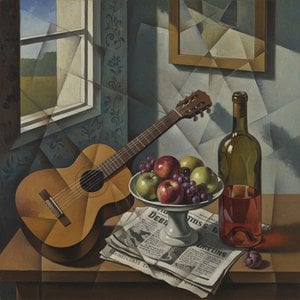
Deconstructing Reality: A Comprehensive Exploration of Cubist Still Life
Explore the revolutionary world of Cubist Still Life with ArtsDot. Discover Picasso & Braque's groundbreaking techniques, its philosophical roots, and lasting impact on modern art. Expert insights for collectors.

Georges Braque : Les 25 Œuvres Maîtresses du Cubisme et de la Modernité | ArtsDot
Plongez dans l'univers de Georges Braque avec les 25 œuvres incontournables du cubisme. Découvrez l'histoire, les techniques et l'impact de ce maître de l'art moderne. Reproductions d'art exceptionnelles sur ArtsDot.com.


