


 Aperçu en situation
 Partager
 Partager
 Détails

 Télécharger l'image
 Articles similaires
 Radiographie
 Voir le diaporama
The Green Jug
 Acrylic
- WallArt
- Analytical Cubism
 1914
1914 17.0 x 24.0 cm
 Afficher la suite
Reproduction à l'huile faite à la main
Huile sur toile peinte à la main, avec cadre et dimensions personnalisés, réalisée sur commande par nos artistes. ( Acheter l'impression Acheter l'image)




P118B $10

P118H $10

P118W $10

P438Z $10

P508JH $12

P508YH $12

P805H $10

P805Z $10

P919BZ $10

P919G $10

P919XJ $10

P959ZH $10

P968JZ $12

W106C $8

W218G $10

W218JH $8

W218Y $10

W307PJ $10

W316G $10

W316PJ $8

W316Y $10

W398PJ $8

W4111J $10

W500HY $15

W500JH $15

W692G $12

W849H $8

W940BG $15

W953PJ $8




Choisissez parmi nos formats prédéfinis qui respectent les proportions originales de l’œuvre.

Vous pouvez saisir vos propres dimensions pour l'adapter à un cadre ou à un espace spécifique. Si la taille sélectionnée ne correspond pas aux proportions de l'image d'origine, nous recadrerons l'œuvre ou prolongerons la peinture avec des éléments peints à la main supplémentaires. Une maquette numérique vous sera envoyée pour approbation avant le début de la production.
Veuillez noter que l'aperçu à l'écran ne reflète pas le recadrage ou l'extension réels. Seule la maquette montrera fidèlement la composition finale.
Bien que des tailles personnalisées soient disponibles, nous vous recommandons de sélectionner une dimension dans la liste prédéfinie afin de préserver les proportions d'origine.
Après la commande, l’équipe ArtsDot.com contactera le client par e-mail pour recueillir ses instructions et lui fournira une maquette d’aperçu
Livraison dans le monde entier () en 3 à 4 semaines au lieu des 5 semaines habituelles. (23 août). Aucun compromis sur la qualité.

Livraison express gratuite dans le monde entier

Toile de lin de haute qualité

Assurance transport complète

Garantie de remboursement des droits de douane

Garantie de fidélité des couleurs

Politique de retour de 60 jours (uniquement en cas de défaut)

Garantie de remboursement à 100%

Tarifs dégressifs sur quantité
 L'option verre n'est disponible que pour les dimensions inférieures à 110 cm.

The Green Jug
Technique de reproduction
Format de la reproduction
-


Prix total final
$ 263
Description de l'œuvre
Georges Braque’s “The Green Jug”: A Fragment of Cubist Exploration
- Subject Matter and Composition:
- Cubist Style and Technique:
- Historical Context – The Birth of Modern Art:
- Symbolism Within the Still Life:
- Emotional Resonance and Artistic Legacy:
Subject Matter and Composition
Georges Braque’s “The Green Jug,” painted in 1914, exemplifies the core tenets of Cubist art. Unlike traditional depictions prioritizing realistic representation, this artwork presents a fragmented view of an everyday object—a simple ceramic jug—challenging viewers to reconsider their perception of form and space. The composition is deliberately asymmetrical, emphasizing Braque’s fascination with dissecting visual reality into geometric planes. Notice how the jug dominates the canvas, occupying approximately half its surface area, yet it's not rendered in a unified manner. Instead, it’s broken down into interlocking cubes and facets that overlap and intersect, creating an illusion of depth without resorting to conventional perspective. The inclusion of a chair and dining table adds to the scene’s complexity, grounding the jug within a domestic setting but simultaneously disrupting any sense of comfortable familiarity.Cubist Style and Technique
Braque's mastery of Cubist technique is evident in every brushstroke. He employed a palette knife alongside traditional brushes, applying thick impasto—textured paint—to build up sculptural surfaces that mimic the physicality of the object being depicted. This approach departs dramatically from Impressionism’s focus on capturing fleeting impressions of light and color; instead, Braque sought to represent objects as they appear simultaneously from multiple viewpoints. The green glaze of the jug itself is rendered in muted tones, contributing to the overall tonal harmony of the painting. Furthermore, Braque meticulously analyzed the optical properties of pigment, experimenting with simultaneous juxtaposition—the placement of colors that appear to coexist on a single plane—a technique pioneered by Picasso and himself. This meticulous attention to detail underscores Braque’s commitment to pushing the boundaries of artistic convention.Historical Context – The Birth of Modern Art
“The Green Jug” emerged during a pivotal moment in art history—the early years of the 20th century, coinciding with the burgeoning influence of movements like Futurism and Dada. These avant-garde artists rejected academic traditions altogether, advocating for radical experimentation and challenging established notions of beauty and representation. Braque’s work aligns perfectly with this spirit of innovation, reflecting a broader cultural shift toward abstraction and conceptual exploration. The artistic debates surrounding Cubism centered on questions of perception and how visual experience could be conveyed beyond mere imitation. Critics initially dismissed the style as intellectually sterile, arguing that it lacked emotional expression; however, its enduring impact testifies to its profound contribution to the development of modern art.Symbolism Within the Still Life
Despite its seemingly austere aesthetic, “The Green Jug” possesses subtle symbolic undertones. The jug itself can be interpreted as representing fertility and nourishment—a reference to traditional ceramic production techniques and the vessel’s function in serving food and drink. The fragmented depiction of the jug may also symbolize the disintegration of established order and the embrace of new perspectives – mirroring the broader anxieties surrounding societal change during World War I. Braque's deliberate simplification of form invites contemplation on the essence of the object rather than its superficial appearance, prompting viewers to engage with deeper questions about materiality and perception.Emotional Resonance and Artistic Legacy
Ultimately, “The Green Jug” transcends mere visual representation; it communicates a sense of quiet contemplation and intellectual curiosity. Braque’s masterful handling of color and texture evokes a feeling of understated elegance—a testament to the enduring power of simplicity. Although devoid of overt emotional drama, the painting possesses an inherent stillness that invites viewers to pause and consider its complexities. Georges Braque's contribution to Cubism cemented his place as one of the fathers of modern art, influencing generations of artists who followed him. Reproductions of “The Green Jug” continue to inspire designers and collectors alike, offering a glimpse into the groundbreaking vision of an artist who fundamentally reshaped our understanding of artistic expression.Œuvres similaires


Biographie de l'artiste
**Jeunesse et formation**
Georges Braque, peintre français renommé, collagiste, dessinateur, graveur et sculpteur, est né le 13 mai 1882 à Argenteuil, dans les Val-d'Oise. Il a grandi à Le Havre et a initialement été formé pour devenir peigneur et décorateur comme son père et son grand-père. Cependant, les inclinations artistiques de Braque l’ont conduit à étudier la peinture à l’École des Beaux-Arts de Le Havre de 1897 à 1899.**Évolution artistique et fauvisme**
En 1902, après avoir terminé son apprentissage auprès d'un décorateur à Paris, Braque a fréquenté l’Académie Humbert jusqu’en 1904. Cette période a marqué son introduction au fauvisme, un style caractérisé par des couleurs vives et des réponses émotionnelles. Influencé par les œuvres de Henri Matisse et André Derain, Braque a adopté une approche fauviste, comme en témoigne son tableau La Patience (fauvisme, huile sur toile).**Contribution au cubisme**
La collaboration de Braque avec Pablo Picasso de 1908 à 1912 a conduit au développement du cubisme. Leurs œuvres cubistes analytiques, telles que Georges Braque: La Patience et Pablo Picasso: Le Clarinette(cubisme analytique, huile sur toile), sont aujourd’hui considérées comme des jalons de l'histoire de l'art.**Héritage et œuvres notables**
* Maisons à l’Estaque : Témoignage de l'utilisation innovante de la géométrie et de la perspective simultanée par Braque. * La Patience(fauvisme, huile sur toile) : démontre le style fauve de Braque. * Le Clarinette(cubisme analytique, huile sur toile) : œuvre cubiste collaborative avec Picasso.**Musées et collections**
* Musée d'Orsay : présente une vaste collection d'art impressionniste et post-impressionniste, incluant des œuvres de Braque. * Musée de l'Orangerie : expose une large gamme d'œuvres d'art, incluant celles de Braque et d'autres artistes notables.- Découvrez-en davantage sur la vie et l’œuvre de Georges Braque sur ArtsDot.com
- Explorez la collection du Musée d'Orsay, présentant des œuvres de Braque et d'autres artistes, sur Musée d'Orsay - Wikipédia
- Apprenez-en davantage sur le fauvisme et son influence sur le développement du cubisme avec le mouvement artistique fauviste sur ArtsDot.com

Georges Braque
1882 - 1963 , France
En bref
- Artistes Influents:
- Henri Matisse
- André Derain
- Paul Cézanne
- Date De Décès: 1963
- Date De Naissance: 13 mai 1882
- Influence Sur Les Artistes: ['Pablo Picasso']
- Lieu De Naissance: Argenteuil, France
- Mouvement Artistique: Cubisme, Fauvisme
- Nationalité: Française
- Nom Complet: Georges Braque
- Oeuvres Notables:
- Maisons à L'Estaque
- La Patience
- Le Clarinette
- Nature morte avec cruets
Articles similaires

Georges Braque : Les 25 Œuvres Maîtresses du Cubisme et de la Modernité | ArtsDot
Plongez dans l'univers de Georges Braque avec les 25 œuvres incontournables du cubisme. Découvrez l'histoire, les techniques et l'impact de ce maître de l'art moderne. Reproductions d'art exceptionnelles sur ArtsDot.com.

Fernand Léger : Les 25 Œuvres Maîtresses d'un Pionnier du Modernisme | ArtsDot
Plongez dans l'univers vibrant de Fernand Léger ! Découvrez les 25 œuvres majeures du cubisme et du tubisme, explorant formes géométriques et couleurs audacieuses. Retrouvez des reproductions d'art exceptionnelles sur ArtsDot.com.

Paul Cézanne : Les 25 Œuvres Maîtresses d'un Génie Révolutionnaire | ArtsDot
Plongez dans l'univers de Paul Cézanne avec les 25 œuvres incontournables du maître post-impressionniste. Découvrez l'histoire, la technique et l'émotion derrière ses tableaux iconiques comme 'Les Baigneuses' ou 'Mont Sainte-Victoire'. Reproductions d'art haute qualité sur ArtsDot.com.
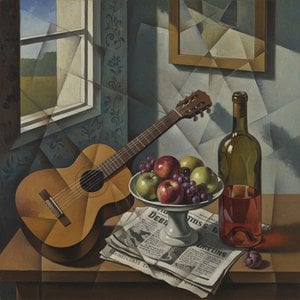
Deconstructing Reality: A Comprehensive Exploration of Cubist Still Life
Explore the revolutionary world of Cubist Still Life with ArtsDot. Discover Picasso & Braque's groundbreaking techniques, its philosophical roots, and lasting impact on modern art. Expert insights for collectors.

Georges Braque : De la Fauvisme à l'Essence du Cubisme – Une Révolution Formelle dans l'Art Moderne
Explorez l'évolution artistique de Georges Braque, du Fauvisme à la révolution cubiste. Analyse approfondie des techniques, influences et héritage durable de ce maître de l'art moderne. Un guide pour collectionneurs avertis.



