


 Aperçu en situation
 Partager
 Partager
 Détails
 Guide imprimable

 Télécharger
 Articles similaires
 Radiographie
 Voir le diaporama
 Statistiques
Sunflower


 Afficher la suite
L’œuvre d'art présentée sur cette page est protégée par le droit d'auteur, ce qui signifie que nous ne pouvons légalement créer ou vendre de reproduction identique. Cette protection est appliquée en vertu d'accords internationaux tels que la Convention de Berne et par les lois nationales, notamment celles énoncées par le Loi américaine sur le droit d'auteur - Titre 17.
Cette méthode est pleinement conforme aux réglementations sur le droit d'auteur car elle ne repose pas sur la copie ou la duplication de l'œuvre protégée. Il s'agit plutôt d'une réinterprétation créative — une nouvelle peinture qui s'inspire de l'original sans pour autant lui être identique.
Giclées et impressions d'art
Impressions giclées ou sur toile de qualité musée, avec une production rapide et des finitions au choix. ( Acheter la peinture faite à la main Passer au format image numérique)




P118B €10

P118H €10

P118W €10

P438Z €10

P508JH €12

P508YH €12

P805H €10

P805Z €10

P919BZ €10

P919G €10

P919XJ €10

P959ZH €10

P968JZ €12

W106C €8

W218G €10

W218JH €8

W218Y €10

W307PJ €10

W316G €10

W316PJ €8

W316Y €10

W398PJ €8

W4111J €10

W500HY €15

W500JH €15

W692G €12

W849H €8

W940BG €15

W953PJ €8




Choisissez parmi nos formats prédéfinis qui respectent les proportions originales de l’œuvre.

Saisissez la largeur et la hauteur souhaitées pour qu'elles s'adaptent à votre cadre ou à votre mur. Une impression ne peut être que découpée, elle ne peut jamais être agrandie au-delà de l'image originale ; ainsi, un format de forme différente entraînera la perte d'une partie de l'image. Nous vous envoyons une maquette numérique pour approbation avant toute impression. L'image présentée sur cette page ne montre pas le recadrage réel — seule la maquette le permet.
Livraison dans le monde entier () en 2 semaines au lieu des 4/5 semaines habituelles. (21 octobre)

Livraison express gratuite dans le monde entier

Toile de lin de haute qualité

Assurance transport complète

Garantie de remboursement des droits de douane

Garantie de fidélité des couleurs

Garantie de retour de 100 jours (uniquement en cas de défaut)

Garantie de remboursement à 100%

Tarifs dégressifs sur quantité
 L'option verre n'est disponible que pour les dimensions inférieures à 110 cm.

Sunflower
Giclées et impressions d'art
Format de la reproduction
-


Prix total final
€ 54
A Moment of Intense Observation: Georges Braque's "Sunflower"
The image before you, a seemingly simple depiction of a sunflower, is far more than just a botanical study. It’s a distilled essence of Georges Braque’s revolutionary approach to painting in the early 20th century – an exploration of form, light, and the very nature of perception. Born in Argenteuil, France, in 1882, Braque's artistic lineage was unexpectedly rooted in his family’s profession as house painters and decorators. This practical grounding, coupled with a rigorous academic training at the École des Beaux-Arts in Le Havre, provided him with an unparalleled understanding of materials and construction – a foundation he would later dismantle and rebuild to create his groundbreaking Cubist style.
This particular “Sunflower” captures a pivotal moment in Braque’s artistic development. Following his initial flirtation with Impressionism, he began to experiment with fragmentation and geometric abstraction, seeking to represent objects not as they appear from a single vantage point, but as they are experienced through the simultaneous convergence of multiple perspectives. The sunflower itself becomes an exercise in this process; its petals aren’t rendered as smooth curves, but rather broken down into angular planes, suggesting their three-dimensional structure and the way light interacts with them. The muted palette – dominated by earthy browns and subtle greens – reinforces this sense of analytical observation, pulling us away from a purely decorative representation and towards a deeper understanding of the subject’s underlying geometry.
Deconstructing Reality: Braque's Cubist Techniques
Braque’s approach to “Sunflower” is deeply rooted in the principles of Cubism. Unlike the vibrant colors often associated with the movement, here we see a restrained use of tone and color, prioritizing structure over superficial beauty. The artist employs a technique known as *papier collé*, or collage – incorporating small pieces of paper, fabric, and other materials directly into the painting’s surface. This wasn't merely an aesthetic choice; it was a deliberate attempt to challenge traditional notions of pictorial space and introduce elements of reality—fragments of the world—into the artwork itself. Notice how these subtle additions seem to push against the painted plane, creating a sense of depth and complexity that defies simple observation.
The brushwork is deliberately rough and unrefined, contributing to the painting’s overall feeling of immediacy and intellectual engagement. Braque wasn't interested in replicating visual appearances with meticulous detail; instead, he sought to capture the *idea* of the sunflower – its essence – through a process of analytical dissection and reconstruction. This focus on underlying structure is mirrored in his collaboration with Pablo Picasso during this period, leading to the development of Analytical Cubism, characterized by its monochromatic palette and fragmented forms.
Symbolic Resonance and Emotional Depth
While often associated with intellectual rigor, Braque’s work possesses a surprising emotional resonance. The sunflower itself carries significant symbolic weight – representing adoration, loyalty, and longevity. Its persistent turning towards the sun embodies an unwavering pursuit of light and life. In this painting, however, these traditional associations are subtly muted, replaced by a sense of quiet contemplation. The close-up perspective invites us to consider the flower not as a symbol of outward devotion, but as a subject worthy of intense, almost scientific, scrutiny.
The subdued colors and fragmented forms evoke a feeling of stillness and introspection – a moment captured outside of time. It’s a painting that rewards careful observation, inviting us to lose ourselves in the intricate details of its composition and contemplate the fundamental questions about perception and representation. Braque's "Sunflower" is not simply a botanical illustration; it’s a profound meditation on the nature of seeing and understanding.
A Timeless Masterpiece – Perfect for Your Space
ArtsDot offers exceptional, hand-painted reproductions of Georges Braque’s “Sunflower,” meticulously crafted to capture the nuances of the original artwork. Whether you are an art enthusiast, a collector seeking to expand your collection, or an interior designer looking for a striking piece to elevate your space, this reproduction provides an authentic and captivating representation of Braque's revolutionary vision. The high-quality materials and expert craftsmanship ensure that your chosen reproduction will be a treasured addition to your home or office for years to come. Bring the intellectual intensity and subtle beauty of this iconic work into your world with ArtsDot.
Questions et réponses
Qui est l'artiste derrière « Sunflower » ?
« Sunflower » est attribué à Georges Braque.
Comment puis-je visionner «Sunflower» de Georges Braque sous forme de diaporama ?
Le diaporama de « Sunflower » peut être visionné sur la page Diaporama de l'œuvre.
Quelle nuance dominante traverse «Sunflower» de Georges Braque ?
La teinte dominante de «Sunflower» de Georges Braque est Ochre to Sepia. Cette teinte constitue la tonalité de fond de la palette.
Œuvres similaires


Biographie de l'artiste
**Jeunesse et formation**
Georges Braque, peintre français renommé, collagiste, dessinateur, graveur et sculpteur, est né le 13 mai 1882 à Argenteuil, dans les Val-d'Oise. Il a grandi à Le Havre et a initialement été formé pour devenir peigneur et décorateur comme son père et son grand-père. Cependant, les inclinations artistiques de Braque l’ont conduit à étudier la peinture à l’École des Beaux-Arts de Le Havre de 1897 à 1899.**Évolution artistique et fauvisme**
En 1902, après avoir terminé son apprentissage auprès d'un décorateur à Paris, Braque a fréquenté l’Académie Humbert jusqu’en 1904. Cette période a marqué son introduction au fauvisme, un style caractérisé par des couleurs vives et des réponses émotionnelles. Influencé par les œuvres de Henri Matisse et André Derain, Braque a adopté une approche fauviste, comme en témoigne son tableau La Patience (fauvisme, huile sur toile).**Contribution au cubisme**
La collaboration de Braque avec Pablo Picasso de 1908 à 1912 a conduit au développement du cubisme. Leurs œuvres cubistes analytiques, telles que Georges Braque: La Patience et Pablo Picasso: Le Clarinette(cubisme analytique, huile sur toile), sont aujourd’hui considérées comme des jalons de l'histoire de l'art.**Héritage et œuvres notables**
* Maisons à l’Estaque : Témoignage de l'utilisation innovante de la géométrie et de la perspective simultanée par Braque. * La Patience(fauvisme, huile sur toile) : démontre le style fauve de Braque. * Le Clarinette(cubisme analytique, huile sur toile) : œuvre cubiste collaborative avec Picasso.**Musées et collections**
* Musée d'Orsay : présente une vaste collection d'art impressionniste et post-impressionniste, incluant des œuvres de Braque. * Musée de l'Orangerie : expose une large gamme d'œuvres d'art, incluant celles de Braque et d'autres artistes notables.- Découvrez-en davantage sur la vie et l’œuvre de Georges Braque sur ArtsDot.com
- Explorez la collection du Musée d'Orsay, présentant des œuvres de Braque et d'autres artistes, sur Musée d'Orsay - Wikipédia
- Apprenez-en davantage sur le fauvisme et son influence sur le développement du cubisme avec le mouvement artistique fauviste sur ArtsDot.com

Georges Braque
1882 - 1963 , France
En bref
- Artistes Influents:
- Henri Matisse
- André Derain
- Paul Cézanne
- Date De Décès: 1963
- Date De Naissance: 13 mai 1882
- Influence Sur Les Artistes: ['Pablo Picasso']
- Lieu De Naissance: Argenteuil, France
- Mouvement Artistique: Cubisme, Fauvisme
- Nationalité: Française
- Nom Complet: Georges Braque
- Oeuvres Notables:
- Maisons à L'Estaque
- La Patience
- Le Clarinette
- Nature morte avec cruets
Articles connexes

Georges Seurat : Les 25 Œuvres Maîtresses du Pointillisme | ArtsDot
Plongez dans l'univers lumineux de Georges Seurat ! Découvrez les 25 œuvres majeures du pointillisme, de 'Un dimanche après-midi à l'Île de la Grande Jatte' aux 'Poseuses'. Reproductions d'art exceptionnelles et inspiration déco sur ArtsDot.com.
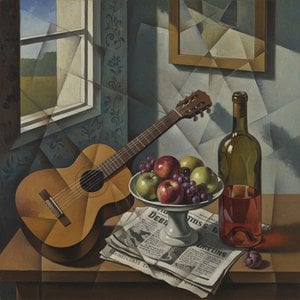
Deconstructing Reality: A Comprehensive Exploration of Cubist Still Life
Explore the revolutionary world of Cubist Still Life with ArtsDot. Discover Picasso & Braque's groundbreaking techniques, its philosophical roots, and lasting impact on modern art. Expert insights for collectors.

Georges Braque : De la Fauvisme à l'Essence du Cubisme – Une Révolution Formelle dans l'Art Moderne
Explorez l'évolution artistique de Georges Braque, du Fauvisme à la révolution cubiste. Analyse approfondie des techniques, influences et héritage durable de ce maître de l'art moderne. Un guide pour collectionneurs avertis.

Georges Braque : Les 25 Œuvres Maîtresses du Cubisme et de la Modernité | ArtsDot
Plongez dans l'univers de Georges Braque avec les 25 œuvres incontournables du cubisme. Découvrez l'histoire, les techniques et l'impact de ce maître de l'art moderne. Reproductions d'art exceptionnelles sur ArtsDot.com.

Verdant Visions: Exploring the Symbolism & Aesthetic Impact of Green in Art History
Explore the rich history & symbolism of green in art! Discover iconic paintings, techniques, and how to bring verdant harmony into your home with ArtsDot's expert guide.


