


 Aperçu en situation
 Envoyer
 Partager
 Détails de l'œuvre

 Télécharger
 Articles similaires
 Radiographie
 Diaporama
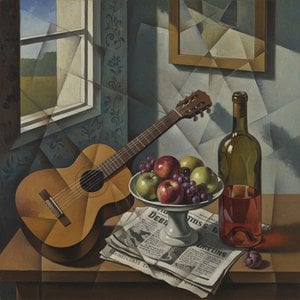
Still Life: The Table
 Acrylic On Canvas
- WallArt
- Cubism
 1928
1928 117.0 x 167.0 cm
 Lire la suite
Giclées et impressions d'art
Impressions giclées ou sur toile de qualité musée, avec une production rapide et des finitions au choix. ( Passer à la peinture faite à la main Passer à l'image)




P118B $10

P118H $10

P118W $10

P438Z $10

P508JH $12

P508YH $12

P805H $10

P805Z $10

P919BZ $10

P919G $10

P919XJ $10

P959ZH $10

P968JZ $12

W106C $8

W218G $10

W218JH $8

W218Y $10

W307PJ $10

W316G $10

W316PJ $8

W316Y $10

W398PJ $8

W4111J $10

W500HY $15

W500JH $15

W692G $12

W849H $8

W940BG $15

W953PJ $8




Choisissez parmi nos formats prédéfinis qui respectent les proportions originales de l’œuvre.

Vous pouvez saisir vos propres dimensions pour vous adapter à un cadre ou à un espace spécifique. Si la taille sélectionnée ne correspond pas aux proportions de l'image originale, nous recadrerons l'œuvre ou étendrons l'image avec une bordure en miroir ou une couleur unie. Une maquette numérique vous sera envoyée pour approbation avant le début de la production.
Veuillez noter que l'aperçu à l'écran ne reflète pas le recadrage ou l'extension réelle. Seule la maquette montrera avec précision la composition finale.
Bien que des tailles personnalisées soient disponibles, nous vous recommandons de choisir une dimension dans la liste prédéfinie afin de préserver les proportions originales.
Livraison dans le monde entier () en 2 semaines au lieu des 4/5 semaines habituelles. (9 août)

Livraison express gratuite dans le monde entier

Toile de lin de qualité supérieure

Assurance transport complète

Garantie de remboursement des droits de douane

Garantie de fidélité des couleurs

Politique de retour de 60 jours (uniquement en cas de défaut)

Garantie de remboursement à 100%

Offre de tarifs dégressifs
 L'option verre n'est disponible que pour les dimensions inférieures à 110 cm.

Still Life: The Table
Giclées et impressions d'art
Format de la reproduction
-


Prix total
$ 62
Description de la pièce
The Genesis of a Still Life
Georges Braque’s “Still Life: The Table,” painted in 1928, isn't merely a depiction of objects; it’s an invitation into a carefully constructed world of fragmented perception and deliberate ambiguity. Born in Argenteuil, France, in 1882, Braque’s artistic journey was deeply rooted in the practicalities of his family’s trade – house painting and decoration – which instilled within him a profound understanding of materials and form. This foundation, combined with rigorous academic training at the École des Beaux-Arts, provided him with an unusual blend of technical skill and a nascent desire to deconstruct traditional artistic conventions. “Still Life: The Table” embodies this spirit perfectly, representing a pivotal moment in Braque’s exploration of Cubism and his fascination with how we perceive reality.
The painting emerged during a period of intense experimentation within the Parisian art scene – a time when artists were actively dismantling established notions of space, perspective, and representation. Influenced by Paul Cézanne's emphasis on geometric forms and multiple viewpoints, Braque began to explore ways to capture the essence of an object not through a single, fixed image, but through a series of intersecting planes and angles. This approach, central to Cubism, sought to convey the totality of an object’s appearance – its various facets and perspectives – simultaneously on a two-dimensional surface.
A Symphony of Muted Tones and Geometric Forms
The painting's visual impact is immediately striking due to its carefully orchestrated palette. Braque employs a restrained range of muted fawn browns, creams, whites, greens, grays, and blacks – colors that evoke a sense of quiet contemplation and understated elegance. These tones are not applied with broad strokes but rather in precisely delineated areas, creating the illusion of flat planes stacked upon one another. This technique, characteristic of Cubism, contributes to the painting’s fragmented appearance, as if the objects themselves have been broken down into their constituent parts and reassembled in a new, unconventional arrangement.
The forms within the still life are equally intriguing. The musical instrument – likely a lute – sits alongside tableware, fruit, and various domestic items, all rendered with simplified geometric shapes. Outlines are sharply defined, creating a sense of artificiality and emphasizing the constructed nature of the composition. Notice how Braque doesn’t attempt to realistically portray these objects; instead, he presents them as abstracted elements within a larger, more conceptual framework. The use of black outlines further reinforces this effect, lending a slightly two-dimensional quality to the scene.
Symbolism and Emotional Resonance
Beyond its formal qualities, “Still Life: The Table” is rich in symbolic potential. The arrangement itself – a collection of seemingly random objects gathered on a tabletop – can be interpreted as a meditation on domesticity, leisure, and the fleeting nature of time. The presence of musical instruments suggests themes of creativity, harmony, and perhaps even melancholy. The scattered fruit hints at abundance and decay, while the rolled-up sheet music evokes memories and forgotten melodies.
Furthermore, the painting’s rough surface – scratched and uneven – adds to its emotional resonance. It feels as though the canvas itself is bearing witness to a process of creation, revealing the artist's hand and the imperfections inherent in any artistic endeavor. This tactile quality invites us to engage with the work on a deeper level, sensing the energy and intention that went into its making. The signed and dated inscription – “G Braque 28” – serves as a quiet testament to this moment in time, anchoring the painting within its historical context.
A Legacy of Innovation
“Still Life: The Table” stands as a quintessential example of Braque’s pioneering work in Cubism. It exemplifies his ability to transform familiar objects into enigmatic symbols and to challenge traditional notions of representation. The painting's influence extends far beyond the confines of the 1920s, continuing to inspire artists and designers today. Reproductions of this captivating artwork offer a unique opportunity to experience Braque’s innovative vision firsthand, bringing a touch of fragmented reality into any space.
Œuvres similaires


Biographie de l'artiste
**Jeunesse et formation**
Georges Braque, peintre français renommé, collagiste, dessinateur, graveur et sculpteur, est né le 13 mai 1882 à Argenteuil, dans les Val-d'Oise. Il a grandi à Le Havre et a initialement été formé pour devenir peigneur et décorateur comme son père et son grand-père. Cependant, les inclinations artistiques de Braque l’ont conduit à étudier la peinture à l’École des Beaux-Arts de Le Havre de 1897 à 1899.**Évolution artistique et fauvisme**
En 1902, après avoir terminé son apprentissage auprès d'un décorateur à Paris, Braque a fréquenté l’Académie Humbert jusqu’en 1904. Cette période a marqué son introduction au fauvisme, un style caractérisé par des couleurs vives et des réponses émotionnelles. Influencé par les œuvres de Henri Matisse et André Derain, Braque a adopté une approche fauviste, comme en témoigne son tableau La Patience (fauvisme, huile sur toile).**Contribution au cubisme**
La collaboration de Braque avec Pablo Picasso de 1908 à 1912 a conduit au développement du cubisme. Leurs œuvres cubistes analytiques, telles que Georges Braque: La Patience et Pablo Picasso: Le Clarinette(cubisme analytique, huile sur toile), sont aujourd’hui considérées comme des jalons de l'histoire de l'art.**Héritage et œuvres notables**
* Maisons à l’Estaque : Témoignage de l'utilisation innovante de la géométrie et de la perspective simultanée par Braque. * La Patience(fauvisme, huile sur toile) : démontre le style fauve de Braque. * Le Clarinette(cubisme analytique, huile sur toile) : œuvre cubiste collaborative avec Picasso.**Musées et collections**
* Musée d'Orsay : présente une vaste collection d'art impressionniste et post-impressionniste, incluant des œuvres de Braque. * Musée de l'Orangerie : expose une large gamme d'œuvres d'art, incluant celles de Braque et d'autres artistes notables.- Découvrez-en davantage sur la vie et l’œuvre de Georges Braque sur ArtsDot.com
- Explorez la collection du Musée d'Orsay, présentant des œuvres de Braque et d'autres artistes, sur Musée d'Orsay - Wikipédia
- Apprenez-en davantage sur le fauvisme et son influence sur le développement du cubisme avec le mouvement artistique fauviste sur ArtsDot.com

Georges Braque
1882 - 1963 , France
L'essentiel de l'artiste
- Artistes Influents:
- Henri Matisse
- André Derain
- Paul Cézanne
- Date De Décès: 1963
- Date De Naissance: 13 mai 1882
- Influence Sur Les Artistes: ['Pablo Picasso']
- Lieu De Naissance: Argenteuil, France
- Mouvement Artistique: Cubisme, Fauvisme
- Nationalité: Française
- Nom Complet: Georges Braque
- Oeuvres Notables:
- Maisons à L'Estaque
- La Patience
- Le Clarinette
- Nature morte avec cruets
Articles connexes

Georges Braque : Les 25 Œuvres Maîtresses du Cubisme et de la Modernité | ArtsDot
Plongez dans l'univers de Georges Braque avec les 25 œuvres incontournables du cubisme. Découvrez l'histoire, les techniques et l'impact de ce maître de l'art moderne. Reproductions d'art exceptionnelles sur ArtsDot.com.
Deconstructing Reality: A Comprehensive Exploration of Cubist Still Life
Explore the revolutionary world of Cubist Still Life with ArtsDot. Discover Picasso & Braque's groundbreaking techniques, its philosophical roots, and lasting impact on modern art. Expert insights for collectors.

Immortaliser l'Intime : La Nature Morte Personnalisée, Reflet de Votre Passion et Élégance
Créez une nature morte personnalisée unique pour votre restaurant avec ArtsDot ! Artistes experts, qualité supérieure et processus sur mesure. Immortalisez votre passion culinaire. Commande facile & garantie satisfaction.

The Bountiful Still Life: Symbolism & Artistic Representation of Fruit Across Art History
Explore the rich history of still life painting & the symbolism of fruit across art movements. Discover masterpieces from Caravaggio to Cézanne with ArtsDot – expert guidance & museum-quality reproductions.

Les 10 Chefs-d'œuvre Cubistes Révolutionnaires : Art, Décor & Histoire
Plongez au cœur du cubisme avec les 10 œuvres révolutionnaires de Picasso, Braque et Gris. Découvrez l'histoire, les techniques et l'impact de ce mouvement artistique majeur. Reproductions d'art de qualité musée sur ArtsDot.com !



