


 Aperçu en situation
 Partager
 Partager
 Détails
 Guide imprimable

 Télécharger
 Articles similaires
 Radiographie
 Voir le diaporama
 Statistiques
Le Studio (VI)


 Afficher la suite
L’œuvre d'art présentée sur cette page est protégée par le droit d'auteur, ce qui signifie que nous ne pouvons légalement créer ou vendre de reproduction identique. Cette protection est appliquée en vertu d'accords internationaux tels que la Convention de Berne et par les lois nationales, notamment celles énoncées par le Loi américaine sur le droit d'auteur - Titre 17.
Cette méthode est pleinement conforme aux réglementations sur le droit d'auteur car elle ne repose pas sur la copie ou la duplication de l'œuvre protégée. Il s'agit plutôt d'une réinterprétation créative — une nouvelle peinture qui s'inspire de l'original sans pour autant lui être identique.
Giclées et impressions d'art
Impressions giclées ou sur toile de qualité musée, avec une production rapide et des finitions au choix. ( Acheter la peinture faite à la main Passer au format image numérique)




P118B €10

P118H €10

P118W €10

P438Z €10

P508JH €12

P508YH €12

P805H €10

P805Z €10

P919BZ €10

P919G €10

P919XJ €10

P959ZH €10

P968JZ €12

W106C €8

W218G €10

W218JH €8

W218Y €10

W307PJ €10

W316G €10

W316PJ €8

W316Y €10

W398PJ €8

W4111J €10

W500HY €15

W500JH €15

W692G €12

W849H €8

W940BG €15

W953PJ €8




Choisissez parmi nos formats prédéfinis qui respectent les proportions originales de l’œuvre.

Type the width and the height you need, to fit your frame or your wall. A print can only be cut, never made bigger than the picture, so a size with a different shape loses a part of the image. We send you a digital mockup to approve before we print anything. The picture shown on this page does not show the real cut — only the mockup does.
Livraison dans le monde entier () en 2 semaines au lieu des 4/5 semaines habituelles. (15 octobre)

Livraison express gratuite dans le monde entier

Toile de lin de haute qualité

Assurance transport complète

Garantie de remboursement des droits de douane

Garantie de fidélité des couleurs

Garantie de retour de 100 jours (uniquement en cas de défaut)

Garantie de remboursement à 100%

Tarifs dégressifs sur quantité
 L'option verre n'est disponible que pour les dimensions inférieures à 110 cm.

Le Studio (VI)
Giclées et impressions d'art
Format de la reproduction
-


Prix total final
€ 54
Georges Braque: The Architect of Cubism
Georges Braque (1882–1963) stands as a monumental figure in the history of modern art, inextricably linked to Pablo Picasso and the genesis of Cubism. More than just an artist, he was a meticulous craftsman who relentlessly interrogated artistic conventions—a quest that yielded groundbreaking results and cemented his legacy as one of the most influential painters of the 20th century.
- Early Life & Artistic Foundations: Born in Argenteuil, France, Braque’s upbringing instilled within him a profound appreciation for form and structure—a sensibility honed by his father's profession as a house painter. This practical grounding combined with formal training at the École des Beaux-Arts in Le Havre provided him with an unparalleled understanding of materials and techniques.
- The Fauvist Breakthrough: Braque’s artistic journey commenced with Impressionism, but he was profoundly moved by Henri Matisse's Fauvist paintings. Embracing bold colors—a deliberate rejection of academic tradition—he collaborated closely with artists like Raoul Dufy and Othon Friesz to explore expressive possibilities within this vibrant movement.
- The Birth of Cubism: The encounter between Braque and Picasso in 1907 marked a pivotal moment, propelling them into the forefront of Cubist experimentation. Influenced by Cézanne’s geometric simplification and inspired by African sculpture and Iberian art, they dismantled traditional perspective, presenting objects from multiple viewpoints simultaneously—a revolutionary approach that challenged viewers' perceptions.
- Analytical Cubism: Braque’s Analytical Cubism (1908–1912) is characterized by monochromatic color palettes and fractured forms meticulously rendered to convey spatial illusion. Paintings like “Houses at L’Estaque” exemplify this technique, demonstrating Braque's unwavering dedication to dissecting visual reality.
- Synthetic Cubism: Moving towards Synthetic Cubism (1912–1914), Braque incorporated collage elements—fragments of newspaper and fabric—into his canvases. This innovative method further expanded the boundaries of artistic expression, reflecting a broader cultural fascination with new materials and processes.
“The Studio” (VI): A Reflection of Artistic Process
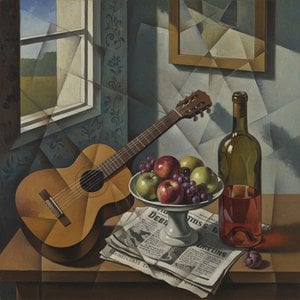
Georges Braque’s “The Studio” (VI), completed in 1951, embodies the culmination of his artistic evolution—a masterful distillation of Cubist principles tempered by a contemplative sensibility. This still life captures a moment of quiet observation within an artist's workspace, inviting viewers to contemplate the complexities of creative endeavor.
The painting’s monochrome palette—primarily ochre and brown—creates a subdued atmosphere that underscores Braque’s fascination with Cézanne’s exploration of form and structure. The fragmented depiction of objects—a chair, vases, bottles, and a cup—mirrors the Cubist technique of presenting multiple viewpoints simultaneously.
Notably, Braque incorporated handwritten script into the composition—a deliberate gesture that symbolizes the act of artistic creation itself. These lines disrupt the geometric precision of Cubism, adding textural richness and hinting at an underlying intellectual engagement with Cézanne’s legacy. The overall effect is one of serene contemplation—a testament to Braque's enduring belief in the transformative power of art.
Symbolic Significance & Emotional Impact
“The Studio” transcends mere visual representation; it speaks to the core values of Braque’s artistic philosophy. The inclusion of objects associated with an artist’s profession—the chair, the instruments—suggests a preoccupation with craftsmanship and intellectual rigor. Simultaneously, the muted color scheme evokes feelings of tranquility and introspection.
Braque's masterful handling of light and shadow contributes to the painting’s emotional resonance, capturing the subtle nuances of an artist’s environment. The composition encourages viewers to engage in a dialogue with the artwork—to contemplate its formal qualities alongside its symbolic implications.
Questions et réponses
Existe-t-il des œuvres similaires à « Le Studio (VI) » ?
Les œuvres similaires à «Le Studio (VI)» de Georges Braque sont regroupées sur la page Œuvres similaires de l'œuvre.
Que représente «Le Studio (VI)» de Georges Braque ?
Les sujets de « Le Studio (VI) » sont still life, geometric shapes, abstraction, studio composition, black and white, bird motif, minimal palette.
Quelle est la teinte dominante de «Le Studio (VI)» de Georges Braque ?
Une nuance De l'ocre au sépia traverse «Le Studio (VI)» de Georges Braque.
Œuvres similaires


Biographie de l'artiste
**Jeunesse et formation**
Georges Braque, peintre français renommé, collagiste, dessinateur, graveur et sculpteur, est né le 13 mai 1882 à Argenteuil, dans les Val-d'Oise. Il a grandi à Le Havre et a initialement été formé pour devenir peigneur et décorateur comme son père et son grand-père. Cependant, les inclinations artistiques de Braque l’ont conduit à étudier la peinture à l’École des Beaux-Arts de Le Havre de 1897 à 1899.**Évolution artistique et fauvisme**
En 1902, après avoir terminé son apprentissage auprès d'un décorateur à Paris, Braque a fréquenté l’Académie Humbert jusqu’en 1904. Cette période a marqué son introduction au fauvisme, un style caractérisé par des couleurs vives et des réponses émotionnelles. Influencé par les œuvres de Henri Matisse et André Derain, Braque a adopté une approche fauviste, comme en témoigne son tableau La Patience (fauvisme, huile sur toile).**Contribution au cubisme**
La collaboration de Braque avec Pablo Picasso de 1908 à 1912 a conduit au développement du cubisme. Leurs œuvres cubistes analytiques, telles que Georges Braque: La Patience et Pablo Picasso: Le Clarinette(cubisme analytique, huile sur toile), sont aujourd’hui considérées comme des jalons de l'histoire de l'art.**Héritage et œuvres notables**
* Maisons à l’Estaque : Témoignage de l'utilisation innovante de la géométrie et de la perspective simultanée par Braque. * La Patience(fauvisme, huile sur toile) : démontre le style fauve de Braque. * Le Clarinette(cubisme analytique, huile sur toile) : œuvre cubiste collaborative avec Picasso.**Musées et collections**
* Musée d'Orsay : présente une vaste collection d'art impressionniste et post-impressionniste, incluant des œuvres de Braque. * Musée de l'Orangerie : expose une large gamme d'œuvres d'art, incluant celles de Braque et d'autres artistes notables.- Découvrez-en davantage sur la vie et l’œuvre de Georges Braque sur ArtsDot.com
- Explorez la collection du Musée d'Orsay, présentant des œuvres de Braque et d'autres artistes, sur Musée d'Orsay - Wikipédia
- Apprenez-en davantage sur le fauvisme et son influence sur le développement du cubisme avec le mouvement artistique fauviste sur ArtsDot.com

Georges Braque
1882 - 1963 , France
En bref
- Artistes Influents:
- Henri Matisse
- André Derain
- Paul Cézanne
- Date De Décès: 1963
- Date De Naissance: 13 mai 1882
- Influence Sur Les Artistes: ['Pablo Picasso']
- Lieu De Naissance: Argenteuil, France
- Mouvement Artistique: Cubisme, Fauvisme
- Nationalité: Française
- Nom Complet: Georges Braque
- Oeuvres Notables:
- Maisons à L'Estaque
- La Patience
- Le Clarinette
- Nature morte avec cruets
Articles similaires
Deconstructing Reality: A Comprehensive Exploration of Cubist Still Life
Explore the revolutionary world of Cubist Still Life with ArtsDot. Discover Picasso & Braque's groundbreaking techniques, its philosophical roots, and lasting impact on modern art. Expert insights for collectors.

Georges Seurat : Les 25 Œuvres Maîtresses du Pointillisme | ArtsDot
Plongez dans l'univers lumineux de Georges Seurat ! Découvrez les 25 œuvres majeures du pointillisme, de 'Un dimanche après-midi à l'Île de la Grande Jatte' aux 'Poseuses'. Reproductions d'art exceptionnelles et inspiration déco sur ArtsDot.com.

Georges Braque : De la Fauvisme à l'Essence du Cubisme – Une Révolution Formelle dans l'Art Moderne
Explorez l'évolution artistique de Georges Braque, du Fauvisme à la révolution cubiste. Analyse approfondie des techniques, influences et héritage durable de ce maître de l'art moderne. Un guide pour collectionneurs avertis.

Georges Braque : Les 25 Œuvres Maîtresses du Cubisme et de la Modernité | ArtsDot
Plongez dans l'univers de Georges Braque avec les 25 œuvres incontournables du cubisme. Découvrez l'histoire, les techniques et l'impact de ce maître de l'art moderne. Reproductions d'art exceptionnelles sur ArtsDot.com.

Abstraction Géométrique : Les 10 Chefs-d'œuvre qui ont Marqué l'Histoire de l'Art
Plongez au cœur de l'abstraction géométrique avec ArtsDot.com ! Découvrez les 10 œuvres majeures de Mondrian, Malevitch et Kandinsky qui ont révolutionné l'art moderne. Inspirez votre décoration intérieure avec des reproductions de tableaux exceptionnelles. Explorez la collection en ligne !


