


 Aperçu en situation
 Partager
 Partager
 Détails
 Guide imprimable

 Télécharger
 Articles similaires
 Radiographie
 Voir le diaporama
 Statistiques
Le Fruitdish


 Afficher la suite
L’œuvre d'art présentée sur cette page est protégée par le droit d'auteur, ce qui signifie que nous ne pouvons légalement créer ou vendre de reproduction identique. Cette protection est appliquée en vertu d'accords internationaux tels que la Convention de Berne et par les lois nationales, notamment celles énoncées par le Loi américaine sur le droit d'auteur - Titre 17.
En tant qu'alternative respectueuse et légale, nous proposons des œuvres d'art personnalisées, peintes à la main et inspirées de l'original. Nos artistes talentueux et professionnels étudient avec soin le style, l'ambiance et l'essence artistique de l'œuvre originale pour créer une pièce nouvelle et unique qui évoque la même émotion — tout en restant une création originale en soi.
Cette méthode est pleinement conforme aux réglementations sur le droit d'auteur car elle ne repose pas sur la copie ou la duplication de l'œuvre protégée. Il s'agit plutôt d'une réinterprétation créative — une nouvelle peinture qui s'inspire de l'original sans pour autant lui être identique.
Reproduction à l'huile faite à la main
Huile sur toile peinte à la main, avec cadre et dimensions personnalisés, réalisée sur commande par nos artistes. ( Passer au format impression Passer au format image numérique)




P118B €10

P118H €10

P118W €10

P438Z €10

P508JH €12

P508YH €12

P805H €10

P805Z €10

P919BZ €10

P919G €10

P919XJ €10

P959ZH €10

P968JZ €12

W106C €8

W218G €10

W218JH €8

W218Y €10

W307PJ €10

W316G €10

W316PJ €8

W316Y €10

W398PJ €8

W4111J €10

W500HY €15

W500JH €15

W692G €12

W849H €8

W940BG €15

W953PJ €8




Choisissez parmi nos formats prédéfinis qui respectent les proportions originales de l’œuvre.

Saisissez la largeur et la hauteur souhaitées, pour s'adapter à votre cadre ou à votre mur. Cette œuvre est peinte à la main ; ainsi, pour un format de forme différente, l'artiste peut peindre un peu plus autour du tableau ou réduire légèrement les bords — c'est vous qui choisissez. Nous vous envoyons une maquette numérique pour approbation avant que la peinture ne commence. L'image présentée sur cette page ne reflète pas le résultat réel — seule la maquette le fait.
Après la commande, l’équipe ArtsDot.com contactera le client par e-mail pour recueillir ses instructions et lui fournira une maquette d’aperçu
Livraison dans le monde entier () en 3 à 4 semaines au lieu des 5 semaines habituelles. (23 octobre). Aucun compromis sur la qualité.

Livraison express gratuite dans le monde entier

Toile de lin de haute qualité

Assurance transport complète

Garantie de remboursement des droits de douane

Garantie de fidélité des couleurs

Garantie de retour de 100 jours (uniquement en cas de défaut)

Garantie de remboursement à 100%

Tarifs dégressifs sur quantité
 L'option verre n'est disponible que pour les dimensions inférieures à 110 cm.

Le Fruitdish
Technique de reproduction
Format de la reproduction
-


Prix total final
€ 231
Georges Braque: Pioneering Cubism & The Fruitdish’s Quiet Revolution
Georges Braque (1882-1963) stands as one of the titans of modern art, inextricably linked to Pablo Picasso in the genesis of Cubism—a movement that irrevocably altered the trajectory of Western painting. Born in Argenteuil, France, his formative years instilled within him a profound appreciation for craftsmanship alongside an innate artistic sensibility honed by formal training at the École des Beaux-Arts in Le Havre. This dual foundation proved crucial as he dismantled traditional representational conventions, embracing geometric abstraction and challenging viewers to reconsider their perception of reality. Moving to Paris in 1902, Braque immersed himself in the vibrant artistic milieu of the city, fostering collaborations that would propel him to international acclaim.- Early Life & Artistic Foundations: Braque’s upbringing within a family of house painters nurtured not only technical mastery but also an early understanding of form and structure—skills he would later translate into groundbreaking visual explorations.
- The École des Beaux-Arts & Marie Laurencin: His studies at Le Havre provided him with the academic grounding necessary to confront established artistic dogma, while his association with Marie Laurencin fostered a shared commitment to innovative aesthetic experimentation.
- Parisian Influences & Francis Picabia: Braque’s Parisian life exposed him to influential contemporaries like Francis Picabia, whose explorations of Surrealism would complement Braque's Cubist endeavors.
The Birth of Cubism – A Dialogue with Picasso
Braque’s artistic journey intersected decisively with Picasso’s in 1907, sparking a collaborative effort that birthed the revolutionary aesthetic known as Cubism. Influenced by Cézanne's radical simplification of form and perspective—particularly his masterful depiction of Mont Sainte-Victoire—Braque embarked on a quest to capture multiple viewpoints simultaneously within a single image. This ambition manifested in works like “Houses at L’Estaque,” where Braque fragmented architectural structures into interlocking planes, mirroring Cézanne’s approach to representing space. The resulting paintings defied conventional illusionism, prioritizing geometric abstraction and challenging viewers to engage with the artwork on an intellectual level.- Cézanne's Influence: Braque recognized Cézanne’s profound impact on his artistic vision, adopting techniques that mirrored Cézanne’s simplification of form and perspective.
- Collaborative Exploration: The partnership with Picasso fueled a dynamic exchange of ideas, resulting in paintings that were indistinguishable for years—a testament to their shared commitment to pushing the boundaries of artistic expression.
- Analyzing Space & Form: Braque meticulously scrutinized Cézanne’s methods for representing space and form, incorporating these insights into his own Cubist compositions.
“The Fruitdish” – A Study in Texture & Illusion
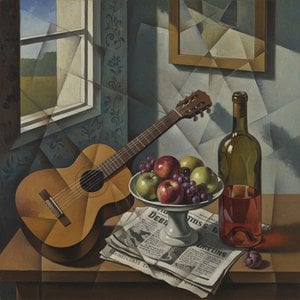
“The FruitDish,” created in 1912, exemplifies Braque's masterful manipulation of texture and illusionistic representation—a hallmark of Synthetic Cubism. This still life oil painting on canvas is more than just a depiction of fruit; it’s an intellectual exercise in challenging viewers’ perceptions of reality. Inspired by the discovery of mass-produced faux bois wallpaper purchased in Avignon, Braque employed *papier collé* – a technique pioneered by Picasso—to integrate fragments of printed paper into his charcoal drawings. The wallpaper's geometric patterns and wood grain texture served as a deliberate counterpoint to the fragmented forms of Cubism, prompting contemplation about how artists represent space and materiality.- The Role of Papier Collé: Braque’s use of papier collé—a technique championed by Picasso—represents a pivotal moment in Cubist art history.
- Texture & Illusionistic Representation: The interplay between charcoal lines and the textured surface of faux bois wallpaper underscores Braque's commitment to exploring both visual elements simultaneously.
- Symbolic Significance: The inclusion of geometric forms alongside naturalistic depictions—such as the grapes—suggests a broader exploration of artistic conventions and their ability to convey meaning beyond mere appearance.
Legacy & Impact – Beyond Fragmentation
Georges Braque’s contribution to Cubism transcends mere stylistic innovation; it represents a fundamental rethinking of how artists engage with the visual world. By prioritizing geometric abstraction alongside illusionistic representation—a strategy mirrored in “The FruitDish”—Braque ushered in an era of artistic experimentation that continues to inspire contemporary artists. His work stands as a beacon of modernist thought, demonstrating the transformative potential of challenging established norms and embracing new perspectives on form, space, and perception. Reproductions of "The Fruitdish" offer viewers a chance to experience Braque’s groundbreaking vision firsthand—a testament to his enduring influence on the history of art.Questions et réponses
Quelle origine nationale sous-tend le Synthetic Cubism de « Le Fruitdish » ?
«Le Fruitdish» a été créé par Georges Braque, né en France, au sein du mouvement Synthetic Cubism. L'origine de l'artiste lie l'œuvre au Synthetic Cubism tel que pratiqué par les artistes de France.
Quels sujets apparaissent dans «Le Fruitdish» de Georges Braque ?
Les thèmes présents dans «Le Fruitdish» de Georges Braque incluent fruit dish, cubism style, collage technique, geometric forms, multiple perspectives, texture illusion, avant garde art. Ensemble, ils résument le sujet de l'œuvre.
À quel artiste est attribuée l'œuvre "Le Fruitdish" ?
« Le Fruitdish » est attribué à Georges Braque.
Œuvres similaires


Biographie de l'artiste
**Jeunesse et formation**
Georges Braque, peintre français renommé, collagiste, dessinateur, graveur et sculpteur, est né le 13 mai 1882 à Argenteuil, dans les Val-d'Oise. Il a grandi à Le Havre et a initialement été formé pour devenir peigneur et décorateur comme son père et son grand-père. Cependant, les inclinations artistiques de Braque l’ont conduit à étudier la peinture à l’École des Beaux-Arts de Le Havre de 1897 à 1899.**Évolution artistique et fauvisme**
En 1902, après avoir terminé son apprentissage auprès d'un décorateur à Paris, Braque a fréquenté l’Académie Humbert jusqu’en 1904. Cette période a marqué son introduction au fauvisme, un style caractérisé par des couleurs vives et des réponses émotionnelles. Influencé par les œuvres de Henri Matisse et André Derain, Braque a adopté une approche fauviste, comme en témoigne son tableau La Patience (fauvisme, huile sur toile).**Contribution au cubisme**
La collaboration de Braque avec Pablo Picasso de 1908 à 1912 a conduit au développement du cubisme. Leurs œuvres cubistes analytiques, telles que Georges Braque: La Patience et Pablo Picasso: Le Clarinette(cubisme analytique, huile sur toile), sont aujourd’hui considérées comme des jalons de l'histoire de l'art.**Héritage et œuvres notables**
* Maisons à l’Estaque : Témoignage de l'utilisation innovante de la géométrie et de la perspective simultanée par Braque. * La Patience(fauvisme, huile sur toile) : démontre le style fauve de Braque. * Le Clarinette(cubisme analytique, huile sur toile) : œuvre cubiste collaborative avec Picasso.**Musées et collections**
* Musée d'Orsay : présente une vaste collection d'art impressionniste et post-impressionniste, incluant des œuvres de Braque. * Musée de l'Orangerie : expose une large gamme d'œuvres d'art, incluant celles de Braque et d'autres artistes notables.- Découvrez-en davantage sur la vie et l’œuvre de Georges Braque sur ArtsDot.com
- Explorez la collection du Musée d'Orsay, présentant des œuvres de Braque et d'autres artistes, sur Musée d'Orsay - Wikipédia
- Apprenez-en davantage sur le fauvisme et son influence sur le développement du cubisme avec le mouvement artistique fauviste sur ArtsDot.com

Georges Braque
1882 - 1963 , France
En bref
- Artistes Influents:
- Henri Matisse
- André Derain
- Paul Cézanne
- Date De Décès: 1963
- Date De Naissance: 13 mai 1882
- Influence Sur Les Artistes: ['Pablo Picasso']
- Lieu De Naissance: Argenteuil, France
- Mouvement Artistique: Cubisme, Fauvisme
- Nationalité: Française
- Nom Complet: Georges Braque
- Oeuvres Notables:
- Maisons à L'Estaque
- La Patience
- Le Clarinette
- Nature morte avec cruets
Articles connexes

Déconstruction de la réalité : L'impact révolutionnaire du cubisme sur l'art du XXe siècle
Explorez l'impact révolutionnaire du cubisme sur l'art moderne. Découvrez Picasso, Braque et les maîtres de ce mouvement clé. Guide pour collectionneurs éclairés.

Georges Seurat : Les 25 Œuvres Maîtresses du Pointillisme | ArtsDot
Plongez dans l'univers lumineux de Georges Seurat ! Découvrez les 25 œuvres majeures du pointillisme, de 'Un dimanche après-midi à l'Île de la Grande Jatte' aux 'Poseuses'. Reproductions d'art exceptionnelles et inspiration déco sur ArtsDot.com.

Georges Braque : De la Fauvisme à l'Essence du Cubisme – Une Révolution Formelle dans l'Art Moderne
Explorez l'évolution artistique de Georges Braque, du Fauvisme à la révolution cubiste. Analyse approfondie des techniques, influences et héritage durable de ce maître de l'art moderne. Un guide pour collectionneurs avertis.
Deconstructing Reality: A Comprehensive Exploration of Cubist Still Life
Explore the revolutionary world of Cubist Still Life with ArtsDot. Discover Picasso & Braque's groundbreaking techniques, its philosophical roots, and lasting impact on modern art. Expert insights for collectors.

Georges Braque : Les 25 Œuvres Maîtresses du Cubisme et de la Modernité | ArtsDot
Plongez dans l'univers de Georges Braque avec les 25 œuvres incontournables du cubisme. Découvrez l'histoire, les techniques et l'impact de ce maître de l'art moderne. Reproductions d'art exceptionnelles sur ArtsDot.com.


