


 Aperçu en situation
 Envoyer
 Partager
 Détails de l'œuvre

 Télécharger
 Articles similaires
 Radiographie
 Diaporama
Pear Compotoir


 Lire la suite
Giclées et impressions d'art
Impressions giclées ou sur toile de qualité musée, avec une production rapide et des finitions au choix. ( Commander la reproduction peinte à la main Acheter l'image haute résolution)




P118B $10

P118H $10

P118W $10

P438Z $10

P508JH $12

P508YH $12

P805H $10

P805Z $10

P919BZ $10

P919G $10

P919XJ $10

P959ZH $10

P968JZ $12

W106C $8

W218G $10

W218JH $8

W218Y $10

W307PJ $10

W316G $10

W316PJ $8

W316Y $10

W398PJ $8

W4111J $10

W500HY $15

W500JH $15

W692G $12

W849H $8

W940BG $15

W953PJ $8




Choisissez parmi nos formats prédéfinis qui respectent les proportions originales de l’œuvre.

Vous pouvez saisir vos propres dimensions pour vous adapter à un cadre ou à un espace spécifique. Si la taille sélectionnée ne correspond pas aux proportions de l'image originale, nous recadrerons l'œuvre ou étendrons l'image avec une bordure en miroir ou une couleur unie. Une maquette numérique vous sera envoyée pour approbation avant le début de la production.
Veuillez noter que l'aperçu à l'écran ne reflète pas le recadrage ou l'extension réelle. Seule la maquette montrera avec précision la composition finale.
Bien que des tailles personnalisées soient disponibles, nous vous recommandons de choisir une dimension dans la liste prédéfinie afin de préserver les proportions originales.
Livraison dans le monde entier () en 2 semaines au lieu des 4/5 semaines habituelles. (1 septembre)

Livraison express gratuite dans le monde entier

Toile de lin de qualité supérieure

Assurance transport complète

Garantie de remboursement des droits de douane

Garantie de fidélité des couleurs

Politique de retour de 60 jours (uniquement en cas de défaut)

Garantie de remboursement à 100%

Offre de tarifs dégressifs
 L'option verre n'est disponible que pour les dimensions inférieures à 110 cm.

Pear Compotoir
Giclées et impressions d'art
Format de la reproduction
-


Prix total
$ 62
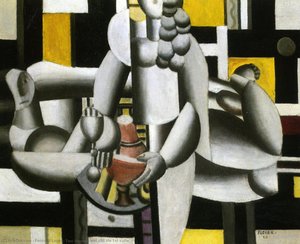
A Symphony of Form and Color: The Mechanical Soul of Pear Compotoir
In the vibrant landscape of early twentieth-century modernism, few works capture the rhythmic pulse of a changing world as evocatively as Fernand Léger’s “Pear Compotoerb,” painted in 1923. This is not merely a still life of fruit resting upon a table; it is an audacious declaration of Cubist principles applied to the most mundane of subjects. Created during a period of intense artistic experimentation following the devastation of World War I, the painting embodies a burgeoning fascination with industrialization and its profound influence on human perception. While the Impressionists sought to capture the fleeting, ethereal qualities of light and atmosphere, Léger deliberately confronts the viewer with something far more grounded and structural. He presents a world where the organic and the mechanical begin to merge, inviting us to see the beauty in the geometric and the strength in the simplified form.
To gaze upon this masterpiece is to witness the Cubist breakthrough in its most energetic state. Léger rejects traditional illusionistic techniques that strive for photographic accuracy, opting instead to dissect reality into interlocking planes. The pear itself is rendered not as a soft, yielding object, but as a series of overlapping geometric shapes—a visual puzzle that challenges our ingrained understanding of space. This technique was deeply personal to Léger; it reflected his belief that art should engage with the underlying structure of reality, mirroring the repetitive patterns and angular contours found in the factories and urban landscapes of the burgeoning machine age. By presenting objects from multiple viewpoints simultaneously, he breaks the stagnant Renaissance perspective, creating a sense of movement and depth that feels both modern and revolutionary.
The Vibrancy of the Machine Age Aesthetic
Beyond its structural complexity, “Pear Compotoir” possesses an emotional resonance driven by a strikingly vibrant color palette. Dominated by bold reds, sunny yellows, and lush greens, the hues are far from arbitrary. Léger utilized color strategically to convey energy and dynamism; the reds evoke the heat and intense movement of industrial furnaces, while the contrasting tones create a visual tension that keeps the eye dancing across the canvas. This use of primary and secondary colors serves to celebrate the strength and unapologetic beauty of modern life. For the collector or interior designer, this painting offers more than just a historical window; it provides a powerful focal point capable of injecting vitality into any contemporary space.
The composition—featuring a carefully arranged collection of a bowl of fruit, a cup, a spoon, and a bottle—functions as a study in Tubism, a style pioneered by Léger himself. Characterized by cylindrical, robust forms, this approach finds profound aesthetic truth in the sleek curves and structural integrity of objects. There is a certain poetic weight to the way the chair is positioned in front of the table, grounding the abstract elements within a recognizable domestic setting. This balance between the abstract and the tangible makes the work incredibly accessible, allowing it to resonate with viewers who seek art that is both intellectually stimulating and visually captivating. Owning a high-quality reproduction of this work means bringing a piece of the industrial revolution's heart into one's home—a celebration of progress, form, and the enduring power of the human gaze.
Œuvres similaires




Biographie de l'artiste
jeune vie et formation
fernand léger, peintre, sculpteur et cinéaste français, est né le 4 février 1881 à Argentan, Orne, en Normandie inférieure. Son père élevait du bétail, et léger a initialement été formé à l'architecture de 1897 à 1899. Il s’est ensuite installé à Paris en 1900, se débrouillant comme dessinateur architectural.développement artistique
Le travail précoce de léger a été influencé par l'impressionnisme, comme le montrent le jardin de ma mère (mon jardin) (1905). Après avoir fréquenté l'école des beaux-arts et l’académie Julian, il a commencé à travailler sérieusement comme peintre à 25 ans. Son style s'est développé en une forme personnelle de cubisme, que les critiques ont qualifié de "tubisme" pour son accent sur les formes cylindriques.cubisme et le groupe des Puteaux
En 1910, léger a exposé au Salon d’automne aux côtés de jean metzinger et henri le fauconnier. Il a rejoint le groupe des Puteaux, également connu sous le nom de section d’or (la section dorée), avec d'autres artistes tels que francis picabia et marcel duchamp.guerre et son influence sur le travail de léger
Les expériences de léger à la Première Guerre mondiale ont eu un impact significatif sur son œuvre. Pendant son séjour au front, il a produit des croquis d'artillerie, d'avions et de soldats. Sa peinture soldier avec un tuyau (1916) reflète cette période.œuvre ultérieure et héritage
L'œuvre post-guerre de léger, caractérisée par des formes machine-like élégantes, le lia à la tradition de la peinture figurative française. Ses paysages animés de 1921 ont présenté des figures et des animaux dans des formes harmonieuses et rationalisées.- voir les œuvres de fernand léger sur ArtsDot
- en savoir plus sur fernand léger sur wikipedia
- découvrez le musée national fernand léger (france) avec ArtsDot
- la femme assise (100 x 81 cm, tubisme)
- élément de machine (cubisme)

Fernand Léger
1881 - 1955 , France
L'essentiel de l'artiste
- Artistes Influents:
- Cézanne
- Impressionnisme
- Date De Décès: 1955
- Date De Naissance: 4 février 1881
- Influences Artistiques: ['Pop Art']
- Lieu De Naissance: Argentan, France
- Mouvement Artistique: Cubisme, Tubisme
- Nationalité: Française
- Nom Complet: Fernand Léger
- Oeuvres Notables:
- La Grande Parade
- Machine Élément
- Femme assise
- Paysages animés
Articles connexes

Fernand Léger : Les 25 Œuvres Maîtresses d'un Pionnier du Modernisme | ArtsDot
Plongez dans l'univers vibrant de Fernand Léger ! Découvrez les 25 œuvres majeures du cubisme et du tubisme, explorant formes géométriques et couleurs audacieuses. Retrouvez des reproductions d'art exceptionnelles sur ArtsDot.com.

Abstraction Géométrique : Les 10 Chefs-d'œuvre qui ont Marqué l'Histoire de l'Art
Plongez au cœur de l'abstraction géométrique avec ArtsDot.com ! Découvrez les 10 œuvres majeures de Mondrian, Malevitch et Kandinsky qui ont révolutionné l'art moderne. Inspirez votre décoration intérieure avec des reproductions de tableaux exceptionnelles. Explorez la collection en ligne !

Kandinsky : Les 25 Œuvres Maîtresses d'un Pionnier de l'Art Abstrait | ArtsDot
Plongez dans l'univers vibrant de Kandinsky ! Découvrez les 25 œuvres majeures du pionnier de l'art abstrait. Explorez son expressionnisme, ses couleurs audacieuses et l'histoire fascinante derrière chaque tableau. Reproductions d'exception sur ArtsDot.com.

Paul Cézanne : Les 25 Œuvres Maîtresses d'un Génie Révolutionnaire | ArtsDot
Plongez dans l'univers de Paul Cézanne avec les 25 œuvres incontournables du maître post-impressionniste. Découvrez l'histoire, la technique et l'émotion derrière ses tableaux iconiques comme 'Les Baigneuses' ou 'Mont Sainte-Victoire'. Reproductions d'art haute qualité sur ArtsDot.com.

Beyond Form & Color: Geometric Abstraction's Evolution in 20th/21st Century Art
Explore the evolution of geometric abstraction from Cubism to contemporary art. Discover key artists like Malevich & Mondrian, investment insights, and expert collecting advice at ArtsDot.



