


 Aperçu en situation
 Envoyer
 Partager
 Détails de l'œuvre

 Télécharger
 Articles similaires
 Radiographie
 Diaporama
Pear Compotoir


 Lire la suite
Acquérez une image numérique haute résolution et optimisée, d'une qualité bien supérieure à l'aperçu en ligne.
Chaque fichier est méticuleusement préparé par nos spécialistes internes à l'aide d'outils avancés et d'une retouche manuelle experte. Nous garantissons que chaque image possède une clarté exceptionnelle, une précision des couleurs irréprochable et un niveau de détail fin.
Le fichier final est livré par e-mail sous 72 heures, optimisé pour une utilisation immédiate dans des contextes professionnels, éditoriaux et d'impression. Il offre la même qualité de confiance que celle utilisée par les plus grands studios de création, éditeurs et galeries.
Image numérique
Téléchargez un fichier haute résolution pour votre usage personnel, l'impression et vos projets créatifs. ( Commander l'impression Commander la reproduction peinte à la main)
Inclus avec chaque commande d'image numérique
Livraison numérique experte, garantie.
En choisissant ArtsDot.com, vous n'obtenez pas seulement une simple image : vous recevez une œuvre numérique sublimée avec professionnalisme, conçue avec précision et accompagnée d'une garantie de satisfaction. Voici tout ce qui accompagne automatiquement votre commande :

Envoi rapide par e-mail
Votre fichier d'image numérique haute résolution vous sera envoyé par e-mail sous 72 heures après votre commande — prêt à un usage immédiat.

Fichier numérique optimisé par l'IA
Votre œuvre d'art bénéficie d'une optimisation professionnelle grâce à des outils d'IA avancés et une retouche manuelle, garantissant un niveau maximal de détail, de clarté et de fidélité chromatique.

Réexpédition gratuite à vie
Vous avez accidentellement supprimé ou perdu votre fichier ? Pas d'inquiétude — nous vous le renverrons gratuitement, quand vous le souhaitez.

Aucuns frais de douane — À jamais
Profitez de votre œuvre d'art instantanément sans frais de douane ni de livraison — les téléchargements numériques sont toujours exonérés de taxes.

Garantie de fidélité des couleurs
Nous garantissons que votre image numérique reproduit les couleurs de l'original aussi fidèlement que possible grâce à des outils professionnels et une gestion rigoureuse des couleurs.

Garantie satisfaction 60 jours
Si vous n'êtes pas satisfait de votre image numérique, nous la retoucherons ou vous rembourserons 100% sous 60 jours — sans poser de questions.

Garantie de remboursement à 100%
Pas satisfait ? Obtenez un remboursement intégral dans les 60 jours suivant la réception de votre fichier numérique — sans aucune question posée.

Réductions sur les commandes groupées
Achetez 3 images, économisez 10% - Achetez 5, économisez 15% - Achetez 10+, économisez 20%. Idéal pour les projets créatifs, les galeries et les agences.
A Symphony of Form and Color: The Mechanical Soul of Pear Compotoir
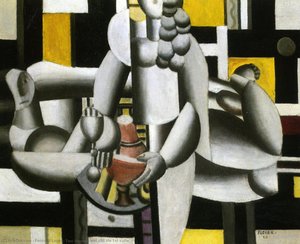
In the vibrant landscape of early twentieth-century modernism, few works capture the rhythmic pulse of a changing world as evocatively as Fernand Léger’s “Pear Compotoerb,” painted in 1923. This is not merely a still life of fruit resting upon a table; it is an audacious declaration of Cubist principles applied to the most mundane of subjects. Created during a period of intense artistic experimentation following the devastation of World War I, the painting embodies a burgeoning fascination with industrialization and its profound influence on human perception. While the Impressionists sought to capture the fleeting, ethereal qualities of light and atmosphere, Léger deliberately confronts the viewer with something far more grounded and structural. He presents a world where the organic and the mechanical begin to merge, inviting us to see the beauty in the geometric and the strength in the simplified form.
To gaze upon this masterpiece is to witness the Cubist breakthrough in its most energetic state. Léger rejects traditional illusionistic techniques that strive for photographic accuracy, opting instead to dissect reality into interlocking planes. The pear itself is rendered not as a soft, yielding object, but as a series of overlapping geometric shapes—a visual puzzle that challenges our ingrained understanding of space. This technique was deeply personal to Léger; it reflected his belief that art should engage with the underlying structure of reality, mirroring the repetitive patterns and angular contours found in the factories and urban landscapes of the burgeoning machine age. By presenting objects from multiple viewpoints simultaneously, he breaks the stagnant Renaissance perspective, creating a sense of movement and depth that feels both modern and revolutionary.
The Vibrancy of the Machine Age Aesthetic
Beyond its structural complexity, “Pear Compotoir” possesses an emotional resonance driven by a strikingly vibrant color palette. Dominated by bold reds, sunny yellows, and lush greens, the hues are far from arbitrary. Léger utilized color strategically to convey energy and dynamism; the reds evoke the heat and intense movement of industrial furnaces, while the contrasting tones create a visual tension that keeps the eye dancing across the canvas. This use of primary and secondary colors serves to celebrate the strength and unapologetic beauty of modern life. For the collector or interior designer, this painting offers more than just a historical window; it provides a powerful focal point capable of injecting vitality into any contemporary space.
The composition—featuring a carefully arranged collection of a bowl of fruit, a cup, a spoon, and a bottle—functions as a study in Tubism, a style pioneered by Léger himself. Characterized by cylindrical, robust forms, this approach finds profound aesthetic truth in the sleek curves and structural integrity of objects. There is a certain poetic weight to the way the chair is positioned in front of the table, grounding the abstract elements within a recognizable domestic setting. This balance between the abstract and the tangible makes the work incredibly accessible, allowing it to resonate with viewers who seek art that is both intellectually stimulating and visually captivating. Owning a high-quality reproduction of this work means bringing a piece of the industrial revolution's heart into one's home—a celebration of progress, form, and the enduring power of the human gaze.
Œuvres similaires




Biographie de l'artiste
jeune vie et formation
fernand léger, peintre, sculpteur et cinéaste français, est né le 4 février 1881 à Argentan, Orne, en Normandie inférieure. Son père élevait du bétail, et léger a initialement été formé à l'architecture de 1897 à 1899. Il s’est ensuite installé à Paris en 1900, se débrouillant comme dessinateur architectural.développement artistique
Le travail précoce de léger a été influencé par l'impressionnisme, comme le montrent le jardin de ma mère (mon jardin) (1905). Après avoir fréquenté l'école des beaux-arts et l’académie Julian, il a commencé à travailler sérieusement comme peintre à 25 ans. Son style s'est développé en une forme personnelle de cubisme, que les critiques ont qualifié de "tubisme" pour son accent sur les formes cylindriques.cubisme et le groupe des Puteaux
En 1910, léger a exposé au Salon d’automne aux côtés de jean metzinger et henri le fauconnier. Il a rejoint le groupe des Puteaux, également connu sous le nom de section d’or (la section dorée), avec d'autres artistes tels que francis picabia et marcel duchamp.guerre et son influence sur le travail de léger
Les expériences de léger à la Première Guerre mondiale ont eu un impact significatif sur son œuvre. Pendant son séjour au front, il a produit des croquis d'artillerie, d'avions et de soldats. Sa peinture soldier avec un tuyau (1916) reflète cette période.œuvre ultérieure et héritage
L'œuvre post-guerre de léger, caractérisée par des formes machine-like élégantes, le lia à la tradition de la peinture figurative française. Ses paysages animés de 1921 ont présenté des figures et des animaux dans des formes harmonieuses et rationalisées.- voir les œuvres de fernand léger sur ArtsDot
- en savoir plus sur fernand léger sur wikipedia
- découvrez le musée national fernand léger (france) avec ArtsDot
- la femme assise (100 x 81 cm, tubisme)
- élément de machine (cubisme)

Fernand Léger
1881 - 1955 , France
En bref
- Artistes Influents:
- Cézanne
- Impressionnisme
- Date De Décès: 1955
- Date De Naissance: 4 février 1881
- Influences Artistiques: ['Pop Art']
- Lieu De Naissance: Argentan, France
- Mouvement Artistique: Cubisme, Tubisme
- Nationalité: Française
- Nom Complet: Fernand Léger
- Oeuvres Notables:
- La Grande Parade
- Machine Élément
- Femme assise
- Paysages animés

