


 Commander l'impression Acheter l'image haute résolution
 Partager
 Partager
 Détails de l'œuvre
 Ajouter aux favoris

 Télécharger
 Articles similaires
 Radiographie
 Diaporama
Green Tree


 Afficher la suite
Reproduction à l'huile faite à la main
Huile sur toile peinte à la main, avec cadre et dimensions personnalisés, réalisée sur commande par nos artistes.




P118B $10

P118H $10

P118W $10

P438Z $10

P508JH $12

P508YH $12

P805H $10

P805Z $10

P919BZ $10

P919G $10

P919XJ $10

P959ZH $10

P968JZ $12

W106C $8

W218G $10

W218JH $8

W218Y $10

W307PJ $10

W316G $10

W316PJ $8

W316Y $10

W398PJ $8

W4111J $10

W500HY $15

W500JH $15

W692G $12

W849H $8

W940BG $15

W953PJ $8




Choisissez parmi nos formats prédéfinis qui respectent les proportions originales de l’œuvre.

Vous pouvez saisir vos propres dimensions pour l'adapter à un cadre ou à un espace spécifique. Si la taille sélectionnée ne correspond pas aux proportions de l'image d'origine, nous recadrerons l'œuvre ou prolongerons la peinture avec des éléments peints à la main supplémentaires. Une maquette numérique vous sera envoyée pour approbation avant le début de la production.
Veuillez noter que l'aperçu à l'écran ne reflète pas le recadrage ou l'extension réels. Seule la maquette montrera fidèlement la composition finale.
Bien que des tailles personnalisées soient disponibles, nous vous recommandons de sélectionner une dimension dans la liste prédéfinie afin de préserver les proportions d'origine.
Après la commande, l’équipe ArtsDot.com contactera le client par e-mail pour obtenir ses instructions et lui fournira une maquette d’aperçu.
Livraison dans le monde entier () en 3 à 4 semaines au lieu des 5 semaines habituelles. (18 juillet). Aucune concession sur la qualité.

Livraison express gratuite dans le monde entier

Toile de lin de haute qualité

Assurance transport complète

Garantie de remboursement des frais de douane

Garantie de fidélité des couleurs

Politique de retour de 60 jours (uniquement en cas de défaut)

Garantie de remboursement à 100%

Réduction sur les achats groupés
 L'option verre n'est disponible que pour les dimensions inférieures à 110 cm.

Green Tree
Technique de reproduction
Format de reproduction
-


Prix total final
-
Description de l'œuvre
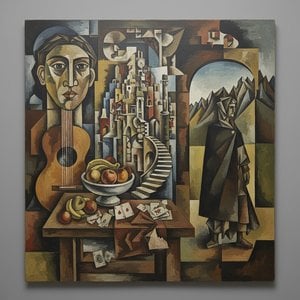
A Surreal Portrait of Industrial Age Anxieties: "Green Tree" by Fernand Léger
Fernand Léger’s “Green Tree,” painted in 1944, is more than just a depiction of a tree; it's a potent visual distillation of the anxieties and fascinations that defined the early 20th century. This seemingly simple image – a vibrant green tree with a deliberately anthropomorphic face, bathed in the glow of a yellow sun – unfolds as a complex meditation on modernity’s impact on humanity and the natural world. Léger, a key figure in the Cubist movement, was deeply concerned with representing the burgeoning industrial landscape, and “Green Tree” embodies this preoccupation with striking clarity.
- Subject Matter: The central subject is undeniably a tree, yet it’s transformed into an almost mournful portrait. The addition of a human-like face imbues the tree with a sense of awareness, perhaps even sorrow, suggesting a displacement or alienation within the rapidly changing world.
- Symbolism: The yellow sun, often associated with optimism and enlightenment, here feels somewhat melancholic, casting a warm but ultimately isolating light on the tree’s visage. Scattered objects – a clock, handbag, scissors – are not merely decorative; they represent the detritus of modern life, hinting at a loss of connection to nature and traditional values.
- Composition: Léger's signature geometric style is evident in the fractured forms of the tree and the surrounding elements. This deliberate fragmentation reflects the breakdown of traditional perspectives and the unsettling feeling of disorientation that accompanied industrialization.
Léger’s Cubist Vision and the Machine Age
Created during a period of immense social and technological upheaval, “Green Tree” is firmly rooted in Léger's artistic philosophy. He rejected purely abstract art, believing it detached from reality. Instead, he sought to capture the essence of modern life – the dynamism of machines, the angularity of urban landscapes, and the impact on human form – through a style he termed "Tubism," later evolving into “Concrete Art.” This approach involved breaking down objects into their fundamental geometric shapes, reassembling them in new configurations, and emphasizing the mechanical aspects of the world. Léger was profoundly influenced by the rise of industrialization and its effect on the human psyche, reflecting this concern through his art.
- Technique: Léger employed a bold, almost brutalist technique characterized by thick impasto – layers of paint applied with considerable force – creating a textured surface that emphasizes the physicality of form. The use of primary colors – green, yellow, and touches of brown – contributes to the painting’s raw energy and emotional intensity.
- Historical Context: Painted in 1944, during World War II, “Green Tree” carries an added layer of significance. The anxieties surrounding conflict, technological advancement, and the potential for destruction are subtly embedded within the artwork's unsettling imagery.
Emotional Resonance and Artistic Legacy
"Green Tree" is not a comfortable image; it’s deliberately provocative and emotionally charged. Léger wasn’t interested in creating pretty pictures; he wanted to confront viewers with the realities of modern life, prompting reflection on humanity's relationship with technology and nature. The painting’s enduring appeal lies in its ability to tap into universal anxieties about change, displacement, and the loss of innocence. Léger’s influence extends far beyond Cubism, shaping the course of 20th-century art and inspiring generations of artists to explore the possibilities of abstraction while remaining connected to the observable world.
Artist: Fernand Léger Date: 1944 Movement: Cubism, Concrete ArtŒuvres apparentées


Biographie de l'artiste
jeune vie et formation
fernand léger, peintre, sculpteur et cinéaste français, est né le 4 février 1881 à Argentan, Orne, en Normandie inférieure. Son père élevait du bétail, et léger a initialement été formé à l'architecture de 1897 à 1899. Il s’est ensuite installé à Paris en 1900, se débrouillant comme dessinateur architectural.développement artistique
Le travail précoce de léger a été influencé par l'impressionnisme, comme le montrent le jardin de ma mère (mon jardin) (1905). Après avoir fréquenté l'école des beaux-arts et l’académie Julian, il a commencé à travailler sérieusement comme peintre à 25 ans. Son style s'est développé en une forme personnelle de cubisme, que les critiques ont qualifié de "tubisme" pour son accent sur les formes cylindriques.cubisme et le groupe des Puteaux
En 1910, léger a exposé au Salon d’automne aux côtés de jean metzinger et henri le fauconnier. Il a rejoint le groupe des Puteaux, également connu sous le nom de section d’or (la section dorée), avec d'autres artistes tels que francis picabia et marcel duchamp.guerre et son influence sur le travail de léger
Les expériences de léger à la Première Guerre mondiale ont eu un impact significatif sur son œuvre. Pendant son séjour au front, il a produit des croquis d'artillerie, d'avions et de soldats. Sa peinture soldier avec un tuyau (1916) reflète cette période.œuvre ultérieure et héritage
L'œuvre post-guerre de léger, caractérisée par des formes machine-like élégantes, le lia à la tradition de la peinture figurative française. Ses paysages animés de 1921 ont présenté des figures et des animaux dans des formes harmonieuses et rationalisées.- voir les œuvres de fernand léger sur ArtsDot
- en savoir plus sur fernand léger sur wikipedia
- découvrez le musée national fernand léger (france) avec ArtsDot
- la femme assise (100 x 81 cm, tubisme)
- élément de machine (cubisme)

Fernand Léger
1881 - 1955 , France
En bref
- Artistes Influents:
- Cézanne
- Impressionnisme
- Date De Décès: 1955
- Date De Naissance: 4 février 1881
- Influences Artistiques: ['Pop Art']
- Lieu De Naissance: Argentan, France
- Mouvement Artistique: Cubisme, Tubisme
- Nationalité: Française
- Nom Complet: Fernand Léger
- Oeuvres Notables:
- La Grande Parade
- Machine Élément
- Femme assise
- Paysages animés
Articles connexes

Top 10 des Peintures Célèbres Dominées par le Vert Olive Sombre | Art & Décor
Plongez dans le monde fascinant des 10 plus célèbres peintures dominées par le vert olive sombre. Découvrez Monet, Van Gogh et Cézanne… Retrouvez l'histoire de ces chefs-d'œuvre et trouvez votre reproduction d'art idéale sur !

Joan Miró : Les 25 Œuvres Maîtresses d'un Artiste Catalan Visionnaire | ArtsDot
Plongez dans l'univers vibrant de Joan Miró ! Découvrez les 25 œuvres majeures du maître catalan, explorant le surréalisme et ses formes abstraites. Reproductions de qualité muséale & inspiration déco sur ArtsDot.com.

Cubisme : Les 10 Chefs-d'œuvre Révolutionnaires à Redécouvrir |
Plongez au cœur du cubisme avec ! Découvrez les 10 chefs-d'œuvre de Picasso, Braque et autres artistes révolutionnaires. Reproductions d'art haute qualité pour une décoration intérieure unique. Explorez la collection sur
Cubisme : 10 Chefs-d'œuvre Révolutionnaires à Redécouvrir | ArtsDot
Plongez au cœur du cubisme avec ArtsDot ! Découvrez 10 chefs-d'œuvre révolutionnaires de Picasso, Braque et autres artistes majeurs. Explorez l'histoire, les techniques et les couleurs vibrantes de ce mouvement artistique unique. Retrouvez ces œuvres en reproduction sur ArtsDot.com.

Les 10 Chefs-d'œuvre du Portrait Cubiste : Artistes & Décor Intérieur
Plongez au cœur du cubisme avec les 10 portraits emblématiques de Picasso, Braque et Gris. Découvrez l'histoire, la technique & l'impact de ces chefs-d'œuvre. Reproductions d'art de qualité musée sur ArtsDot.com !



