


L'image s'adapte à vos choix : , .
Description de la pièce
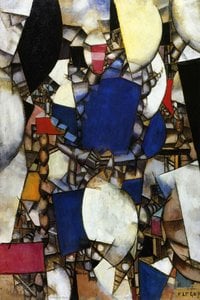
Fernand Léger's "Le Passage à niveau" captivates with Cubist abstraction and vibrant colors—a pioneering work reflecting modern urban life & the influence of Orphism. Explore Leger’s legacy!
 Lire la suite
Biographie de l'artiste
Explorez l'art de Fernand Léger (1881-1955), un pionnier du Cubisme et du 'Tubisme'. Découvrez ses peintures audacieuses et figuratives célébrant la vie moderne, les machines et la forme humaine. Un précurseur du Pop Art !
Reproduction à l'huile faite à la main
Huile sur toile peinte à la main, avec cadre et dimensions personnalisés, réalisée sur commande par nos artistes. ( Passer au format impression Passer au format numérique)
En savoir plus sur cette peinture
 Aperçu en situation
 Envoyer
 Partager
 Détails de l'œuvre
 Guide
Guide

 Télécharger l'image
 Articles similaires
 Radiographie
 Diaporama
 Questions et réponses
 Statistiques
Commandez votre tableau en quatre étapes simples
Prenez votre temps. Vous pouvez modifier chaque réponse ; le prix dans votre panier s'ajustera selon vos choix.
1 Première étape sur quatre
Quel format souhaitez-vous ?
Ces formats respectent les proportions de l'œuvre originale. Le dessin illustre votre choix sur un mur, au-dessus d'un canapé de deux mètres.
Ou indiquez vos propres dimensions
Choisissez parmi nos formats prédéfinis qui respectent les proportions originales de l’œuvre.

Saisissez la largeur et la hauteur souhaitées, pour s'adapter à votre cadre ou à votre mur. Cette œuvre est peinte à la main ; ainsi, pour un format de forme différente, l'artiste peut peindre un peu plus autour du tableau ou réduire légèrement les bords — c'est vous qui choisissez. Nous vous envoyons une maquette numérique pour approbation avant que la peinture ne commence. L'image présentée sur cette page ne reflète pas le résultat réel — seule la maquette le fait.
2 Deuxième étape sur quatre
Comment doit-il être préparé : roulé, tendu ou encadré ?
Les prix ci-dessous correspondent au format choisi à l'étape précédente.
Choisissez le type de bordure pour votre toile tendue
Choisissez votre cadre

Bords blancs €1

Bords estompés €1

Bords imprimés €1

P118B €10

P118H €10

P118W €10

P438Z €10

P508JH €12

P508YH €12

P805H €10

P805Z €10

P919BZ €10

P919G €10

P919XJ €10

P959ZH €10

P968JZ €12

W106C €8

W218G €10

W218JH €8

W218Y €10

W307PJ €10

W316G €10

W316PJ €8

W316Y €10

W398PJ €8

W4111J €10

W500HY €15

W500JH €15

W692G €12

W849H €8

W940BG €15

W953PJ €8

H24-GOLD €30

H24-SILVER €30

H36-GOLD €45

H36-SILVER €45
Sous cadre
Baguette : . Dimensions hors tout avec le cadre : .
3 Troisième étape sur quatre
Souhaitez-vous apporter des modifications à la peinture ?
La plupart des gens répondent non. Comme chaque peinture est réalisée à la main, notre artiste peut également l'adapter pour vous.
Après la commande, l'équipe de ArtsDot.com contactera le client par e-mail pour obtenir ses instructions et lui fournir un aperçu de la maquette
4 Quatrième étape sur quatre
Quelques options de finition
Tous sont facultatifs. Les réponses déjà sélectionnées ne comportent aucun coût supplémentaire.
Qui l'a peint ?
Livraison dans le monde entier () en 3 à 4 semaines au lieu des 5 semaines habituelles. (8 novembre). Aucun compromis sur la qualité.
Une plaque nominative, comme au musée ?
Détails de la plaque en bronze gravée
This elegant plaque features the artist's name and the title of the artwork, finely engraved for a timeless presentation.
It is made from bronze with a refined, elegant finish. The text is precisely laser-engraved for a sharp and permanent result. Measuring 9x2 cm, the plaque is compact yet easy to read. It's built to be durable and scratch-resistant, offering a professional, museum-quality look. Mounting is simple thanks to the included adhesive backing.
Détails de la plaque en acrylique transparent
The plaque includes essential engraved details such as the artist's name, the title of the artwork, the date it was created, the type of media used-like oil on canvas or watercolor-a brief description of the piece, and a QR code that links to the complete artwork information.
It is crafted from clear acrylic, offering a sleek, modern appearance. The text is UV-engraved in black to ensure strong visual contrast. With a size of 10x15 cm, it ensures optimal readability. It comes equipped with two metal hooks for secure wall mounting. The plaque is designed to be weather-resistant, making it suitable for various environments, and it includes interactive features that work seamlessly with smartphone scanning.
Détails de la plaque en acrylique noir
This elegant plaque includes engraved information such as the artist's name, the title of the artwork, the date it was created, the type of media used (like oil on canvas or watercolor), a short description of the artwork, and a QR code for quick access to more information.
The plaque itself is made from refined black acrylic with a premium finish. The text is laser-engraved in white for high contrast and readability. Its size is 10x15 cm, designed to be easy to read. It comes with two metal hooks for professional mounting. The design is sleek and fits any interior style. It is also weather-resistant and durable, with built-in digital integration for mobile compatibility.
Un vernis protecteur ?
Pour quand en avez-vous besoin ?
✓ Vérifier et commander
Votre tableau, tel que vous l'avez commandé

Le Passage à niveau
Technique de reproduction
Format de la reproduction
-

Artiste de prestige
Plus de détails, de finesse et un temps de production accru
-

Cadre de reproduction
-
-
Pour les œuvres ou reproductions dont un côté mesure plus de 105 cm (environ 41 pouces), le cadre sera expédié sous forme de kit démonté. Cette méthode garantit une livraison sécurisée et prévient tout dommage pendant le transport.
Assemblage professionnel requis - ce produit n'est pas destiné au bricolage (DIY).
Le kit doit être assemblé et la toile tendue par un encadreur professionnel expérimenté, en utilisant de la colle à bois (non fournie), une pince à tendre la toile et des serre-joints pour maintenir les traverses d'équerre pendant le séchage de la colle. Un assemblage incorrect ou une tension inégale de la toile peut endommager l'œuvre de manière irréversible et n'est pas couvert par notre garantie.
 Pour les œuvres ou reproductions dont un côté mesure plus de 105 cm (environ 41 pouces), le cadre sera expédié sous forme de kit démonté. Cette méthode garantit une livraison sécurisée et prévient tout dommage pendant le transport.
Toutes les baguettes en bois massif sont incluses, découpées avec précision à la taille requise.
À assembler avec les vis fournies, ainsi qu'avec de la colle à bois pour les assemblages d'angles (non fournie), à prévoir par votre encadreur.
L'utilisation d'outils professionnels est requise et non incluse : une pince à tendre la toile (tendeur) et des serre-joints pour maintenir les baguettes bien d'équerre pendant le séchage de la colle.
Important :
L'assemblage des angles nécessite de la colle à bois, les barres doivent être maintenues avec des serre-joints jusqu'au séchage complet de la colle, et le tendage de la toile sur le châssis assemblé nécessite une pince à tendre la toile. Aucun de ces éléments n'est inclus dans le kit. Veuillez consulter un encadreur professionnel expérimenté avant de commander ce format.

Cartel
-
-

Vernis de protection
Vernis brillant (intensifie les couleurs, protège de la lumière et de l'humidité)
-

Personnaliser mon œuvre
Exemples de personnalisation : remplacer le visage par une photo du client ; ajouter un animal de compagnie (par exemple, remplacer un chat par un chien) ; inclure un message caché en arrière-plan ; modifier le paysage ou les éléments d'arrière-plan.
-

Livraison urgente
Livraison dans le monde entier () en 3 à 4 semaines au lieu des 5 semaines habituelles. (8 novembre). Aucune concession sur la qualité.
-
Livraison express
Livraison dans le monde entier () sous 5 semaines. (15 novembre).
Inclus
Prix total
€ 235
L'option verre n'est disponible que pour les dimensions inférieures à 110 cm.
Inclus avec chaque commande
- Livraison express gratuite dans le monde entier
- Toile de lin de qualité supérieure
- Assurance transport complète
- Garantie de remboursement des droits de douane
- Garantie de fidélité des couleurs
- Politique de retour de 100 jours (uniquement en cas de défaut)
- Garantie de remboursement à 100%
- Offre de tarifs dégressifs


Le Passage à niveau
Fernand Léger’s “The Level Crossing,” created in 1912, stands as a cornerstone of Cubism and Orphism—movements that irrevocably altered the trajectory of twentieth-century art. More than just a depiction of a railway station scene, it embodies Leger's profound engagement with the burgeoning industrial age and his masterful manipulation of geometric abstraction to convey its dynamism and underlying tension. This painting isn’t merely observed; it’s felt—a visceral reaction to the rapid pace of change that defined the era. It captures not just what was seen but what was *experienced*, a testament to Léger's conviction that art should engage with the realities of modern life.Cubism: A Revolutionary Vision
Cubism, spearheaded by Pablo Picasso and Georges Braque, fundamentally challenged traditional artistic conventions. Rejecting illusionistic representation—the attempt to create an image that faithfully reproduces reality—Cubists fragmented objects into interlocking planes and multiple viewpoints simultaneously. This technique wasn’t simply about accuracy; it was about capturing the essence of an object's structure—its underlying geometry—rather than its surface appearance. Léger embraced this approach wholeheartedly, distilling complex scenes into simplified forms that prioritized visual impact over meticulous detail. The resulting images possess a striking immediacy and forcefulness, reflecting Leger’s conviction that art should engage with the realities of modern life. Consider Picasso's Les Demoiselles d'Avignon – it shattered preconceived notions about perspective and representation, paving the way for Léger’s groundbreaking style.Composition and Symbolism: Decoding the Visual Language
The painting’s composition is deliberately unsettling yet captivating. Léger arranges figures—a man standing on the platform, several individuals in the foreground—within a network of cylindrical forms reminiscent of pistons and machinery. These shapes dominate the canvas, conveying a sense of relentless movement and mechanical precision. Notably, a dog sits prominently near the center, acting as an anchor amidst the swirling abstraction. The inclusion of a chair suggests a waiting area, subtly hinting at themes of anticipation and transition. Léger’s use of bold colors—primarily reds, yellows, and blues—amplifies this emotional resonance. These hues aren't chosen arbitrarily; they mirror the fiery energy of industrial furnaces and convey a feeling of urgency. The stark contrast between warm and cool tones contributes to the painting’s dramatic effect.- Technique: Léger employed oil paint on canvas, utilizing a technique characterized by thick impasto—applying pigment thickly onto the surface—to create textural surfaces that heighten visual impact.
- Historical Context: Created during the height of the Industrial Revolution, “The Level Crossing” reflects anxieties about technological advancement and its influence on human experience. Léger sought to portray this era not as romanticized nostalgia but as a forceful confrontation with new realities.
Further Exploration: Léger's Influence on Pop Art
Fernand Léger’s pioneering approach to abstraction anticipated many developments in later art movements, notably Pop Art. Artists like Andy Warhol and Roy Lichtenstein drew inspiration from Léger’s simplification of forms and his use of bold colors—techniques that challenged the elitism of Abstract Expressionism and embraced the visual language of popular culture. Léger's work signaled a shift away from intellectual contemplation toward direct engagement with everyday life, a principle that resonated deeply with Pop Art artists who sought to capture the spirit of their time.Reproductions & Inspiration
A high-quality reproduction of “The Level Crossing” can bring Léger’s vision into your home—a striking testament to his mastery of geometric abstraction and his ability to convey the emotional intensity of the industrial age. Explore our collection of hand-painted reproductions at ArtsDot.com for a timeless piece of art that speaks volumes about modernity and artistic innovation.Questions et réponses
Quel format et quelle orientation sont recommandés pour l'impression de « Le Passage à niveau » ?
Format Grand format, orientation Format portrait : voici la configuration d'impression suggérée pour «Le Passage à niveau» de Fernand Léger.
Qui est l'auteur de "Le Passage à niveau" ?
« Le Passage à niveau » a été créé par Fernand Léger. Les informations présentes sur cette page décrivent l'œuvre originale de Fernand Léger.
Quel âge avait Fernand Léger lors de la création de « Le Passage à niveau » en 1912 ?
Fernand Léger avait 31 ans lors de la création de « Le Passage à niveau » en 1912. L'âge est calculé à partir de l'année de naissance de l'artiste, 1881.
Œuvres similaires




Fernand Léger
1881 - 1955, France
Biographie de l'artiste
jeune vie et formation
fernand léger, peintre, sculpteur et cinéaste français, est né le 4 février 1881 à Argentan, Orne, en Normandie inférieure. Son père élevait du bétail, et léger a initialement été formé à l'architecture de 1897 à 1899. Il s’est ensuite installé à Paris en 1900, se débrouillant comme dessinateur architectural.développement artistique
Le travail précoce de léger a été influencé par l'impressionnisme, comme le montrent le jardin de ma mère (mon jardin) (1905). Après avoir fréquenté l'école des beaux-arts et l’académie Julian, il a commencé à travailler sérieusement comme peintre à 25 ans. Son style s'est développé en une forme personnelle de cubisme, que les critiques ont qualifié de "tubisme" pour son accent sur les formes cylindriques.cubisme et le groupe des Puteaux
En 1910, léger a exposé au Salon d’automne aux côtés de jean metzinger et henri le fauconnier. Il a rejoint le groupe des Puteaux, également connu sous le nom de section d’or (la section dorée), avec d'autres artistes tels que francis picabia et marcel duchamp.guerre et son influence sur le travail de léger
Les expériences de léger à la Première Guerre mondiale ont eu un impact significatif sur son œuvre. Pendant son séjour au front, il a produit des croquis d'artillerie, d'avions et de soldats. Sa peinture soldier avec un tuyau (1916) reflète cette période.œuvre ultérieure et héritage
L'œuvre post-guerre de léger, caractérisée par des formes machine-like élégantes, le lia à la tradition de la peinture figurative française. Ses paysages animés de 1921 ont présenté des figures et des animaux dans des formes harmonieuses et rationalisées.- voir les œuvres de fernand léger sur ArtsDot
- en savoir plus sur fernand léger sur wikipedia
- découvrez le musée national fernand léger (france) avec ArtsDot
- la femme assise (100 x 81 cm, tubisme)
- élément de machine (cubisme)


Articles connexes

L'Art de la Machine : Les 25 Chefs-d'œuvre Incontournables de Fernand Léger
Explorez les 25 chefs-d'œuvre de Fernand Léger et l'énergie du Tubisme. Découvrez nos reproductions d'exception sur ArtsDot.com.

Déconstruction de la réalité : L'impact révolutionnaire du cubisme sur l'art du XXe siècle
Explorez l'impact révolutionnaire du cubisme sur l'art moderne. Découvrez Picasso, Braque et les maîtres de ce mouvement clé. Guide pour collectionneurs éclairés.

L'Âme Industrielle : 10 Chefs-d'œuvre Révélant la Beauté du Monde Moderne | ArtsDot
Plongez dans l'âme industrielle de 10 chefs-d'œuvre emblématiques ! Découvrez les histoires fascinantes de Van Gogh, Monet et d'autres artistes ayant capturé la beauté brute du monde moderne. Reproductions de qualité musée sur ArtsDot.com – Explorez la collection en ligne.