
- Accueil

- Impression sur toile
- Fernand Léger
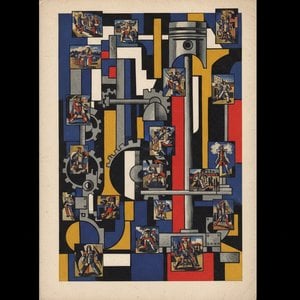
- Composition with the two parrots

 Commander la reproduction Acheter l'image haute résolution
 Partager
 Partager
 Détails de l'œuvre
 Ajouter aux favoris

 Télécharger
 Articles similaires
 Radiographie
 Diaporama
Composition with the two parrots


 Afficher la suite
Giclée / Impression d'art
Impression giclée ou sur toile de qualité musée, avec une production rapide et des finitions au choix.




P118B $10

P118H $10

P118W $10

P438Z $10

P508JH $12

P508YH $12

P805H $10

P805Z $10

P919BZ $10

P919G $10

P919XJ $10

P959ZH $10

P968JZ $12

W106C $8

W218G $10

W218JH $8

W218Y $10

W307PJ $10

W316G $10

W316PJ $8

W316Y $10

W398PJ $8

W4111J $10

W500HY $15

W500JH $15

W692G $12

W849H $8

W940BG $15

W953PJ $8




Choisissez parmi nos formats prédéfinis qui respectent les proportions originales de l’œuvre.

Vous pouvez saisir vos propres dimensions pour vous adapter à un cadre ou à un espace spécifique. Si la taille sélectionnée ne correspond pas aux proportions de l'image originale, nous recadrerons l'œuvre ou étendrons l'image avec une bordure en miroir ou une couleur unie. Une maquette numérique vous sera envoyée pour approbation avant le début de la production.
Veuillez noter que l'aperçu à l'écran ne reflète pas le recadrage ou l'extension réelle. Seule la maquette montrera avec précision la composition finale.
Bien que des tailles personnalisées soient disponibles, nous vous recommandons de choisir une dimension dans la liste prédéfinie afin de préserver les proportions originales.
Livraison dans le monde entier () en 2 semaines au lieu des 4/5 semaines habituelles. (18 juillet)

Livraison express gratuite dans le monde entier

Toile de lin de haute qualité

Assurance transport complète

Garantie de remboursement des frais de douane

Garantie de fidélité des couleurs

Politique de retour de 60 jours (uniquement en cas de défaut)

Garantie de remboursement à 100%

Réduction sur les achats groupés
 L'option verre n'est disponible que pour les dimensions inférieures à 110 cm.

Composition with the two parrots
Giclée / Impression d'art
Format de reproduction
-


Prix total final
-
Description de l'œuvre
A Symphony of Form and Color: Exploring Fernand Léger’s “Composition with the Two Parrots”
Fernand Léger's "Composition with the Two Parrots," painted in 1939, stands as a remarkable testament to the burgeoning influence of Cubism and Surrealism on European art during its tumultuous period. More than just a depiction of birds—though their presence is undeniably striking—the painting embodies Léger’s unwavering commitment to translating the dynamism of industrial life into an aesthetically innovative visual language. It's a piece that invites contemplation, prompting viewers to consider not only what they see but also how Léger achieved his arresting effect.The Geometric Landscape: Style and Technique
Léger’s distinctive style is immediately recognizable through its embrace of geometric abstraction. Departing from traditional representational methods, he dismantled objects into fragmented planes—a technique heavily indebted to Picasso and Braque—creating a fractured perspective that simultaneously captures spatial depth and disrupts conventional visual harmony. The painting utilizes bold, angular lines and simplified shapes – predominantly rectangles and trapezoids – to construct the landscape and figures within it. Color is employed sparingly but purposefully; Léger favors muted hues of ochre, brown, and gray, punctuated by splashes of vibrant reds and yellows that draw attention to key elements like the birds themselves. This deliberate restriction of color contributes to a sense of austerity and reinforces the painting’s connection to the industrial environment.Echoes of Cubism and Surrealist Influences
“Composition with the Two Parrots” firmly resides within the broader context of artistic experimentation during the 1930s. Léger's exploration of geometric abstraction aligns seamlessly with the core tenets of Cubism, pioneered by Picasso and Braque, which sought to portray subjects from multiple viewpoints simultaneously. However, unlike pure Cubist works focused solely on analytical dissection, Léger’s approach incorporates elements suggestive of Surrealism—particularly in the dreamlike juxtaposition of figures and animals—creating a visual experience that transcends mere observation. The positioning of the human figures, stacked atop each other, hints at an underlying tension or imbalance, mirroring the anxieties prevalent during the eve of World War II.Symbolic Resonance: Birds as Embodiments of Freedom
The inclusion of two parrots is laden with symbolic significance. Traditionally associated with intelligence and communication—attributes valued in Léger’s era—the birds represent a yearning for liberation from constraints and an affirmation of vitality amidst the mechanized world. Their vibrant plumage serves as a counterpoint to the muted tones of the landscape, emphasizing their presence and highlighting their role as emblems of optimism. The horse on the right side adds another layer of complexity, symbolizing strength and nobility – qualities that Léger wished to convey alongside the dynamism of modern life.Emotional Impact: Capturing the Spirit of an Age
Ultimately, “Composition with the Two Parrots” succeeds in conveying a profound emotional resonance. It’s not merely a visually stimulating artwork; it's a reflection of Léger’s intellectual engagement with the transformative forces reshaping Europe at the time. The painting captures the spirit of an age grappling with technological advancement and societal upheaval—a mood conveyed through its austere palette, fragmented forms, and carefully considered composition. Reproductions offer viewers a chance to experience this artistic vision firsthand, bringing Léger's groundbreaking style into their homes and inspiring appreciation for his enduring contribution to modern art history.


Biographie de l'artiste
jeune vie et formation
fernand léger, peintre, sculpteur et cinéaste français, est né le 4 février 1881 à Argentan, Orne, en Normandie inférieure. Son père élevait du bétail, et léger a initialement été formé à l'architecture de 1897 à 1899. Il s’est ensuite installé à Paris en 1900, se débrouillant comme dessinateur architectural.développement artistique
Le travail précoce de léger a été influencé par l'impressionnisme, comme le montrent le jardin de ma mère (mon jardin) (1905). Après avoir fréquenté l'école des beaux-arts et l’académie Julian, il a commencé à travailler sérieusement comme peintre à 25 ans. Son style s'est développé en une forme personnelle de cubisme, que les critiques ont qualifié de "tubisme" pour son accent sur les formes cylindriques.cubisme et le groupe des Puteaux
En 1910, léger a exposé au Salon d’automne aux côtés de jean metzinger et henri le fauconnier. Il a rejoint le groupe des Puteaux, également connu sous le nom de section d’or (la section dorée), avec d'autres artistes tels que francis picabia et marcel duchamp.guerre et son influence sur le travail de léger
Les expériences de léger à la Première Guerre mondiale ont eu un impact significatif sur son œuvre. Pendant son séjour au front, il a produit des croquis d'artillerie, d'avions et de soldats. Sa peinture soldier avec un tuyau (1916) reflète cette période.œuvre ultérieure et héritage
L'œuvre post-guerre de léger, caractérisée par des formes machine-like élégantes, le lia à la tradition de la peinture figurative française. Ses paysages animés de 1921 ont présenté des figures et des animaux dans des formes harmonieuses et rationalisées.- voir les œuvres de fernand léger sur ArtsDot
- en savoir plus sur fernand léger sur wikipedia
- découvrez le musée national fernand léger (france) avec ArtsDot
- la femme assise (100 x 81 cm, tubisme)
- élément de machine (cubisme)

Fernand Léger
1881 - 1955 , France
En bref
- Artistes Influents:
- Cézanne
- Impressionnisme
- Date De Décès: 1955
- Date De Naissance: 4 février 1881
- Influences Artistiques: ['Pop Art']
- Lieu De Naissance: Argentan, France
- Mouvement Artistique: Cubisme, Tubisme
- Nationalité: Française
- Nom Complet: Fernand Léger
- Oeuvres Notables:
- La Grande Parade
- Machine Élément
- Femme assise
- Paysages animés
Articles connexes

L'Âge d'Or Néerlandais : 10 Chefs-d'œuvre Incontournables pour Décorer avec Art et Histoire
Plongez au cœur de l'Âge d'Or néerlandais ! Découvrez 10 chefs-d'œuvre intemporels de Rembrandt, Vermeer et autres maîtres hollandais. Explorez leur histoire, technique & trouvez l'inspiration déco sur

Rijksmuseum : Les 25 Chefs-d'Œuvre Incontournables pour Embellir Votre Intérieur
Plongez au cœur du Rijksmuseum avec les 25 œuvres incontournables de Rembrandt, Vermeer et autres maîtres néerlandais. Découvrez l'histoire et la beauté de ces chefs-d'œuvre pour sublimer votre intérieur. Explorez la collection complète sur ArtsDot.com !
Jan Steen: A Master of Dutch Genre Painting & the Golden Age
Explore the life & art of Jan Steen, a leading Dutch Golden Age painter renowned for his humorous genre scenes & insightful social commentary. Discover his techniques, legacy, and collecting tips.

Les Années Folles en Art : Top 10 des Œuvres Iconiques à Redécouvrir
Plongez dans l'effervescence des Années Folles ! Découvrez 10 œuvres iconiques de Tamara de Lempicka, Klimt & Hopper. L'Art Déco, le modernisme et les couleurs vibrantes à redécouvrir. Reproductions d'art exceptionnelles sur ArtsDot.com
Fernand Léger : Les 25 Œuvres Maîtresses d'un Pionnier du Modernisme | ArtsDot
Plongez dans l'univers vibrant de Fernand Léger ! Découvrez les 25 œuvres majeures du cubisme et du tubisme, explorant formes géométriques et couleurs audacieuses. Retrouvez des reproductions d'art exceptionnelles sur ArtsDot.com.



