
- Accueil

- Reproduction de peinture à l'huile
- charles amédée philippe van loo
- Zéphyr et Flore, ou Le Printemps

 Commander l'impression Acheter l'image haute résolution
 Partager
 Partager
 Details
 Ajouter aux favoris

 Télécharger
 Articles similaires
 X-Ray
X-Ray
 Diaporama
Zéphyr et Flore, ou Le Printemps

Reproduction à l'huile faite à la main
Huile sur toile peinte à la main, avec cadre et dimensions personnalisés, réalisée sur commande par nos artistes.




P118B ¥10

P118H ¥10

P118W ¥10

P438Z ¥10

P508JH ¥12

P508YH ¥12

P805H ¥10

P805Z ¥10

P919BZ ¥10

P919G ¥10

P919XJ ¥10

P959ZH ¥10

P968JZ ¥12

W106C ¥8

W218G ¥10

W218JH ¥8

W218Y ¥10

W307PJ ¥10

W316G ¥10

W316PJ ¥8

W316Y ¥10

W398PJ ¥8

W4111J ¥10

W500HY ¥15

W500JH ¥15

W692G ¥12

W849H ¥8

W940BG ¥15

W953PJ ¥8




 En savoir plus
Choisissez parmi nos formats prédéfinis qui respectent les proportions originales de l’œuvre.

Vous pouvez saisir vos propres dimensions pour l'adapter à un cadre ou à un espace spécifique. Si la taille sélectionnée ne correspond pas aux proportions de l'image d'origine, nous recadrerons l'œuvre ou prolongerons la peinture avec des éléments peints à la main supplémentaires. Une maquette numérique vous sera envoyée pour approbation avant le début de la production.
Veuillez noter que l'aperçu à l'écran ne reflète pas le recadrage ou l'extension réels. Seule la maquette montrera fidèlement la composition finale.
Bien que des tailles personnalisées soient disponibles, nous vous recommandons de sélectionner une dimension dans la liste prédéfinie afin de préserver les proportions d'origine.
Après la commande, l’équipe WahooArt.com contactera le client par e-mail pour obtenir ses instructions et lui fournira une maquette d’aperçu.
Livraison dans le monde entier () en 3 à 4 semaines au lieu des 5 semaines habituelles. (1 juillet). Aucune concession sur la qualité.

Livraison express gratuite dans le monde entier

Toile de lin de haute qualité

Assurance transport complète

Garantie de remboursement des frais de douane

Garantie de fidélité des couleurs

Politique de retour de 60 jours (uniquement en cas de défaut)

Garantie de remboursement à 100%

Réduction sur les achats groupés
 L'option verre n'est disponible que pour les dimensions inférieures à 110 cm.

Zéphyr et Flore, ou Le Printemps
Technique de reproduction
Format de reproduction
-


Prix total final
-
Œuvres apparentées




Biographie de l'artiste
Charles Amédée Philippe Vanloo: A Master of Rococo Grace and Dramatic Narrative
The world of 18th-century French art is often associated with opulent grandeur, intricate detail, and a profound sense of theatricality. At the heart of this vibrant scene stood Charles Amédée Philippe Vanloo (1719 – 1795), a painter whose career spanned decades and encompassed a remarkable range of subjects—from allegorical scenes brimming with mythological figures to strikingly realistic portraits that captured the essence of his aristocratic patrons. More than just a skilled craftsman, Vanloo was a master storyteller, weaving narratives of power, virtue, and human drama into every canvas he touched.
Born in Aix-en-Provence, Vanloo’s artistic journey began under the tutelage of his father, Jean-Baptiste van Loo—himself a respected painter—in Turin and Rome. This early immersion in the traditions of the Baroque and Roman art academies proved invaluable, providing him with a solid foundation in technique and composition. A pivotal moment in his development arrived in 1738 when he secured the Prix de Rome, a prestigious award that opened doors to the artistic circles of Rome and allowed him to hone his skills amidst some of Europe’s leading artists. His time in Rome wasn't merely academic; it was a period of intense observation and experimentation, shaping his distinctive style – characterized by its elegant lines, dynamic poses, and masterful use of light and shadow.
Vanloo’s early career saw him working primarily in Aix-en-Provence, where he gained recognition for his allegorical paintings—subjects that were immensely popular during the Rococo period. These works often depicted scenes from classical mythology or biblical stories, rendered with a captivating blend of elegance and drama. His ability to infuse these narratives with human emotion was particularly noteworthy; figures weren’t simply presented as idealized archetypes but rather as individuals grappling with complex feelings and situations. He quickly gained favor within the French court, eventually being invited to join the Académie Royale de Peinture et de Sculpture in 1747 – a testament to his rising reputation.
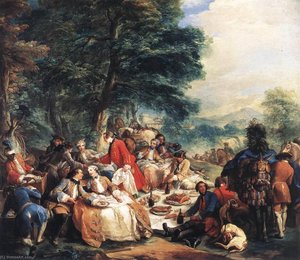
A significant turning point in Vanloo’s career occurred when he accepted an invitation from Frederick the Great of Prussia in 1748. He spent several years at the Prussian court, where he produced numerous works for the royal collection, including a monumental hunting scene—the “Halt de Chasse”—now housed in the Louvre Museum. This commission showcased his ability to capture movement and atmosphere with remarkable precision, solidifying his reputation as one of the most sought-after painters in Europe. His time in Berlin also allowed him to refine his technique and experiment with new approaches to composition and color.
Upon returning to Paris in 1763, Vanloo continued to serve as a court painter, executing portraits of prominent figures—including the Marquis de Sade (a portrait that remains remarkably candid for its time) and members of the royal family. His portraits were distinguished by their psychological depth and ability to reveal the inner lives of his subjects. He also undertook numerous commissions for churches and private collectors, demonstrating a versatility that spanned various genres. Notably, he was commissioned to restore frescoes in the Palace of Fontainebleau, showcasing his skills in both painting and decorative arts.
Vanloo’s legacy extends beyond his individual works; he played a crucial role in shaping the artistic landscape of 18th-century France. He was a student of Jean-Baptiste van Loo, who himself had been mentored by Louis-Michel van Loo—creating a lineage of talented painters within the family. His influence can be seen in the work of his successors, particularly Charles-André van Loo, and he contributed significantly to the development of Rococo painting in France. His ability to seamlessly blend classical influences with contemporary sensibilities ensured that his art remained relevant and engaging for generations to come.
Key Works and Notable Achievements
- The Camera Obscura (1764): This captivating painting, now housed in the Louvre, exemplifies Vanloo’s mastery of light and shadow. It depicts a young man contemplating a camera obscura—a device used to project images onto a surface—creating a sense of intellectual curiosity and wonder.
- Soap Bubbles (1764): Another iconic work from the Louvre, this painting captures a fleeting moment of childhood joy as children chase soap bubbles. The delicate rendering of the bubbles’ iridescent surfaces is a testament to Vanloo's technical skill and his ability to capture ephemeral beauty.
- Portrait of the Marquis de Sade (c. 1778): This remarkably unflinching portrait offers a rare glimpse into the life of this controversial figure. Vanloo’s depiction is far from flattering, revealing a man with piercing eyes and a somewhat unsettling gaze—a stark contrast to the idealized portraits that were common at the time.
- Portrait of Louis XV (various dates): Vanloo painted several portraits of Louis XV, capturing the king’s regal bearing and commanding presence. These works are considered masterpieces of court portraiture, showcasing his skill in conveying power and authority.
Influences and Artistic Style
Vanloo's artistic style was deeply rooted in the traditions of the Baroque and Roman art academies, but he also drew inspiration from the work of contemporary artists such as Nicolas Lancret and Jean-Honoré Fragonard. He skillfully blended these influences to create a distinctive Rococo style characterized by its elegance, grace, and theatricality. His compositions are often dynamic and asymmetrical, creating a sense of movement and energy. He was particularly adept at using light and shadow to enhance the drama of his scenes and to draw attention to key figures.
Historical Significance
Charles Amédée Philippe Vanloo’s work represents a pivotal moment in the history of French art. He embodies the spirit of the Rococo period—a time of artistic experimentation, social change, and political upheaval. His paintings reflect the values and sensibilities of the aristocracy, while also offering glimpses into the complexities of human nature. His legacy continues to inspire artists today, demonstrating the enduring power of beauty, drama, and narrative in art.

charles amédée philippe van loo
1719 - 1795
En bref
- Artistic Movement Or Style: Rococo, Portraiture
- Artists Or Movements Influenced By This Artist:
- Louis-Michel van Loo
- Charles-André van Loo
- Artists Who Influenced This Artist:
- Jean-Baptiste van Loo
- Michel Lebrun
- Date Of Birth: August 25, 1719
- Date Of Death: November 15, 1795
- Full Name: Charles-Amédée-Philippe van Loo
- Nationality: French
- Notable Artworks:
- Camera Obscura
- Soap Bubbles
- Halt de Chasse
- Place Of Birth: Aix-en-Provence, France
Articles connexes

L'Art de l'Emphase : Optimiser la Mise à l'Échelle des Œuvres pour Créer des Murs d'Impact Visuel
Optimisez l'impact visuel de vos murs ! Découvrez nos conseils d'experts pour choisir la taille idéale des œuvres d'art et créer une ambiance luxueuse. Guide complet pour décorateurs & amateurs.


Reflets de Pouvoir : L'Aristocratie et l'Art du Rococo
Explorez l'art aristocratique du Rococo : portraits raffinés, maîtres italiens et français renommés. Découvrez l'histoire, les techniques et l'influence de ce style luxueux avec WahooArt.

Hugo van der Goes: Devotion, Innovation & the Psychological Depth of Early Netherlandish Painting
Explore the revolutionary art of Hugo van der Goes – a master of Early Netherlandish painting renowned for his dramatic realism, psychological depth & profound influence on Renaissance artists. Discover his iconic works and lasting legacy.

L'Art de la Composition Décalée : Harmonie Spatiale et Cohérence Visuelle dans les Arrangements Multiples d'Œuvres
Maîtrisez l'art de la composition décalée ! Découvrez les principes essentiels pour créer des arrangements d'œuvres harmonieux et captivants. Conseils d'experts pour une décoration intérieure raffinée.

Echoes of Olympus: Mythological Narratives in Western Art Through the Ages
Explore the captivating history of mythological narratives in Western art! From ancient Greece to modern masterpieces, discover iconic artworks & symbolism. Expert analysis and high-quality reproductions at WahooArt.

