


 Commander la reproduction Acheter l'image haute résolution
 Partager
 Partager
 Details
 Ajouter aux favoris

 Télécharger
 Articles similaires
 X-Ray
X-Ray
 Diaporama
Delos
 Acrylic On Canvas
- WallArt
- Modernism
 1971
1971 76.0 x 54.0 cm
 The Hepworth Wakefield
 Afficher la suite
Giclée / Impression d'art
Impression giclée ou sur toile de qualité musée, avec une production rapide et des finitions au choix.




P118B $10

P118H $10

P118W $10

P438Z $10

P508JH $12

P508YH $12

P805H $10

P805Z $10

P919BZ $10

P919G $10

P919XJ $10

P959ZH $10

P968JZ $12

W106C $8

W218G $10

W218JH $8

W218Y $10

W307PJ $10

W316G $10

W316PJ $8

W316Y $10

W398PJ $8

W4111J $10

W500HY $15

W500JH $15

W692G $12

W849H $8

W940BG $15

W953PJ $8




Choisissez parmi nos formats prédéfinis qui respectent les proportions originales de l’œuvre.

Vous pouvez saisir vos propres dimensions pour vous adapter à un cadre ou à un espace spécifique. Si la taille sélectionnée ne correspond pas aux proportions de l'image originale, nous recadrerons l'œuvre ou étendrons l'image avec une bordure en miroir ou une couleur unie. Une maquette numérique vous sera envoyée pour approbation avant le début de la production.
Veuillez noter que l'aperçu à l'écran ne reflète pas le recadrage ou l'extension réelle. Seule la maquette montrera avec précision la composition finale.
Bien que des tailles personnalisées soient disponibles, nous vous recommandons de choisir une dimension dans la liste prédéfinie afin de préserver les proportions originales.
Livraison dans le monde entier () en 2 semaines au lieu des 4/5 semaines habituelles. (1 juillet)

Livraison express gratuite dans le monde entier

Toile de lin de haute qualité

Assurance transport complète

Garantie de remboursement des frais de douane

Garantie de fidélité des couleurs

Politique de retour de 60 jours (uniquement en cas de défaut)

Garantie de remboursement à 100%

Réduction sur les achats groupés
 L'option verre n'est disponible que pour les dimensions inférieures à 110 cm.

Delos
Giclée / Impression d'art
Format de reproduction
-


Prix total final
-
Description de l'œuvre
Delos: A Meditation on Form and Void by Barbara Hepworth
Barbara Hepworth’s “Delos,” created in 1971, is more than just a painting; it's an invitation to contemplate the relationship between solidity and emptiness, form and space. The work immediately draws the eye with its striking palette of yellows and blacks – a deliberate contrast that speaks volumes about the artist’s core concerns. The dominant yellow, reminiscent of sun-drenched stone or aged parchment, provides a warm, almost luminous backdrop for the carefully sculpted voids represented by the stark black circles. These aren't merely decorative elements; they are crucial to understanding Hepworth’s intention – to suggest a profound sense of absence and the inherent tension within any form.
Hepworth, a pivotal figure in 20th-century British art, was deeply influenced by both European modernism and her own experiences with sculpture. Her work moved beyond representational imagery, seeking instead to capture essential qualities – weight, texture, and the dynamic interplay of positive and negative space. “Delos” echoes this approach, translating the tactile experience of three-dimensional form into a two-dimensional plane. The painting’s genesis lies partly in Hepworth's fascination with Greek mythology, particularly the island of Delos, sacred to Apollo and Artemis and renowned for its ancient ruins. The title itself acts as a direct reference to this historical and symbolic significance, grounding the abstract composition within a rich cultural context.
Technique and Composition: A Study in Contrasts
The painting’s technique is deceptively simple yet remarkably sophisticated. Hepworth employed a layered approach, building up the yellow ground with thin washes of color to create subtle tonal variations. The black circles are not painted directly onto the surface; rather, they appear as carefully applied areas of concentrated pigment, suggesting a deliberate process of carving or subtraction. This technique reinforces the idea of form emerging from void – a central theme in Hepworth’s oeuvre. The placement of the circles is equally important. The largest circle dominates the center of the composition, acting as a visual anchor and drawing the eye inward. Smaller circles are strategically positioned around it, creating a dynamic balance between stability and movement.
Hepworth's use of color is particularly noteworthy. The yellow isn’t a bright, cheerful hue; it possesses a muted quality, hinting at age and weathering – qualities that resonate with the ancient ruins of Delos itself. The black circles, conversely, are intensely dark, creating a powerful contrast that demands attention. This interplay of light and shadow generates a sense of depth and volume, inviting the viewer to explore the painting’s surface and contemplate its hidden dimensions.
Symbolism and Emotional Resonance
Beyond its formal qualities, “Delos” is imbued with a profound sense of symbolism. The circles can be interpreted as representing the absence of something – perhaps loss, memory, or the unknowable mysteries of the universe. They also evoke the idea of holes or voids within forms, suggesting that even the most solid and substantial objects are ultimately defined by their emptiness. This concept aligns with Hepworth’s broader exploration of the relationship between form and space, a theme she consistently revisited throughout her career.
The painting's emotional impact is subtle yet deeply affecting. It doesn’t offer easy answers or explicit narratives; instead, it invites contemplation and introspection. There’s a sense of quiet melancholy, a recognition of the transient nature of existence, and a profound appreciation for the beauty that can be found in emptiness. “Delos” ultimately serves as a reminder that true understanding often arises not from filling every space with detail, but from embracing the power of suggestion and allowing the mind to complete the picture.
A Legacy of Form and Space
Barbara Hepworth’s “Delos” stands as a testament to her pioneering spirit and her profound insights into the nature of art. It's a work that transcends its simple composition, offering viewers a glimpse into the artist’s inner world and inviting them to engage in a dialogue with timeless themes of form, space, and existence. Reproductions of this piece offer an accessible way to experience Hepworth’s vision, bringing her evocative exploration of emptiness and solidity into any interior space – a reminder that sometimes, the most powerful art is found not in what is shown, but in what is left unsaid.
Œuvres apparentées


Biographie de l'artiste
Premières années et formation
Dame Barbara Hepworth, une artiste et sculptrice anglaise de renom, est née le 10 janvier 1903 à Wakefield, dans le Yorkshire. Elle a fréquenté la Leeds School of Art à partir de 1920 puis a remporté une bourse du comté pour étudier à la Royal College of Art (RCA) à Londres de 1921 jusqu'à ce qu'elle obtienne le diplôme en 1924.Carrière artistique
- L’œuvre de Dame Barbara Hepworth exemplifie le modernisme, en particulier la sculpture moderne. Elle était l'une des rares artistes féminines à atteindre une reconnaissance internationale.
- En 1933, elle a cofondé le mouvement artistique Unit One avec Ben Nicholson, Paul Nash et d'autres, cherchant à unir le surréalisme et l'abstraction dans l'art britannique.
- Le travail précoce de Hepworth était caractérisé par l'abstraction et son implication avec le mouvement artistique parisien, Abstraction-Création.
Œuvres notables et expositions
- Oval Form (Trezion), une sculpture en bronze, fait partie de la collection du Kimball Art Museum à Fort Worth, aux États-Unis. (voir sur ArtsDot)
- Two Forms, une sculpture, est exposée au Hepworth Wakefield à Wakefield, dans le Yorkshire. (voir sur ArtsDot)
- Totem, une sculpture en marbre, fait également partie de la collection du Hepworth Wakefield. (voir sur ArtsDot)
Évolution artistique et influences
L'œuvre de Hepworth a évolué au fil des ans, passant d'abstractions influencées par le cubisme et le surréalisme à des formes plus organiques et abstraites. Son séjour en France dans les années 1930, où elle a rencontré des artistes comme Brancusi et Arp, a été déterminant pour son développement artistique. Elle s’est intéressée aux formes naturelles, notamment celles trouvées dans la mer et le paysage de Cornouailles, où elle a vécu pendant une grande partie de sa carrière.
Héritage et collections muséales
L'œuvre de Barbara Hepworth est largement reconnue, ses sculptures et peintures faisant partie de diverses collections de musées dans le monde. Le Hepworth Wakefield, du nom de l'artiste, abrite de nombreux chefs-d'œuvre d'artistes renommés, dont les propres œuvres de Hepworth. (découvrez davantage sur le Hepworth Wakefield sur ArtsDot)Conclusion
Dame Barbara Hepworth’s pioneering work in modern British sculpture has left an indelible mark on the art world. Her legacy continues to inspire artists and art enthusiasts alike, with her works remaining a testament to her innovative spirit and artistic genius. more about barbara hepworth on wikipedia
Barbara Hepworth
1903 - 1975 , Royaume-Uni
En bref
- Artistes Influents:
- Brancusi
- Henry Moore
- Ben Nicholson
- Date De Naissance: 10 janvier 1903
- Lieu De Naissance: Wakefield, Royaume-Uni
- Mouvement Artistique: Modernisme, Sculpture abstraite
- Nationalité: Britannique
- Nom Complet: Barbara Hepworth
- Oeuvres Notables:
- Oval Form (Trezion)
- Two Forms
- Totem
Articles connexes

Barbara Hepworth: A Sculptural Dialogue with Form, Space & the Human Condition
Explore the profound world of Barbara Hepworth's sculpture. Discover her artistic evolution, iconic forms, and lasting influence on modern art. A guide for collectors & enthusiasts.

L'Orphisme : Une Symphonie de Couleur et de Forme – Exploration des Racines Abstraites de l'Art Moderne
Explorez l'Orphisme : son histoire, ses figures clés (Robert & Sonia Delaunay), et son impact sur l'art moderne. Analyse approfondie pour collectionneurs avertis et passionnés d'abstraction.

Hiro Yamagata: Abstraction, Materiality & Spatial Dynamics in Contemporary Sculpture
Explore the captivating world of Hiro Yamagata’s innovative sculptures & paintings. Discover his pioneering use of laser technology, immersive installations, and abstract forms – a must-read for discerning art collectors.
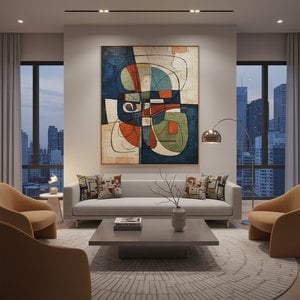
L'Allure de l'Abstraction : Pourquoi elle Résonne dans le Design Moderne
Explorez l'influence de l'art abstrait sur le design moderne avec . Conseils d'experts, reproductions haute qualité et inspiration pour décorateurs d'intérieur.

Au-delà de la Représentation : Décoder l'Émotion et le Sens dans l'Art Abstrait Moderne
Explorez l'art abstrait moderne avec ArtsDot : découvrez les maîtres, décryptez les émotions et investissez en toute confiance dans des œuvres exceptionnelles. Conseils d'experts & reproductions de qualité.



