


 Katso seinällä
 Lähetä
 Jaa
Jaa
 Tarkemmat tiedot
 Opas
Opas

 Lataa kuva
 Samanlaisia kohteita
 Röntgenkuvaus
 Diaesitys
 Tilastot
Tennessee


 Lue lisää
Giclée- ja taideprintit
Museolaatuisia giclée- tai kankaitaulun tulosteita nopealla tuotannolla ja joustavilla viimeistelyvaihtoehdoilla. ( Tilaa käsinmaalattu jäljennös Siirry digitaaliseen kuvaan)




P118B $10

P118H $10

P118W $10

P438Z $10

P508JH $12

P508YH $12

P805H $10

P805Z $10

P919BZ $10

P919G $10

P919XJ $10

P959ZH $10

P968JZ $12

W106C $8

W218G $10

W218JH $8

W218Y $10

W307PJ $10

W316G $10

W316PJ $8

W316Y $10

W398PJ $8

W4111J $10

W500HY $15

W500JH $15

W692G $12

W849H $8

W940BG $15

W953PJ $8




Valitse valmiista mitoistamme sellaiset, jotka vastaavat teoksen alkuperäisiä mittasuhteita.

Voit syöttää omat mitat sopiaksesi tiettyyn kehykseen tai tilaan. Jos valittu koko ei vastaa alkuperäisen kuvan mittasuhteita, rajaamme teosta tai laajennamme kuvaa peilatulla tai yhtenäisellä reunalla. Digitaalinen mallikuva lähetetään hyväksyttäväksi ennen tuotannon aloittamista.
Huomaathan, että näytöllä näkyvä esikatselu ei vastaa lopullista rajausta tai laajennusta. Vain mallikuva näyttää lopullisen sommittelun tarkasti.
Vaikka räätälöityjä kokoja on saatavilla, suosittelemme valitsemaan mitat valmiista listasta alkuperäisten mittasuhteiden säilyttämiseksi.
Maailmanlaajuinen toimitus () 2 viikossa tavallisen 4–5 viikon sijaan. (26 syyskuu)

Ilmainen pikatoimitus ympäri maailman

Korkealaatuinen pellavakangas

Kattava kuljetusvakuutus

Tulliveron palautustakuu

Takuu täydellisestä värien vastaavuudesta

100 päivän palautusoikeus valmistusvirhetapauksissa

100% rahat takaisin -takuu

Määräalennus saatavilla
 Lasivaihtoehto on saatavilla vain alle 110 cm kokoisille teoksille

Tennessee
Giclée- ja taideprintit
Replikaatin koko
-


Kokonaishinta
$ 62
A Poet of the American Landscape: Unveiling “Tennessee” by Alexander Helwig Wyant
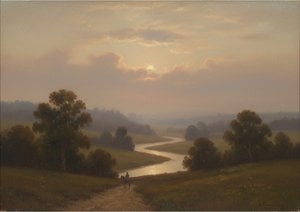
Alexander Helwig Wyant’s “Tennessee,” painted in 1866, isn't merely a depiction of a river valley; it’s an immersive experience, a carefully constructed evocation of mood and atmosphere. Wyant, a pivotal figure bridging the romanticism of the Hudson River School with the nascent tonalism movement, possessed a rare gift: he translated the subtle poetry of nature into visual form, imbuing his canvases with a profound sense of introspection. This particular work captures a fleeting moment in the Tennessee countryside – perhaps late afternoon, judging by the diffused light and the muted palette – yet it transcends simple representation to become a meditation on solitude, memory, and the enduring beauty of the American wilderness.
The painting immediately draws the eye into its heart: a broad river, rendered with a delicate wash of blues and greens, snakes through a gently rolling landscape. Mountains, hazy in the distance, provide a dramatic backdrop, their peaks softened by atmospheric perspective – a technique borrowed from the masters of light and color like J.M.W. Turner. Scattered amongst the trees are hints of human presence, a small figure near the riverbank suggesting a quiet observer, lost in contemplation. Wyant’s brushstrokes are loose and expressive, avoiding sharp outlines and favoring instead a blending of tones that creates an almost dreamlike quality. This deliberate ambiguity invites the viewer to project their own emotions and experiences onto the scene.
The Tonalist Vision: Light, Shadow, and Emotion
Wyant’s approach aligns perfectly with the principles of tonalism, a movement that sought to capture not just the appearance of objects but also the *feeling* they evoked. Unlike the Hudson River School's emphasis on detailed realism and dramatic lighting, Wyant favored subtle gradations of tone – variations in light and shadow – to create an atmosphere of mood and emotion. He achieved this through a layering technique, applying thin washes of paint that gradually built up to form the final image. The absence of strong color contrasts contributes to the painting’s sense of quiet melancholy, while the diffused light suggests a timelessness, as if the scene exists outside of specific time or place.
The choice of subject matter – a rural landscape – is also significant. Wyant was deeply interested in exploring the relationship between humanity and nature, often depicting scenes that evoked feelings of nostalgia and longing for simpler times. “Tennessee” embodies this theme perfectly, inviting us to pause and reflect on our connection to the natural world.
Historical Context: A Painter’s Journey
Wyant's artistic development was shaped by a series of transformative experiences. Initially influenced by George Inness, he later traveled extensively in Europe, studying with Hans Gude in Düsseldorf and Karlsruhe. These journeys exposed him to new techniques and perspectives, broadening his understanding of landscape painting. However, it was his return to America and the challenges posed by a stroke that ultimately led him to refine his style – forcing him to adapt and innovate, using only his left hand to create works of remarkable sensitivity and depth.
The painting’s creation coincided with a period of profound change in American history. The Civil War was raging, and the nation was grappling with issues of identity and division. Wyant's work reflects this turmoil, capturing a sense of uncertainty and melancholy that resonates deeply within the viewer. Despite the somber mood, there is also an underlying current of hope – a belief in the enduring beauty and resilience of the American landscape.
Symbolism and Emotional Resonance
Beyond its technical merits, “Tennessee” is rich in symbolism. The river itself represents the flow of time and life, while the mountains symbolize strength and permanence. The solitary figure suggests a yearning for connection and belonging. The overall effect is one of quiet contemplation – an invitation to lose oneself in the beauty of nature and reflect on our place within it. “Tennessee” isn’t just a painting; it's a portal into a world of feeling, a testament to Wyant’s extraordinary ability to capture the essence of the American spirit.
Samankaltaisia teoksia


Taiteilijan elämäkerta
Alexander Helwig Wyant – A Poet of Atmospheric Landscapes
Alexander Helwig Wyant, born in Port Washington, Ohio, stands as a remarkable figure bridging the stylistic currents of the Hudson River School and Tonalism—a testament to American art’s capacity for innovation and introspection. He wasn't merely a painter *of* landscapes; he possessed an almost poetic sensibility, translating the subtle moods of nature onto canvas with increasing sensitivity and nuance. His artistic journey began modestly, sketching along the banks of the Ohio River near Cincinnati, yet swiftly ascended into a vocation fueled by formative encounters and transformative experiences that would shape his distinctive vision.Early Influences and Artistic Formation
Wyant’s initial artistic endeavors bore the unmistakable imprint of the Hudson River School, characterized by meticulous depictions of natural vistas and an ardent celebration of America's untamed wilderness. However, even within these early canvases—particularly *Mohawk Valley*, now housed at the Metropolitan Museum of Art—hints of his future trajectory emerge: a burgeoning preoccupation with atmospheric effects and a preference for palettes imbued with subdued hues. This inclination intensified over time, propelling him away from purely representational painting toward the nascent aesthetic championed by Tonalism – a movement that prioritized mood, atmosphere, and poetic interpretation above precise detail. Crucially, Wyant’s artistic development was profoundly impacted by his encounter with George Inness in 1857. This pivotal meeting served as catalyst for relocating to New York City, where he sought mentorship and formal training at the National Academy of Design—a patronage generously bestowed upon him by Nicholas Longworth of Cincinnati.European Travels and Artistic Synthesis
A subsequent voyage to Europe in 1860 broadened Wyant’s artistic horizons considerably, exposing him to diverse artistic traditions originating from Germany and brief sojourns in England and Ireland. These formative experiences instilled within him a deep appreciation for European landscape painting—particularly the works of Jean-Baptiste Camille Corot and Jules Dupré—and fueled his desire to synthesize these influences with American sensibilities. This synthesis resulted in a distinctive style that blended the meticulous observation championed by the Hudson River School with the evocative subtlety of Tonalism, marking Wyant as a true innovator within his time. He diligently studied under Hans Fredrik Gude in Düsseldorf and Karlsruhe during this period, absorbing techniques and philosophies that would inform his subsequent artistic endeavors.The Shift Towards Atmospheric Resonance: From Detail to Emotion
From 1867 onward, Wyant increasingly favored a looser handling of paint—a deliberate departure from the rigid conventions of academic art—employing shades of white, gray, and earthy tones to capture the ephemeral qualities of light and shadow. This stylistic evolution mirrored the broader trend toward *plein air* painting and emotional expression that characterized the Barbizon movement in France – a movement Wyant embraced wholeheartedly. His paintings became imbued with a palpable sense of tranquility and contemplation, reflecting his profound connection to the natural world. Notably, after suffering a debilitating stroke in 1873—which necessitated adapting to painting with his left hand—Wyant’s artistic focus intensified further, honing his technique and distilling his vision to its purest essence. This adversity served as impetus for producing some of his most evocative landscapes—particularly those executed during his winters in Keene Valley and summers at Arkville, NY—where he established a home amidst the Catskill Mountains.Legacy and Recognition
Wyant’s enduring legacy resides not merely in technical proficiency but in his ability to convey profound emotional resonance through landscape art. He championed the American Watercolor Society in 1878, furthering the advancement of watercolor painting as an expressive medium—a testament to his commitment to artistic innovation and national identity. His paintings continue to captivate audiences today for their understated beauty, contemplative spirit, and astute understanding of nature’s subtle moods. Alexander Helwig Wyant's contribution to American art history is undeniable: he stands as a pivotal figure bridging the traditions of realism and impressionism, securing his place among the most influential landscape painters of the late nineteenth century—a poet who transformed observation into emotion and solidified his reputation as one of America’s foremost artistic voices.
Alexander Helwig Wyant
1836 - 1892 , Yhdysvallat
Tietoa taiteilijasta
- Artistic Movement Or Style: Hudson River School & Tonalism
- Artists Or Movements Influenced By This Artist: ['American Watercolor Society']
- Artists Who Influenced This Artist:
- George Inness
- John Constable
- J.M.W. Turner
- Date Of Birth: 1836
- Date Of Death: 1892
- Full Name: Alexander Helwig Wyant
- Nationality: Amerikkalainen
- Notable Artworks:
- Mohawk Valley
- Arkville Autumn Landscape
- The Flume
- Place Of Birth: Port Washington, USA
Aiheeseen liittyvät artikkelit

George Elbert Burr: A Pioneer of American Tonalism & Evocative Landscape Painting
Explore the captivating landscapes of George Elbert Burr, a pioneer of American Tonalism. Discover his masterful etchings, drypoints & watercolors – and learn about collecting this influential artist's work.
Atmospheric Visions: Exploring Tonalism in American Painting
Explore the captivating world of American Tonalism! Discover its history, key artists like Whistler & Inness, techniques, and lasting influence on art. Expert insights for collectors & enthusiasts.

George Inness: Transcendental Landscapes & the American Search for Spiritual Harmony
Explore the profound landscapes of George Inness, a leading American artist-philosopher. Discover his spiritual approach to painting, influences, and lasting legacy with ArtsDot.

Evocations of Place: A Historical Journey Through Landscape Art
Explore the rich history of landscape art with ArtsDot. Discover renowned artists, movements like Impressionism & Romanticism, and expert guidance for collecting timeless pieces. Find your perfect serene escape today!

Grant Wood & American Regionalism: Identity, Myth & the Rural Landscape
Explore the world of Grant Wood & American Regionalism with ArtsDot. Discover the symbolism behind 'American Gothic', recurring themes, and the movement's lasting impact on art history. High-quality reproductions available.