


Kuva noudattaa valintojasi: , .
Keräilykohteen kuvaus
Albert Edelfelt's 'Burnt Village' (1879) depicts a poignant scene of Finnish peasants after a devastating fire, showcasing realism and historical detail. A powerful genre painting by a master.
 Lue lisää
Taiteilijan elämäkerta
Albert Edelfeltin realistiset maalaukset ovat tunnettuja erityisesti Louis Pasteurin muotokuvan ja Pohjanmaan lepästä sekä vaikutuksesta nuorempiin suomalaisiin taiteilijoihin. Tutustu hänen mestariteoksiinsa!
Käsinmaalattu öljyvärinen jäljennös
Käsinmaalattu öljyväri kankaalle haluamassasi koossa ja kehyksissä, taiteilijoidemme valmistamana tilauksesta. ( Vaihda tulosteeseen Siirry digitaaliseen kuvaan)
Lisää tästä teoksesta
 Esikatselu
 Jaa teos
 Jaa
Jaa
 Tiedot
 Opas
Opas

 Lataa kuva
 Samanlaisia kohteita
 Röntgenkuvaus
 Diaesitys
 Kysymykset ja vastaukset
 Tilastot
Tilaa maalauksesi neljässä helpossa vaiheessa
Älä kiirehdi. Voit muuttaa mitä tahansa vastausta; tilauksesi loppusumma päivittyy jokaisen valinnan myötä.
1 Ensimmäinen vaihe neljästä
Minkä kokoisen haluaisit?
Nämä koot säilyttävät alkuperäisen maalauksen mittasuhteet. Piirros näyttää valitsemasi koon seinällä, kahden metrin pitkän sohvan yläpuolella.
Tai anna omat mitat
Valitse valmiista mitoistamme sellaiset, jotka vastaavat teoksen alkuperäisiä mittasuhteita.

Kirjoita tarvitsemasi leveys ja korkeus, jotta teos sopii kehyksiisi tai seinällesi. Koska kyseessä on käsinmaalattu teos, taiteilija voi maalata hieman enemmän kuvan ympärille tai rajata sitä hieman, jos haluat eri muotoisen koon — valinta on sinun. Lähetämme sinulle digitaalisen mallikuvan hyväksyttäväksi ennen kuin maalaus alkaa. Tällä sivulla näkyvä kuva ei vastaa lopullista tulosta — vain mallikuva näyttää sen.
2 Toinen vaihe neljästä
Miten teoksen tulisi olla valmiina: rullattuna, kangasjännitteenä vai kehystettynä?
Alla olevat hinnat koskevat ensimmäisessä vaiheessa valitsemaasi kokoa.
Valitse kangaspinnan reunat
Valitse kehys

Valkoinen reuna €1

pehmennetty reuna €1

Jatkuva reuna €1

P118B €10

P118H €10

P118W €10

P438Z €10

P508JH €12

P508YH €12

P805H €10

P805Z €10

P919BZ €10

P919G €10

P919XJ €10

P959ZH €10

P968JZ €12

W106C €8

W218G €10

W218JH €8

W218Y €10

W307PJ €10

W316G €10

W316PJ €8

W316Y €10

W398PJ €8

W4111J €10

W500HY €15

W500JH €15

W692G €12

W849H €8

W940BG €15

W953PJ €8

H24-GOLD €30

H24-SILVER €30

H36-GOLD €45

H36-SILVER €45
Kehystetty
Kehystys: . Kokonaismitat kehyksen kanssa: .
3 Kolmas vaihe neljästä
Haluaisitko tehdä maalaukseen jonkin muutoksen?
Useimmat vastaavat kieltävästi. Koska jokainen maalaus on käsintehty, taiteilijamme voi myös muokata sitä sinua varten.
Tilauksen jälkeen ArtsDot.com -tiimi lähettää asiakkaalle sähköpostia ohjeita varten ja toimittaa luonnoksen esikatselun
4 Neljäs vaihe neljästä
Muutamia viimeistelyvaihtoehtoja
Kaikki ovat valinnaisia. Jo valitut vastaukset eivät aiheuta lisäkustannuksia.
Kuka sen maalaa?
Maailmanlaajuinen toimitus () 3–4 viikossa tavallisen 5 viikon sijaan. (7 marraskuu). Laadusta ei tingitä.
Nimikyltti, kuten museossa?
Kaiverretun pronssilaatan tiedot
This elegant plaque features the artist's name and the title of the artwork, finely engraved for a timeless presentation.
It is made from bronze with a refined, elegant finish. The text is precisely laser-engraved for a sharp and permanent result. Measuring 9x2 cm, the plaque is compact yet easy to read. It's built to be durable and scratch-resistant, offering a professional, museum-quality look. Mounting is simple thanks to the included adhesive backing.
Läpinäkyvän akryylilaatan tiedot
The plaque includes essential engraved details such as the artist's name, the title of the artwork, the date it was created, the type of media used-like oil on canvas or watercolor-a brief description of the piece, and a QR code that links to the complete artwork information.
It is crafted from clear acrylic, offering a sleek, modern appearance. The text is UV-engraved in black to ensure strong visual contrast. With a size of 10x15 cm, it ensures optimal readability. It comes equipped with two metal hooks for secure wall mounting. The plaque is designed to be weather-resistant, making it suitable for various environments, and it includes interactive features that work seamlessly with smartphone scanning.
Mustan akryylilaatan tiedot
This elegant plaque includes engraved information such as the artist's name, the title of the artwork, the date it was created, the type of media used (like oil on canvas or watercolor), a short description of the artwork, and a QR code for quick access to more information.
The plaque itself is made from refined black acrylic with a premium finish. The text is laser-engraved in white for high contrast and readability. Its size is 10x15 cm, designed to be easy to read. It comes with two metal hooks for professional mounting. The design is sleek and fits any interior style. It is also weather-resistant and durable, with built-in digital integration for mobile compatibility.
Suojaava lakka?
Milloin tarvitset sen?
✓ Tarkista ja tilaa
Maalauksesi juuri niin kuin tilasit

Burnt Village
Reproduktiotekniikka
Replikaatin koko
-

Kokenut huipputaiteilija
Lisää yksityiskohtia, hienostuneisuutta ja enemmän aikaa tuotantoon
-

Reproduktion kehystysvaihtoehdot
-
-
Teoksille tai reproduktioille, joiden mikä tahansa sivu on suurempi kuin 105 cm (noin 41 tuumaa), kehys toimitetaan osina purettuna sarjana. Tämä menetelmä varmistaa turvallisen toimituksen ja ehkäisee vaurioita kuljetuksen aikana.
Vaatii ammattimaista kokoamista – kyseessä ei ole tee-se-itse-tuote.
Sarja on koottava ja kangas kiristettävä kokeneen kehystysammattilaisen toimesta käyttäen puuliimaa (ei sisälly pakkaukseen), kangaspinnetteitä ja puristimia, jotta kehyksen kulmat pysyvät suorina liiman kuivuessa. Virheellinen kokoaminen tai epätasainen kankaan kiristys voi vaurioittaa teosta pysyvästi, eikä tällaiset vauriot ala takuun piiriin.
 Teoksille tai reproduktioille, joiden mikä tahansa sivu on suurempi kuin 105 cm (noin 41 tuumaa), kehys toimitetaan osina purettuna sarjana. Tämä menetelmä varmistaa turvallisen toimituksen ja ehkäisee vaurioita kuljetuksen aikana.
Kaikki massiivipuupalat sisältyvät, tarkasti mittojen mukaan leikattuina.
Kootaan mukana tulevilla ruuveilla sekä kulmaliitoksia varten tarvittavalla puuliimalla, jota ei toimiteta, joten se on hankittava kehystäjältä.
Vaatii ammattilaisvälineitä, jotka eivät sisälly pakkaukseen: kankaan venytyspihdit (kiristin) ja puristimet, joilla pidetään kehyksen puut suorassa liiman kuivuessa.
Tärkeää:
Kulmaliitoksissa tarvitaan puuliimaa, kehyksien osat on pidettävä puristimilla, kunnes liima on täysin kuivunut, ja koottuun kehykseen jännitettävän kankaan kiristämiseen tarvitaan kangaspenssipihti. Mikään näistä ei sisälly pakkaukseen. Suosittelemme varmistamaan kokeneen kehystäjän saatavuuden ennen tämän kokoisen kehyksen tilaamista.

Nimilaatta
-
-

Suojalakkaus
Kiiltävä lakka (syventää värejä, suojaa valolta ja kosteudelta)
-

Mukauta taideteokseni
Esimerkkejä muokattavista asioista: Vaihda kasvot asiakkaan omaan valokuvaan; Lisää lemmikki (esim. vaihda kissa koiraan); Lisää taustalle piilotettu viesti; Muuta taustan maisemaa tai elementtejä.
-

Pikatoimitus
Maailmanlaajuinen toimitus () 3–4 viikossa tavallisen 5 viikon sijaan. (7 marraskuu). Laadusta ei tingitä.
-
Pikatoimitus
Maailmanlaajuinen toimitus () 5 viikon kuluessa. (14 marraskuu).
Sisältyy hintaan
Kokonaishinta
€ 235
Lasivaihtoehto on saatavilla vain alle 110 cm kokoisille teoksille
Sisältyy jokaiseen tilaukseen
- Ilmainen pikatoimitus ympäri maailman
- Korkealaatuinen pellavakangas
- Kattava kuljetusvakuutus
- Tulliveron palautustakuu
- Takuu täydellisestä värien vastaavuudesta
- 100 päivän palautusoikeus (vain valmistusvirheet)
- 100% rahat takaisin -takuu
- Määräalennus tarjolla


Albert Edelfelt’s “Burnt Village”: A Frozen Moment of Sorrow and Resilience
Albert Edelfelt's "Burnt Village," painted in 1879, is more than just a winter landscape; it’s a poignant tableau that speaks to the enduring spirit of a people facing devastation. This oil-on-canvas masterpiece, created during a period of significant artistic exploration for Edelfelt, offers a glimpse into a pivotal moment in Finnish history – the aftermath of the Cudgel War (1596–1597), a brutal peasant uprising against Swedish rule. The painting depicts an imagined scene, meticulously rendered with a realism that borders on photographic detail, capturing the stark beauty and profound sadness of a village reduced to ashes.
The central figures – a woman in a vibrant red skirt, her gaze fixed upwards, and an older man supporting himself with what appears to be a staff – immediately draw the viewer’s attention. Their postures convey a sense of quiet dignity amidst unimaginable loss. The snow-covered ground, the imposing rock formation hinting at a shoreline, and the overcast sky contribute to a palpable atmosphere of coldness and isolation. Edelfelt's masterful use of color—the dominant cool tones of white, gray, and blue punctuated by the warm red – heightens the emotional impact, emphasizing both the bleakness of the scene and the enduring warmth of human resilience.
Realism and the Finnish Artistic Landscape
Edelfelt’s artistic journey was shaped by his time in Antwerp and Paris, where he honed his skills in history painting. However, it's within the context of Realism that “Burnt Village” truly shines. Following the influence of Jean-Léon Gérôme during his Parisian studies, Edelfelt returned to Finland with a commitment to depicting everyday life and historical events with unflinching honesty. This approach was revolutionary for its time, moving away from idealized depictions towards a more grounded and socially conscious representation of the Finnish people.
The painting’s meticulous detail – the textures of the snow, the folds in the clothing, the expressions on the faces – are hallmarks of Edelfelt's technique. He employed a layering method, building up thin glazes of paint to achieve remarkable luminosity and depth. This painstaking process is evident in every brushstroke, contributing significantly to the painting’s enduring power.
Symbolism and Historical Context
"Burnt Village" isn’t simply a depiction of a historical event; it's laden with symbolic meaning. The title itself immediately evokes images of destruction and loss, reflecting the brutal realities of the Cudgel War. The peasant family, frozen in this moment, represents not just individual suffering but also the broader struggle for freedom and self-determination that characterized Finnish history. The woman’s upward gaze suggests a yearning for hope amidst despair, while the older man's support symbolizes the importance of community and tradition in times of crisis.
Interestingly, the painting was created during a period when Finland was transitioning from Swedish rule towards greater autonomy. Edelfelt’s work, therefore, can be seen as subtly advocating for this burgeoning national identity. The Cygnaeus Gallery's acquisition of the piece further underscores its significance within Finnish cultural heritage.
A Timeless Masterpiece – Perfect for Your Space
ArtsDot offers a stunning hand-painted reproduction of Albert Edelfelt’s “Burnt Village,” allowing you to bring this powerful and evocative artwork into your home or office. Each reproduction is created by skilled artisans, meticulously replicating Edelfelt's original technique and color palette. Whether you are an art collector, an interior designer seeking a statement piece, or simply someone who appreciates the beauty of historical painting, this reproduction offers a unique opportunity to own a fragment of Finnish artistic history – a testament to resilience, sorrow, and the enduring power of the human spirit.
Kysymykset ja vastaukset
Onko Albert Edelfelt:n "Burnt Village" vaalea vai tumma teos?
Teoksen Albert Edelfelt:n "Burnt Village" kirkkaus on bright ja luminanssi Bright Balance.
Onko teokselle Albert Edelfelt:n "Burnt Village" opasta?
Teoksesta Albert Edelfelt:n "Burnt Village" on saatavilla Opas -sivu: tulostettava tietolomake teoksesta, joka on suunniteltu opiskelijoita ja luokkahuonekäyttöä varten.
Mihin käyttöön Albert Edelfelt:n "Burnt Village" on suositeltu?
Albert Edelfelt:n "Burnt Village"-teoksen suositeltu käyttötarkoitus on Statement. Se soveltuu kuitenkin myös muihin tarkoituksiin.
Samankaltaisia teoksia


Albert Edelfelt
1854 - 1905, Suomi
Taiteilijan elämäkerta
early life and education
Albert Gustaf Aristides Edelfelt, a Finnish painter who achieved international renown, was born on July 21, 1854, in Porvoo, Finland. His parents, Carl Albert Edelfelt and Alexandra Edelfelt (née Brandt), were Swedish-speaking Finns. From an early age, Edelfelt demonstrated an innate fascination with art—a passion that would propel him toward formal studies at the Drawing School of the Finnish Art Society in 1869. This formative experience laid the groundwork for his artistic journey and instilled within him a lifelong dedication to mastering his craft.artistic journey
Edelfelt’s artistic pursuits extended beyond Finland's borders, shaping him through exposure to diverse artistic traditions. He embarked on a significant educational voyage to Antwerp Academy of Art in 1873-74, where he honed his skills in history painting under the guidance of Jean-Léon Gérôme—a pivotal step in developing his stylistic sensibilities. Subsequently, he pursued further refinement at École nationale des beaux-arts in Paris (1874-78), continuing to learn from Gérôme and absorbing influences from Impressionism. A brief period spent in Saint Petersburg (1881-82) broadened his artistic horizons and introduced him to the stylistic nuances of Russian art.rise to prominence and notable works
Edelfelt’s career ascended rapidly following a triumphant performance at the Paris Universal Exposition of 1889, securing him a gold medal—a testament to his talent and dedication. Among his most celebrated paintings are “Portrait of Louis Pasteur,” which garnered him the Legion of Honor in 1886, capturing the likeness of the renowned scientist with remarkable accuracy and detail. Equally compelling is “Young Woman in Her Boudoir,” portraying femininity with grace and subtlety—a masterful depiction of light and shadow that exemplifies Edelfelt’s artistic prowess. Furthermore, “Under the Birches” stands as a poignant emblem of Finnish landscapes, conveying both beauty and melancholy through evocative brushstrokes and atmospheric perspective. And finally, "Girl from Porvoo" is an unforgettable portrait capturing the essence of youthful innocence and charm.legacy and impact
Albert Edelfelt’s contribution to Finnish art history is undeniable—he stands as one of the pioneers who ushered in a new era of realism within the nation's artistic landscape. His influence resonated deeply with younger artists like Akseli Gallen-Kallela and Gunnar Berndtson, whom he mentored during their formative years in Paris—solidifying his position as a pivotal figure in shaping Finnish art’s trajectory. Today, Edelfelt’s works are housed in prestigious museums across Europe, including Ateneum Museum in Helsinki, where they continue to inspire admiration for their artistic merit and historical significance. His legacy persists not only through the enduring beauty of his paintings but also through the lasting impact he had on subsequent generations of Finnish artists—a testament to his enduring contribution to art history.museum collections and commemoration
Edelfelt’s masterpieces are proudly displayed in Ateneum Museum, Helsinki, Finland, allowing visitors to immerse themselves in the splendor of his artistic vision. To honor his remarkable life and legacy, a €100 Albert Edelfelt commemorative coin was issued in 2004—celebrating the centenary of his birth anniversary. This symbolic gesture underscores the enduring appreciation for Edelfelt’s contribution to Finnish culture and art—a lasting reminder of his indelible mark on artistic history.
Aiheeseen liittyvät artikkelit

The Evocative Embrace of Reality: Exploring Romantic Realism in 19th-Century Painting
Explore the captivating world of Romantic Realism! Discover key artists like Courbet & Millet, masterpieces, and the social context behind this influential art movement. Expert insights for collectors at ArtsDot.

Romantic Realism's Finest: 10 Masterpieces for Your Home | ArtsDot
Explore 10 defining masterpieces of Romantic Realism! Discover Courbet, Millet & Daumier's powerful paintings—capturing emotion and social realities. Find museum-quality reproductions for your home at ArtsDot.com.
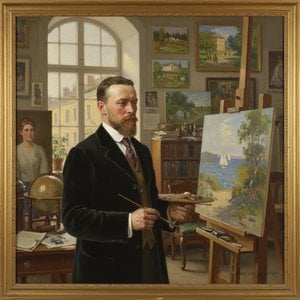
Albert Edelfelt: A Pioneer of Finnish Realism & International Impressionist Circles
Explore the life & work of Albert Edelfelt, a pioneering Finnish Realist painter who bridged Impressionism & national identity. Discover his masterpieces and lasting influence on art history.