

- 105.0 x 100.0 cm


Kuva noudattaa valintojasi: , .
Keräilykohteen kuvaus
Ihaile Agnolo Bronzino’s ‘Pieta’, joka on koskettava vuoden 1530 renessanssimestariteos Kristuksen kärsimyksestä. Tutustu sen klassiseen tyyliin, hillittyihin väreihin ja upeisiin yksityiskohtiin.
 Lue lisää
Taiteilijan elämäkerta
Agnolo Bronzino oli italialainen manieristitaiteilija, jonka ikoniset maalaukset ja tyylinen tarkkuus ovat mestariluokkaa. Tutustu hänen tunnusomaiseen eleganssiinsa ja Medici-dynastian vaikutukseen!
Käsinmaalattu öljyvärinen jäljennös
Käsinmaalattu öljyväri kankaalle haluamassasi koossa ja kehyksissä, taiteilijoidemme valmistamana tilauksesta. ( Vaihda tulosteeseen Siirry digitaaliseen kuvaan)
Lisää tästä teoksesta
 Esikatselu
 Jaa teos
 Jaa
Jaa
 Tiedot
 Opas
Opas

 Lataa kuva
 Samanlaisia kohteita
 Röntgenkuvaus
 Diaesitys
 Kysymykset ja vastaukset
 Tilastot
Tilaa maalauksesi neljässä helpossa vaiheessa
Älä kiirehdi. Voit muuttaa mitä tahansa vastausta; tilauksesi loppusumma päivittyy jokaisen valinnan myötä.
1 Ensimmäinen vaihe neljästä
Minkä kokoisen haluaisit?
Nämä koot säilyttävät alkuperäisen maalauksen mittasuhteet. Piirros näyttää valitsemasi koon seinällä, kahden metrin pitkän sohvan yläpuolella.
Tai anna omat mitat
Valitse valmiista mitoistamme sellaiset, jotka vastaavat teoksen alkuperäisiä mittasuhteita.

Kirjoita tarvitsemasi leveys ja korkeus, jotta teos sopii kehyksiisi tai seinällesi. Koska kyseessä on käsinmaalattu teos, taiteilija voi maalata hieman enemmän kuvan ympärille tai rajata sitä hieman, jos haluat eri muotoisen koon — valinta on sinun. Lähetämme sinulle digitaalisen mallikuvan hyväksyttäväksi ennen kuin maalaus alkaa. Tällä sivulla näkyvä kuva ei vastaa lopullista tulosta — vain mallikuva näyttää sen.
2 Toinen vaihe neljästä
Miten teoksen tulisi olla valmiina: rullattuna, kangasjännitteenä vai kehystettynä?
Alla olevat hinnat koskevat ensimmäisessä vaiheessa valitsemaasi kokoa.
Valitse kangaspinnan reunat
Valitse kehys

Valkoinen reuna €1

pehmennetty reuna €1

Jatkuva reuna €1

P118B €10

P118H €10

P118W €10

P438Z €10

P508JH €12

P508YH €12

P805H €10

P805Z €10

P919BZ €10

P919G €10

P919XJ €10

P959ZH €10

P968JZ €12

W106C €8

W218G €10

W218JH €8

W218Y €10

W307PJ €10

W316G €10

W316PJ €8

W316Y €10

W398PJ €8

W4111J €10

W500HY €15

W500JH €15

W692G €12

W849H €8

W940BG €15

W953PJ €8

H24-GOLD €30

H24-SILVER €30

H36-GOLD €45

H36-SILVER €45
Kehystetty
Kehystys: . Kokonaismitat kehyksen kanssa: .
3 Kolmas vaihe neljästä
Haluaisitko tehdä maalaukseen jonkin muutoksen?
Useimmat vastaavat kieltävästi. Koska jokainen maalaus on käsintehty, taiteilijamme voi myös muokata sitä sinua varten.
Tilauksen jälkeen ArtsDot.com -tiimi lähettää asiakkaalle sähköpostia ohjeita varten ja toimittaa luonnoksen esikatselun
4 Neljäs vaihe neljästä
Muutamia viimeistelyvaihtoehtoja
Kaikki ovat valinnaisia. Jo valitut vastaukset eivät aiheuta lisäkustannuksia.
Kuka sen maalaa?
Maailmanlaajuinen toimitus () 3–4 viikossa tavallisen 5 viikon sijaan. (4 marraskuu). Laadusta ei tingitä.
Nimikyltti, kuten museossa?
Kaiverretun pronssilaatan tiedot
This elegant plaque features the artist's name and the title of the artwork, finely engraved for a timeless presentation.
It is made from bronze with a refined, elegant finish. The text is precisely laser-engraved for a sharp and permanent result. Measuring 9x2 cm, the plaque is compact yet easy to read. It's built to be durable and scratch-resistant, offering a professional, museum-quality look. Mounting is simple thanks to the included adhesive backing.
Läpinäkyvän akryylilaatan tiedot
The plaque includes essential engraved details such as the artist's name, the title of the artwork, the date it was created, the type of media used-like oil on canvas or watercolor-a brief description of the piece, and a QR code that links to the complete artwork information.
It is crafted from clear acrylic, offering a sleek, modern appearance. The text is UV-engraved in black to ensure strong visual contrast. With a size of 10x15 cm, it ensures optimal readability. It comes equipped with two metal hooks for secure wall mounting. The plaque is designed to be weather-resistant, making it suitable for various environments, and it includes interactive features that work seamlessly with smartphone scanning.
Mustan akryylilaatan tiedot
This elegant plaque includes engraved information such as the artist's name, the title of the artwork, the date it was created, the type of media used (like oil on canvas or watercolor), a short description of the artwork, and a QR code for quick access to more information.
The plaque itself is made from refined black acrylic with a premium finish. The text is laser-engraved in white for high contrast and readability. Its size is 10x15 cm, designed to be easy to read. It comes with two metal hooks for professional mounting. The design is sleek and fits any interior style. It is also weather-resistant and durable, with built-in digital integration for mobile compatibility.
Suojaava lakka?
Milloin tarvitset sen?
✓ Tarkista ja tilaa
Maalauksesi juuri niin kuin tilasit

Pieta
Reproduktiotekniikka
Replikaatin koko
-

Kokenut huipputaiteilija
Lisää yksityiskohtia, hienostuneisuutta ja enemmän aikaa tuotantoon
-

Reproduktion kehystysvaihtoehdot
-
-
Teoksille tai reproduktioille, joiden mikä tahansa sivu on suurempi kuin 105 cm (noin 41 tuumaa), kehys toimitetaan osina purettuna sarjana. Tämä menetelmä varmistaa turvallisen toimituksen ja ehkäisee vaurioita kuljetuksen aikana.
Vaatii ammattimaista kokoamista – kyseessä ei ole tee-se-itse-tuote.
Sarja on koottava ja kangas kiristettävä kokeneen kehystysammattilaisen toimesta käyttäen puuliimaa (ei sisälly pakkaukseen), kangaspinnetteitä ja puristimia, jotta kehyksen kulmat pysyvät suorina liiman kuivuessa. Virheellinen kokoaminen tai epätasainen kankaan kiristys voi vaurioittaa teosta pysyvästi, eikä tällaiset vauriot ala takuun piiriin.
 Teoksille tai reproduktioille, joiden mikä tahansa sivu on suurempi kuin 105 cm (noin 41 tuumaa), kehys toimitetaan osina purettuna sarjana. Tämä menetelmä varmistaa turvallisen toimituksen ja ehkäisee vaurioita kuljetuksen aikana.
Kaikki massiivipuupalat sisältyvät, tarkasti mittojen mukaan leikattuina.
Kootaan mukana tulevilla ruuveilla sekä kulmaliitoksia varten tarvittavalla puuliimalla, jota ei toimiteta, joten se on hankittava kehystäjältä.
Vaatii ammattilaisvälineitä, jotka eivät sisälly pakkaukseen: kankaan venytyspihdit (kiristin) ja puristimet, joilla pidetään kehyksen puut suorassa liiman kuivuessa.
Tärkeää:
Kulmaliitoksissa tarvitaan puuliimaa, kehyksien osat on pidettävä puristimilla, kunnes liima on täysin kuivunut, ja koottuun kehykseen jännitettävän kankaan kiristämiseen tarvitaan kangaspenssipihti. Mikään näistä ei sisälly pakkaukseen. Suosittelemme varmistamaan kokeneen kehystäjän saatavuuden ennen tämän kokoisen kehyksen tilaamista.

Nimilaatta
-
-

Suojalakkaus
Kiiltävä lakka (syventää värejä, suojaa valolta ja kosteudelta)
-

Mukauta taideteokseni
Esimerkkejä muokattavista asioista: Vaihda kasvot asiakkaan omaan valokuvaan; Lisää lemmikki (esim. vaihda kissa koiraan); Lisää taustalle piilotettu viesti; Muuta taustan maisemaa tai elementtejä.
-

Pikatoimitus
Maailmanlaajuinen toimitus () 3–4 viikossa tavallisen 5 viikon sijaan. (4 marraskuu). Laadusta ei tingitä.
-
Pikatoimitus
Maailmanlaajuinen toimitus () 5 viikon kuluessa. (11 marraskuu).
Sisältyy hintaan
Kokonaishinta
€ 279
Lasivaihtoehto on saatavilla vain alle 110 cm kokoisille teoksille
Sisältyy jokaiseen tilaukseen
- Ilmainen pikatoimitus ympäri maailman
- Korkealaatuinen pellavakangas
- Kattava kuljetusvakuutus
- Tulliveron palautustakuu
- Takuu täydellisestä värien vastaavuudesta
- 100 päivän palautusoikeus (vain valmistusvirheet)
- 100% rahat takaisin -takuu
- Määräalennus tarjolla


Pieta – Agnolo Bronzino: Elegance Amidst Sorrow
Agnolo Bronzino’s “Pieta,” completed around 1530, stands as an emblem of Renaissance artistic refinement and profound spiritual contemplation. More than just a depiction of Christ’s Lamentation—the mourning over his crucifixion—it embodies the humanist ideals that shaped Florentine culture during its golden age, skillfully blending classical aesthetics with deeply felt emotion. The painting resides within Santa Maria della Pietà dei Sangro in Naples, Italy, a testament to its enduring beauty and artistic significance.- Subject Matter & Composition: At its core lies the iconic image of Mary Magdalene, Mary (the Virgin Mother), and possibly John the Apostle gathered around Jesus’ lifeless body. The horizontal format emphasizes stability and solemnity, mirroring the grandeur of classical sculpture while simultaneously conveying the gravity of grief.
- Style & Technique: Bronzino adhered to Mannerism—a stylistic movement characterized by stylized forms, exaggerated poses, and a deliberate avoidance of naturalistic representation—yet he achieved remarkable realism through meticulous observation and masterful brushwork. Oil paint was employed, allowing for subtle blending and gradations of tone that contribute to the painting’s ethereal luminescence.
- Color Palette & Lighting: The muted color scheme—primarily browns, blues, and ochres—creates an atmosphere of subdued melancholy. Diffused lighting casts soft shadows, highlighting the contours of the figures and amplifying the emotional impact of the scene. This deliberate use of light underscores the solemnity of the event and evokes a sense of spiritual reverence.
- Symbolism & Iconography: The draped cloth symbolizes burial, referencing Christian tradition and emphasizing Christ’s sacrifice. Mary's halo signifies her holiness and divine grace—a common motif in Renaissance art reflecting faith and piety. The figures’ expressions convey palpable sorrow, capturing the universal human experience of loss and mourning.
- Historical Context: Bronzino’s “Pieta” reflects the humanist spirit of Florence during Michelangelo's reign, prioritizing intellectual contemplation alongside artistic excellence. It exemplifies the Mannerist preoccupation with idealized beauty and psychological depth—a departure from the more naturalistic styles prevalent earlier in the Renaissance.
Kysymykset ja vastaukset
Mikä sijoittelu sopii teoksen Agnolo Bronzino:n "Pieta" formaattiin?
Muoto (Pystyasento) ja suositeltu tila (Olohuone) ovat teokselle Agnolo Bronzino:n "Pieta" ilmoitetut sijoittelutiedot.
Kuinka monta ihmistä katsoo teosta "Pieta"?
Teokselle "Pieta" on olemassa Tilastot -sivu. Se esittää teoksen ja taiteilijan muiden teosten kuukausittaiset vierailumäärät maakohtaisesti ja kielittäin eriteltynä.
Kuka on teoksen "Pieta" taiteilija ja mikä on sen tyyli?
Agnolo Bronzino loi teoksen "Pieta" Renaissance Mannerism-suuntauksen piirissä.
Samankaltaisia teoksia


Agnolo Bronzino
1503 - 1572, Italia
Taiteilijan elämäkerta
Agnolo Bronzino – Florentine Master of Reserved Elegance
Agnolo di Cosimo, known to history as Bronzino, emerged from the vibrant artistic landscape of Renaissance Florence in 1503, a period already brimming with genius. Born the son of a butcher, his path diverged sharply from familial trade, guided instead by an innate talent that would see him become one of the most sought-after portraitists of his era and a defining figure of Mannerism. His early training began with Raffaellino del Garbo, but it was under the tutelage of Jacopo da Pontormo that Bronzino’s artistic sensibilities truly took shape. While absorbing Pontormo's innovative style, he ultimately forged his own distinct voice—one characterized by a cool composure and refined detail markedly different from his teacher’s often emotionally charged works. This early period was also influenced by studies with Andrea del Sarto, exposing him to the legacies of Michelangelo and Leonardo da Vinci, foundational influences that would subtly permeate his mature style. The young Bronzino quickly demonstrated an aptitude for capturing not just physical likeness but a certain psychological depth, even in his earliest commissions.Early Influences and Artistic Development
Bronzino’s formative years were marked by exposure to the artistic titans of Florence—Michelangelo Buonarroti and Leonardo da Vinci—whose monumental sculptures and groundbreaking paintings profoundly shaped his aesthetic sensibilities. He absorbed Pontormo's daring experimentation with perspective and color, pushing boundaries beyond what was considered acceptable at the time. Simultaneously, he honed his technical skills under Andrea del Sarto’s guidance, mastering the meticulous rendering of drapery and achieving an unparalleled level of realism in his portraits. This confluence of influences instilled in him a commitment to precision and intellectual rigor—qualities that would characterize his entire artistic career. His early works reveal a fascination with idealized beauty and a subtle awareness of humanist thought, foreshadowing the stylistic developments that would define Mannerism.Ascension at the Medici Court – Patronage and Artistic Output
Bronzino’s fortunes dramatically shifted when he secured the patronage of Cosimo I de’ Medici, Duke of Tuscany—a relationship cemented after he contributed to the opulent celebrations commemorating Cosimo's wedding to Eleonora di Toledo in 1539. This prestigious commission propelled him to the forefront of Florentine art and afforded him access to unparalleled resources for artistic production. During his reign, Cosimo entrusted Bronzino with decorating the chapel dedicated to Eleonora—a monumental undertaking spanning two decades that showcased his versatility as a fresco painter. The resulting murals are breathtaking in their scale and ambition, demonstrating Bronzino’s mastery of technique and his ability to convey complex narratives through visual imagery. He produced numerous portraits of members of the Medici family, capturing not merely physical likeness but conveying an aura of aristocratic dignity and restrained emotion. These works solidified his reputation as Florence's premier court painter—a role he upheld with unwavering dedication until his death in 1572.The Mannerist Style – Characteristics and Innovations
Bronzino’s artistic style is undeniably Mannerist—a movement that emerged in Italy during the mid-16th century as a deliberate reaction against the harmonious idealism of the High Renaissance. Unlike Michelangelo and Leonardo, who sought to represent the human form with anatomical accuracy and emotional fervor, Bronzino prioritized stylistic refinement above all else. His figures are often elongated and stylized, rendered with an unsettling stillness that defies natural movement—a hallmark of Mannerist aesthetics. He employed a palette dominated by cool colors—pale blues, greens, and yellows—creating compositions characterized by ethereal beauty and subtle ambiguity. Venus, Cupid, Folly and Time exemplifies this approach perfectly: the figures are positioned in poses that seem frozen in time, their expressions deliberately devoid of emotion. Bronzino’s meticulous attention to detail—the textures of fabrics, the gleam of jewels, the delicate rendering of facial features—elevated his portraits to levels of artistic sophistication previously unattainable. He skillfully manipulated perspective and illusionistic techniques to create immersive environments that captivated viewers' imaginations.Legacy and Enduring Influence
Agnolo Bronzino’s contribution to Renaissance art is undeniable. His stylistic innovations profoundly impacted subsequent generations of artists, establishing Mannerism as a dominant aesthetic force across Europe. Beyond his technical prowess, Bronzino possessed an intellectual curiosity—a fascination with mythology and allegory that informed his artistic vision. He wasn't merely replicating reality; he sought to transcend it through artifice and stylistic control—a pursuit that continues to inspire admiration today. His portraits remain iconic representations of aristocratic power and elegance—testaments to the enduring beauty of Mannerist refinement. Bronzino’s legacy extends beyond individual artworks; he helped shape the visual language of the Renaissance court, influencing artistic conventions for centuries to come. He is remembered as a master craftsman who elevated portraiture to new heights of sophistication—a figure whose influence resonates powerfully within the annals of art history.- Born: Florence, Italy, 1503
- Died: Florence, Italy, 1572
- Key Movement: Mannerism
- Notable Works: *Venus, Cupid, Folly and Time*, Portraits of Cosimo I de’ Medici and Eleonora di Toledo


Aiheeseen liittyvät artikkelit

Sacred Narratives on Canvas: Exploring Religious Scenes & Their Enduring Influence
Explore the rich history of religious art from Giotto to the Renaissance masters with ArtsDot. Discover symbolism, techniques & enduring legacies. Museum-quality reproductions available.
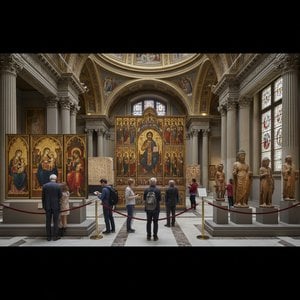
Sacred Narratives Embodied: A Comprehensive Exploration of Religious Iconography in Art History
Explore the rich history of religious iconography in art! Discover symbolism, movements & masterpieces from Byzantine to Renaissance periods. Expert insights for collectors and enthusiasts at ArtsDot.

Echoes of Faith: Devotion as Central Theme in Western Art History
Explore the rich history of religious art with ArtsDot.com! Discover iconic artworks, symbolism & techniques from antiquity to the Renaissance. Enhance your art appreciation today.