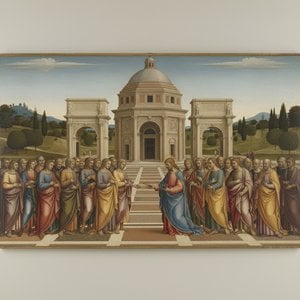
Agnolo Bronzino – Florentine Master of Reserved Elegance
Agnolo di Cosimo, known to history as Bronzino, emerged from the vibrant artistic landscape of Renaissance Florence in 1503, a period already brimming with genius. Born the son of a butcher, his path diverged sharply from familial trade, guided instead by an innate talent that would see him become one of the most sought-after portraitists of his era and a defining figure of Mannerism. His early training began with Raffaellino del Garbo, but it was under the tutelage of Jacopo da Pontormo that Bronzino’s artistic sensibilities truly took shape. While absorbing Pontormo's innovative style, he ultimately forged his own distinct voice—one characterized by a cool composure and refined detail markedly different from his teacher’s often emotionally charged works. This early period was also influenced by studies with Andrea del Sarto, exposing him to the legacies of Michelangelo and Leonardo da Vinci, foundational influences that would subtly permeate his mature style. The young Bronzino quickly demonstrated an aptitude for capturing not just physical likeness but a certain psychological depth, even in his earliest commissions.Early Influences and Artistic Development
Bronzino’s formative years were marked by exposure to the artistic titans of Florence—Michelangelo Buonarroti and Leonardo da Vinci—whose monumental sculptures and groundbreaking paintings profoundly shaped his aesthetic sensibilities. He absorbed Pontormo's daring experimentation with perspective and color, pushing boundaries beyond what was considered acceptable at the time. Simultaneously, he honed his technical skills under Andrea del Sarto’s guidance, mastering the meticulous rendering of drapery and achieving an unparalleled level of realism in his portraits. This confluence of influences instilled in him a commitment to precision and intellectual rigor—qualities that would characterize his entire artistic career. His early works reveal a fascination with idealized beauty and a subtle awareness of humanist thought, foreshadowing the stylistic developments that would define Mannerism.Ascension at the Medici Court – Patronage and Artistic Output
Bronzino’s fortunes dramatically shifted when he secured the patronage of Cosimo I de’ Medici, Duke of Tuscany—a relationship cemented after he contributed to the opulent celebrations commemorating Cosimo's wedding to Eleonora di Toledo in 1539. This prestigious commission propelled him to the forefront of Florentine art and afforded him access to unparalleled resources for artistic production. During his reign, Cosimo entrusted Bronzino with decorating the chapel dedicated to Eleonora—a monumental undertaking spanning two decades that showcased his versatility as a fresco painter. The resulting murals are breathtaking in their scale and ambition, demonstrating Bronzino’s mastery of technique and his ability to convey complex narratives through visual imagery. He produced numerous portraits of members of the Medici family, capturing not merely physical likeness but conveying an aura of aristocratic dignity and restrained emotion. These works solidified his reputation as Florence's premier court painter—a role he upheld with unwavering dedication until his death in 1572.The Mannerist Style – Characteristics and Innovations
Bronzino’s artistic style is undeniably Mannerist—a movement that emerged in Italy during the mid-16th century as a deliberate reaction against the harmonious idealism of the High Renaissance. Unlike Michelangelo and Leonardo, who sought to represent the human form with anatomical accuracy and emotional fervor, Bronzino prioritized stylistic refinement above all else. His figures are often elongated and stylized, rendered with an unsettling stillness that defies natural movement—a hallmark of Mannerist aesthetics. He employed a palette dominated by cool colors—pale blues, greens, and yellows—creating compositions characterized by ethereal beauty and subtle ambiguity. Venus, Cupid, Folly and Time exemplifies this approach perfectly: the figures are positioned in poses that seem frozen in time, their expressions deliberately devoid of emotion. Bronzino’s meticulous attention to detail—the textures of fabrics, the gleam of jewels, the delicate rendering of facial features—elevated his portraits to levels of artistic sophistication previously unattainable. He skillfully manipulated perspective and illusionistic techniques to create immersive environments that captivated viewers' imaginations.Legacy and Enduring Influence
Agnolo Bronzino’s contribution to Renaissance art is undeniable. His stylistic innovations profoundly impacted subsequent generations of artists, establishing Mannerism as a dominant aesthetic force across Europe. Beyond his technical prowess, Bronzino possessed an intellectual curiosity—a fascination with mythology and allegory that informed his artistic vision. He wasn't merely replicating reality; he sought to transcend it through artifice and stylistic control—a pursuit that continues to inspire admiration today. His portraits remain iconic representations of aristocratic power and elegance—testaments to the enduring beauty of Mannerist refinement. Bronzino’s legacy extends beyond individual artworks; he helped shape the visual language of the Renaissance court, influencing artistic conventions for centuries to come. He is remembered as a master craftsman who elevated portraiture to new heights of sophistication—a figure whose influence resonates powerfully within the annals of art history.- Born: Florence, Italy, 1503
- Died: Florence, Italy, 1572
- Key Movement: Mannerism
- Notable Works: *Venus, Cupid, Folly and Time*, Portraits of Cosimo I de’ Medici and Eleonora di Toledo
Kysymykset ja vastaukset
Miten löydän tietyn teeman mukaisia Agnolo Bronzino teoksia?
Agnolo Bronzino:n teoksia voi tutkia avainsanoittain artistin Avainsanojen mukaan -sivulla. Jokainen avainsana kokoaa yhteen aiheeseen liittyvät teokset.
Onko Agnolo Bronzino teoksista saatavilla aikajana?
Agnolo Bronzino'n teokset ovat nähtävissä aikajärjestyksessä artistin Teosten aikajana -sivulla.
Mistä voin löytää tilastoja Agnolo Bronzino teoksista?
Tiedot Agnolo Bronzino:n teoksista löytyvät artistin Tilastot -sivulta.