
- Inicio

- Impresión en lienzo
- Thomas Eakins
- Home Ranch
 Encargar reproducción Comprar imagen en alta resolución
 Enviar
 Compartir
 Details
 Añadir a favoritos

 Descargar
 Similares
 X-Ray
X-Ray
 Presentación de diapositivas
Home Ranch


 Ver más
Giclée / Impresión de arte
Impresión giclée o en lienzo de calidad de museo con producción rápida y opciones de acabado flexibles.




P118B $10

P118H $10

P118W $10

P438Z $10

P508JH $12

P508YH $12

P805H $10

P805Z $10

P919BZ $10

P919G $10

P919XJ $10

P959ZH $10

P968JZ $12

W106C $8

W218G $10

W218JH $8

W218Y $10

W307PJ $10

W316G $10

W316PJ $8

W316Y $10

W398PJ $8

W4111J $10

W500HY $15

W500JH $15

W692G $12

W849H $8

W940BG $15

W953PJ $8




Elija entre nuestros tamaños predefinidos que respetan las proporciones originales de la obra.

Puede introducir sus propias dimensiones para adaptarse a un marco o espacio específico. Si el tamaño seleccionado no coincide con las proporciones de la imagen original, recortaremos la obra de arte o extenderemos la imagen con un borde con efecto espejo o de color sólido. Se enviará una maqueta digital para su aprobación antes de que comience la producción.
Tenga en cuenta que la vista previa en pantalla no refleja el recorte o la extensión real. Solo la maqueta mostrará con precisión la composición final.
Aunque existen tamaños personalizados, recomendamos seleccionar una dimensión de la lista predefinida para preservar las proporciones originales.
Entrega mundial () en 2 semanas en lugar de las 4/5 semanas estándar. (2 julio)

Envío exprés gratuito a todo el mundo

Lienzo de lino de alta calidad

Seguro de envío total

Garantía de reembolso de impuestos aduaneros

Garantía de fidelidad de color

Política de devolución de 60 días (solo por defectos)

Garantía de devolución del 100% del dinero

Descuento por pedido múltiple
 La opción de vidrio solo está disponible en tamaños inferiores a 110 cm.

Home Ranch
Giclée / Impresión de arte
Tamaño de la reproducción
-


Precio total final
-
Descripción de la obra
The Quiet Drama of Everyday Life
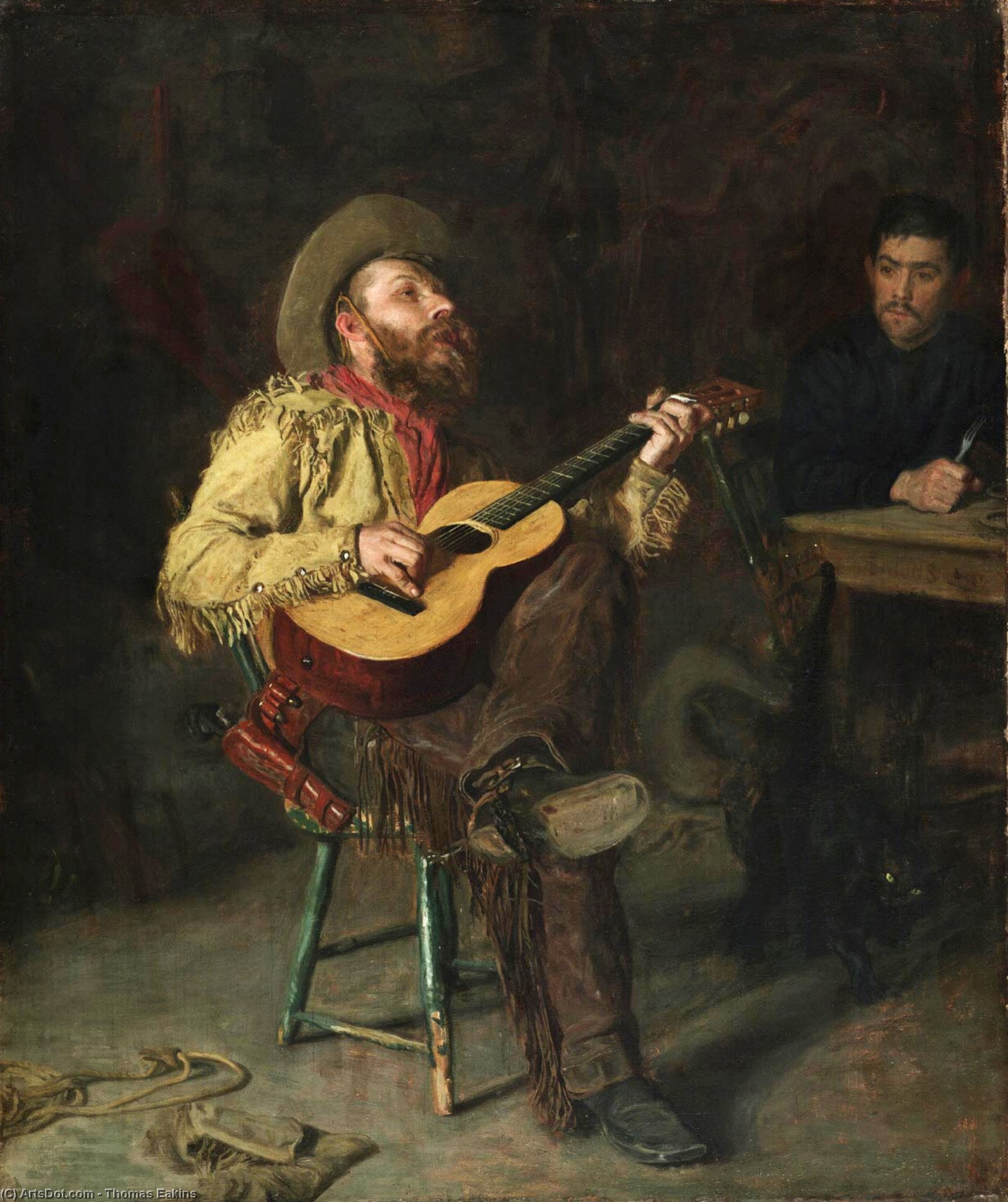
Thomas Eakins’s “Home Ranch,” painted in 1892 and now residing within the Philadelphia Museum of Art, isn't a grand historical tableau or a dramatic portrait; instead, it offers a remarkably intimate glimpse into the domestic sphere of late 19th-century America. It’s a scene seemingly devoid of overt narrative – a man playing the guitar, two figures observing him, a table laden with books – yet within this simplicity lies a profound exploration of human connection, observation, and the subtle nuances of social interaction. Eakins, a master of realism, eschewed romanticism or idealized representations in favor of an unflinching honesty that captured the essence of his subjects’ lives as he witnessed them.
The painting immediately draws the eye to the central figure, a man absorbed in his music. His posture is relaxed yet focused, his expression hinting at both contentment and perhaps a touch of melancholy. He's not performing for an audience; rather, he seems lost within his own world, creating a private moment of enjoyment. The other figures – a woman and a younger man – are rendered with equal care, their gazes directed towards the musician with varying degrees of interest and contemplation. Eakins’s skill lies in conveying these unspoken exchanges—the shared experience of music, the quiet observation, the subtle dynamics of relationships—without resorting to explicit gestures or dialogue.
A Masterclass in Composition and Light
Eakins's compositional choices are meticulously considered. The room itself is rendered with a remarkable sense of depth and spatial awareness. The placement of the furniture – the dining table, chairs, and books – establishes a comfortable, lived-in atmosphere. Notice how the light, soft and warm, filters through the windows, casting gentle shadows that define the forms and create a sense of intimacy. This use of light isn’t merely decorative; it's integral to the painting’s mood, contributing significantly to the relaxed and casual ambiance.
The artist’s attention to detail is astonishing. The texture of the clothing, the sheen of the guitar strings, the worn surfaces of the furniture – all are rendered with painstaking accuracy. Eakins was a student of anatomy and observation, and this dedication to realism extends beyond mere representation; it reflects a deep understanding of how light interacts with form and how materials possess unique qualities. The subtle variations in tone and color create a sense of visual richness that invites close examination.
The Context of American Realism
"Home Ranch" is firmly rooted within the context of American realism, a movement that emerged in the late 19th century as a reaction against romanticism and idealization. Artists like Eakins sought to depict everyday life with honesty and objectivity, often focusing on working-class subjects and urban environments. Philadelphia, where Eakins spent much of his career, provided a rich source of inspiration—a city of factories, row houses, and diverse communities.
Eakins’s work challenged conventional notions of portraiture by eschewing traditional formal poses and idealized representations. Instead, he captured his subjects in candid moments, revealing their personalities and experiences. “Home Ranch” exemplifies this approach, offering a glimpse into the private lives of ordinary people—a testament to Eakins's belief that beauty and significance could be found in the most unassuming scenes.
Owning a Piece of History
Hand-painted reproductions of "Home Ranch" by Thomas Eakins offer art enthusiasts a unique opportunity to bring this iconic work into their homes. These meticulously crafted reproductions capture the painting’s rich detail, vibrant colors, and evocative atmosphere with remarkable fidelity. Whether displayed in a formal living room or a more casual space, “Home Ranch” will undoubtedly serve as a captivating conversation piece—a window into the world of American realism and a celebration of Eakins's artistic genius.
Obras similares


Biografía del artista
Una vida dedicada a capturar la realidad
Thomas Cowperthwait Eakins, pintor realista estadounidense, fotógrafo, escultor y educador en bellas artes, dejó una huella imborrable en el lienzo de la historia del arte americano. Nacido el 25 de julio de 1844 en Filadelfia, Pensilvania, su vida fue un testimonio de su inquebrantable dedicación a capturar la esencia de la realidad.Primeros años y educación
Los primeros años de Eakins estuvieron marcados por su agudo interés en el dibujo y las ciencias. Asistió a la escuela secundaria central y luego estudió en la Academia de Bellas Artes de Pensilvania, donde perfeccionó sus habilidades en dibujo y anatomía. Su tiempo en Europa, particularmente bajo la tutela de Jean-Léon Gérôme en París, influyó significativamente en su enfoque artístico.Una carrera definida por el realismo
La obra de Eakins se caracteriza por su implacable realismo, una característica que lo distinguía de sus contemporáneos. Sus retratos, que suman varios cientos, ofrecen una visión conmovedora del tejido intelectual y social de finales del siglo XIX y principios del XX en Filadelfia. Obras notables incluyen Max Schmitt en una Cesta de Remo Individual, que no solo muestra la maestría de Eakins para capturar el movimiento, sino también su profundo interés en la forma humana.Enseñanza y controversia
El período de Eakins como instructor en la Academia de Bellas Artes de Pensilvania se caracterizó tanto por la influencia como por la controversia. Su enfoque docente, que enfatizaba la importancia de estudiar la forma humana desde la vida, a menudo provocaba fricciones con sus colegas. Esto, junto con escándalos personales, truncó su éxito y dañó su reputación durante su vida.Legado
A pesar de los desafíos que enfrentó, Eakins es ahora celebrado como "el realista más fuerte y profundo en el arte estadounidense del siglo XIX y principios del XX". Su obra se puede encontrar en varios museos, incluido el Museo Metropolitano de Arte, que alberga varias de sus obras notables.- El campeón en una cesta de remo individual (Max Schmitt en una cesta de remo individual) - Una obra fundamental que muestra la temprana maestría de Eakins para capturar el movimiento.
- Thomas Eakins - Explore la extensa colección de obras de Eakins en ArtsDot, ofreciendo una inmersión profunda en su evolución artística y estilo.
- Wikipedia: Thomas Eakins - Profundice en la completa entrada de Wikipedia sobre Eakins, que detalla su vida, influencias y el impacto de su obra en la historia del arte americano.

Thomas Eakins
1844 - 1916 , Estados Unidos de América
Datos clave
- Artistas Que Influyeron: ['Jean-Léon Gérôme']
- Fecha De Fallecimiento: 25 de junio de 1916
- Fecha De Nacimiento: 25 de julio de 1844
- Lugar De Nacimiento: Filadelfia, Estados Unidos
- Movimiento Artístico: Realismo estadounidense
- Nacionalidad: Estadounidense
- Nombre Completo: Thomas Cowperthwait Eakins
- Obras Notables:
- La Clínica Gross
- Max Schmitt en una cesta individual
- El Agnew Clinic
Artículos relacionados

La Escuela del Cubo de Basura: Realismo Urbano y la Democratización del Arte Americano
Exploramos la Escuela del Cubo de Basura y el realismo urbano americano. Descubre cómo este movimiento artístico revolucionó la representación de la sociedad, democratizando el arte y desafiando las convenciones estéticas tradicionales.

Realismo Contemporáneo: 10 Obras Maestras que Transformaron el Arte |
Descubre 10 obras maestras del Realismo Contemporáneo que revolucionaron el arte. Explora la historia, técnica y emociones de artistas como Lucian Freud y Gerhard Richter. Reproducciones de alta calidad en .

Abbott Handerson Thayer: Ethereal Realism & Spiritual Symbolism in American Art
Explore the captivating world of Abbott Handerson Thayer, a pioneer of American realism & Symbolism. Discover his ethereal angel paintings, innovative techniques, and lasting influence on art history. Learn about his scientific pursuits & Transcendentalist spirit.

Los 10 Maestros del Realismo Académico: Obras que Marcaron la Historia del Arte
Descubre los 10 lienzos más emblemáticos del Realismo Académico. Explora la historia, técnica y belleza de obras maestras de Bouguereau, Gérôme y Cabanel. Encuentra reproducciones de arte clásico en ArtsDot.com.

Realismo Estadounidense: 10 Obras Maestras que Cambiaron el Arte y la Decoración
Descubre 10 obras maestras del Realismo Estadounidense: Winslow Homer, Edward Hopper y más. Explora la historia, técnica y emoción de estos icónicos cuadros. Encuentra reproducciones de arte de museo en ArtsDot.com.



