- Inicio

- Impresión en lienzo
- Johannes Vermeer
- El Arte de Pintar

 Encargar reproducción Comprar imagen en alta resolución
 Enviar
 Compartir
 Details
 Añadir a favoritos

 Descargar
 Similares
 X-Ray
X-Ray
 Presentación de diapositivas
El Arte de Pintar


Giclée / Impresión de arte
Impresión giclée o en lienzo de calidad de museo con producción rápida y opciones de acabado flexibles.
 Leer más información



P118B $10

P118H $10

P118W $10

P438Z $10

P508JH $12

P508YH $12

P805H $10

P805Z $10

P919BZ $10

P919G $10

P919XJ $10

P959ZH $10

P968JZ $12

W106C $8

W218G $10

W218JH $8

W218Y $10

W307PJ $10

W316G $10

W316PJ $8

W316Y $10

W398PJ $8

W4111J $10

W500HY $15

W500JH $15

W692G $12

W849H $8

W940BG $15

W953PJ $8




Elija entre nuestros tamaños predefinidos que respetan las proporciones originales de la obra.

Puede introducir sus propias dimensiones para adaptarse a un marco o espacio específico. Si el tamaño seleccionado no coincide con las proporciones de la imagen original, recortaremos la obra de arte o extenderemos la imagen con un borde con efecto espejo o de color sólido. Se enviará una maqueta digital para su aprobación antes de que comience la producción.
Tenga en cuenta que la vista previa en pantalla no refleja el recorte o la extensión real. Solo la maqueta mostrará con precisión la composición final.
Aunque existen tamaños personalizados, recomendamos seleccionar una dimensión de la lista predefinida para preservar las proporciones originales.
Entrega mundial () en 2 semanas en lugar de las 4/5 semanas estándar. (1 julio)

Envío exprés gratuito a todo el mundo

Lienzo de lino de alta calidad

Seguro de envío total

Garantía de reembolso de impuestos aduaneros

Garantía de fidelidad de color

Política de devolución de 60 días (solo por defectos)

Garantía de devolución del 100% del dinero

Descuento por pedido múltiple
 La opción de vidrio solo está disponible en tamaños inferiores a 110 cm.

El Arte de Pintar
Giclée / Impresión de arte
Tamaño de la reproducción
-


Precio total final
-
Descripción de la obra
The Art of Painting (detail)
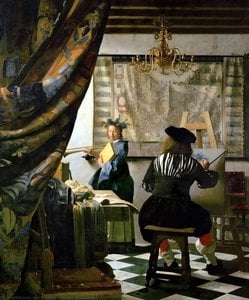
Johannes Vermeer’s “The Art of Painting,” completed in 1665, stands as an unparalleled testament to Dutch Golden Age artistry and a profound meditation on the creative process itself. Owned by the Austrian Republic and housed within the Kunsthistorisches Museum in Vienna, this monumental canvas transcends mere depiction; it aspires to capture the very essence of artistic endeavor—a daring ambition realized with breathtaking precision and luminous color. As eloquently described on ArtsDot.com, Vermeer’s masterpiece embodies a masterful blend of observation, illusionism, and intellectual contemplation.Composition and Iconography: An Allegory Embodied
The painting's complexity derives from its meticulously crafted composition and richly layered iconography—a deliberate choice reflecting Vermeer’s fascination with the allegorical tradition prevalent during his time. At its core lies a scene depicting an artist diligently engaged in painting before a woman who serves as his model, bathed in the soft glow of candlelight emanating from a window. Surrounding them are objects imbued with symbolic significance: a detailed map of the Low Countries dominates the background, representing knowledge and exploration; a chair positioned against the wall symbolizes contemplation and repose; and various tools—brushes, palettes, and pigments—speak to the practical realities of artistic creation. The inclusion of these elements elevates “The Art of Painting” beyond a simple portrait into an elaborate visual metaphor for the pursuit of art itself. As noted on Wikipedia, Vermeer’s work is considered one of the most famous of its era, lauded for its innovative use of perspective and atmospheric effects.Technique: Light and Color as Instruments of Expression
Vermeer's unparalleled skill lies in his masterful manipulation of light—a technique that distinguishes him from many of his contemporaries. The artist employs chiaroscuro—the dramatic interplay between light and shadow—to sculpt the figures and surfaces within the canvas, creating an illusionistic depth that draws the viewer into the scene. Vermeer’s meticulous layering of glazes—thin coats of translucent paint—allows for subtle gradations of color and texture, resulting in a luminous quality unmatched by other painters of his generation. This painstaking attention to detail is evident throughout the painting, from the delicate rendering of drapery folds to the shimmering surface of the map—a testament to Vermeer’s dedication to achieving photographic realism.Historical Context: The Dutch Golden Age and Artistic Innovation
“The Art of Painting” emerged during the apex of the Dutch Golden Age—a period characterized by unprecedented economic prosperity, artistic flourishing, and intellectual curiosity. Vermeer's work aligns seamlessly with the broader cultural currents of his time, reflecting a humanist interest in observation and representation—values championed by thinkers like René Descartes and Francis Bacon. The painting’s depiction of domestic life—a genre favored by Vermeer—captures the spirit of the era, portraying a scene of quiet contemplation amidst the comforts of home. Furthermore, Vermeer's influence extended beyond his immediate surroundings, inspiring subsequent artists and shaping the trajectory of Dutch art history. As highlighted on ArtsDot.com, Vermeer’s legacy continues to resonate today, cementing his place as one of the most revered figures in European painting.Emotional Impact: A Window into Artistic Soul
Ultimately, “The Art of Painting” transcends its formal elements—composition, technique, and iconography—to convey a profound emotional resonance. The woman's gaze—downcast yet thoughtful—suggests an inner life brimming with contemplation and artistic aspiration. Vermeer’s masterful depiction captures not merely the appearance of his subject but also her psychological state—a feat accomplished through subtle gestures and nuanced expressions. This ability to evoke emotion—to transport the viewer into the artist’s world—is what distinguishes Vermeer's work from mere visual spectacle, elevating it to a timeless masterpiece that speaks across centuries. As noted on Kunsthistorisches Museum’s website, “The Art of Painting” remains an enduring symbol of artistic creativity and intellectual pursuit.Obras similares


Biografía del artista
vida y carrera
johannes vermeer, una figura destacada en la edad de oro holandesa, nació en octubre de 1632 en Delft, Países Bajos. Es conocido por sus cautivadoras escenas domésticas que ofrecen una mirada íntima a la vida de la clase media durante este período. La carrera artística de Vermeer estuvo marcada por un manejo profundo de la luz y un meticuloso enfoque en la pintura. La familia de Vermeer estuvo involucrada en el comercio artístico, con su padre, Reijnier Jansz, siendo un comerciante de arte. Esta exposición probablemente influyó en la decisión de Vermeer de seguir una carrera en la pintura. Se casó con Catharina Bolnes, una mujer católica, en abril de 1653 y tuvieron dos hijos juntos.Estilo artístico y obras notables
Las pinturas de Vermeer se caracterizan por el uso de pigmentos costosos y un énfasis en la vida cotidiana. Algunas de sus obras más notables incluyen:- La carta de amor (c. 1665), una obra maestra que muestra la habilidad de Vermeer para capturar los matices de la vida doméstica.
- Vista de Delft (c. 1660-1670), un cuadro que ejemplifica la capacidad de Vermeer para equilibrar la luz y la composición.
- La hilandera (c. 1659-1660), una obra que destaca la atención al detalle y la fascinación de Vermeer por las actividades cotidianas de las mujeres.
Legado y redescubrimiento
El modesto éxito de Vermeer durante su vida dio paso a la oscuridad después de su muerte. Sin embargo, su redescubrimiento en el siglo XIX por Gustav Friedrich Waagen y Théophile Thoré-Bürger condujo a un aumento significativo en su popularidad. Hoy en día, Vermeer es reconocido como uno de los pintores más grandes del edad de oro holandesa, con sus obras muy apreciadas por coleccionistas y museos de todo el mundo.- Descubra más sobre la vida y obra de Vermeer en ArtsDot.com.
- Explore la colección del Museo Mauritshuis, que presenta muchas de las obras maestras de Vermeer, en ArtsDot.com.
- Aprenda más sobre la edad de oro holandesa y su influencia en la pintura occidental en wikipedia.

Johannes Vermeer
1632 - 1675 , Países Bajos
Datos clave
- Artistas Que Influyeron:
- Pieter de Hooch
- Gerard ter Borch
- Estilo Artístico: Barroco, Realismo
- Fecha De Muerte: Diciembre 1675
- Fecha De Nacimiento: Octubre 1632
- Lugar De Nacimiento: Delft, Países Bajos
- Nacionalidad: Holandés
- Nombre Completo: Johannes Vermeer
- Obras Notables:
- La carta de amor
- Vista de Delft
- La hilandera
- La joven con la perla
- El concierto
Artículos relacionados

Los 10 Maestros del Siglo de Oro Holandés: Arte, Historia y Decoración Exclusiva
Descubre los 10 imprescindibles del Siglo de Oro Holandés: Rembrandt, Vermeer y más. Explora la historia, técnica y belleza de estos lienzos clásicos. Encuentra reproducciones de arte exclusivas para decorar tu hogar en .


The Bountiful Still Life: Symbolism & Artistic Representation of Fruit Across Art History
Explore the rich history of still life painting & the symbolism of fruit across art movements. Discover masterpieces from Caravaggio to Cézanne with ArtsDot – expert guidance & museum-quality reproductions.

Reflejos de una Época Dorada: La Pintura Barroca Holandesa y la Innovación Cultural
Descubra la riqueza y el detalle de la pintura barroca holandesa del Siglo de Oro. Explore las obras maestras de Rembrandt, Vermeer y otros artistas clave. Análisis experto e historia cultural.

Silent Narratives: Exploring the Enduring Appeal of Still Life Painting Across Centuries
Explore the rich history of still life painting with ArtsDot. Discover Dutch Masters, decode vanitas symbolism & learn about collecting timeless art. Expert insights and museum-quality reproductions.

Frans Hals I: Innovation, Intimacy & the Dutch Golden Age Portrait
Explore the revolutionary portraiture of Frans Hals I, a master of the Dutch Golden Age. Discover his innovative techniques, captivating character studies & lasting impact on art history. Learn more at ArtsDot.