
- Inicio

- Reproducción al óleo
- Fernand Léger
- String Constructors
 Comprar impresión Comprar imagen en alta resolución
 Enviar
 Compartir
 Detalles
 Añadir a favoritos

 Descargar
 Similares
 Rayos X
 Presentación de diapositivas
String Constructors

 Ver más
Reproducción al óleo hecha a mano
Óleo sobre lienzo pintado a mano en el tamaño y marco de su elección, realizado por encargo por nuestros artistas.




P118B $10

P118H $10

P118W $10

P438Z $10

P508JH $12

P508YH $12

P805H $10

P805Z $10

P919BZ $10

P919G $10

P919XJ $10

P959ZH $10

P968JZ $12

W106C $8

W218G $10

W218JH $8

W218Y $10

W307PJ $10

W316G $10

W316PJ $8

W316Y $10

W398PJ $8

W4111J $10

W500HY $15

W500JH $15

W692G $12

W849H $8

W940BG $15

W953PJ $8




Elija entre nuestros tamaños predefinidos que respetan las proporciones originales de la obra.

Puede ingresar sus propias dimensiones para adaptarse a un marco o espacio específico. Si el tamaño seleccionado no coincide con las proporciones de la imagen original, recortaremos la obra o extenderemos la pintura con elementos adicionales pintados a mano. Se le enviará una maqueta digital para su aprobación antes de comenzar la producción.
Tenga en cuenta que la vista previa en pantalla no refleja el recorte o la extensión reales. Solo la maqueta mostrará con precisión la composición final.
Si bien existen tamaños personalizados, recomendamos seleccionar una dimensión de la lista predefinida para preservar las proporciones originales.
Tras realizar el pedido, el equipo de WahooArt.com enviará un correo electrónico al cliente para solicitar instrucciones y proporcionarle una vista previa del boceto.
Entrega mundial () en 3-4 semanas en lugar de las 5 semanas estándar. (2 julio). Sin compromisos con la calidad.

Envío exprés gratuito a todo el mundo

Lienzo de lino de alta calidad

Seguro de envío total

Garantía de reembolso de impuestos aduaneros

Garantía de fidelidad de color

Política de devolución de 60 días (solo por defectos)

Garantía de devolución del 100% del dinero

Descuento por pedido múltiple
 La opción de vidrio solo está disponible en tamaños inferiores a 110 cm.

String Constructors
Técnica de reproducción
Tamaño de la reproducción
-


Precio total final
-
Descripción de la obra
Fernand Léger’s “String Constructors”: A Symphony of Steel and Soul
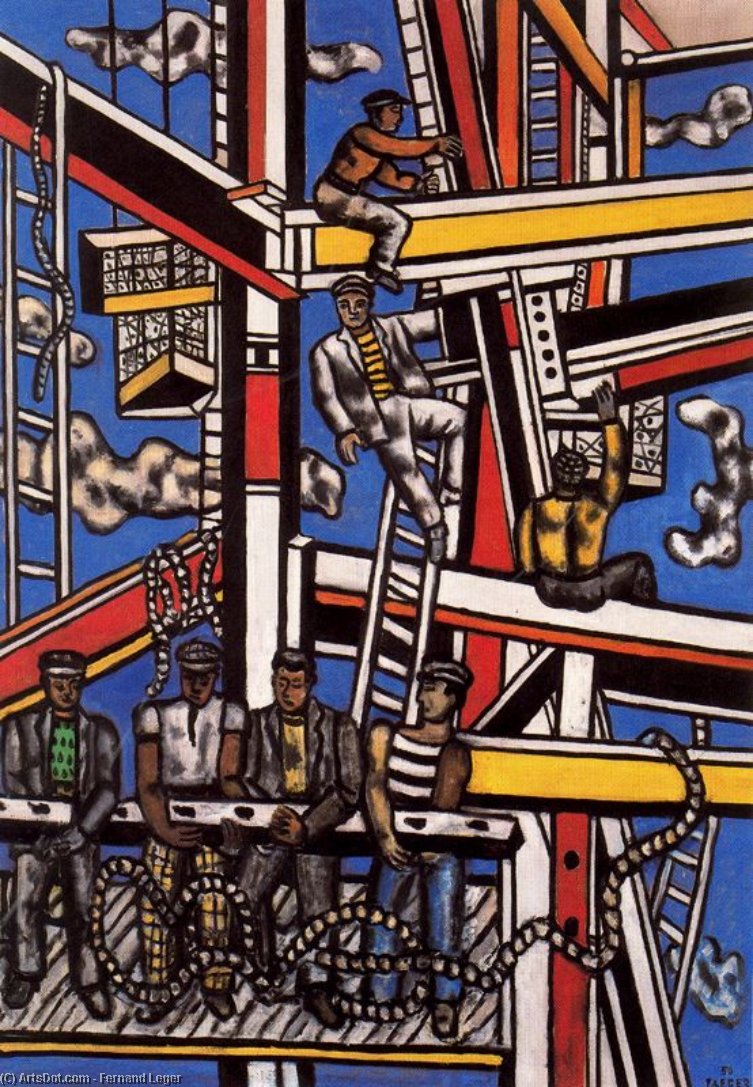
The painting "String Constructors" by Fernand Léger isn't merely an image; it’s a declaration—a bold assertion that the anxieties and exhilarations of industrial progress could be rendered in terms of pure visual form. Completed in 1923, during the height of Léger’s engagement with Cubism and Surrealism, this monumental canvas embodies the artist’s fascination with both geometric abstraction and the burgeoning influence of technology on human experience. It resides within a broader artistic movement grappling with questions of perception and representation, rejecting traditional illusionistic techniques in favor of fractured planes and overlapping perspectives—a stylistic choice that mirrors the fragmented reality of the era.- Style & Technique: Léger’s Cubist approach is evident in the deliberate dismantling of objects into constituent geometric shapes – cubes, cylinders, spheres – which are then recomposed in a manner that simultaneously suggests solidity and instability. The painting utilizes a predominantly monochromatic palette dominated by shades of blue, punctuated by flashes of yellow and red, creating an arresting visual rhythm. Léger’s distinctive technique involves applying paint thickly—sometimes almost sculptural—to the canvas surface, resulting in textured brushstrokes that convey both physicality and dynamism.
- Historical Context: The painting emerged from a period marked by rapid industrial expansion and growing apprehension about the dehumanizing effects of urbanization. Léger’s artistic concerns mirrored those prevalent in intellectual circles of his time—a preoccupation with the impact of machines on human consciousness and social life. He actively sought to capture the energy and rhythm of the factory floor, translating its visual vocabulary into a new aesthetic language.
Symbolism & Conceptual Depth
Beyond its formal qualities, “String Constructors” is laden with symbolic significance. Léger deliberately avoids depicting recognizable figures or objects—instead opting for abstracted forms that represent not individuals but rather the collective experience of labor and construction. The repetitive geometric shapes symbolize the relentless cycle of production and transformation inherent in industrial society. Furthermore, the bold colors – particularly yellow and red – convey a sense of urgency and excitement, reflecting the optimism associated with technological advancement during the interwar years. Léger’s intention wasn't simply to depict what he saw; it was to communicate an underlying philosophical proposition about the relationship between humanity and machinery.- Emotional Impact: The painting evokes a complex emotional response—a mixture of fascination, apprehension, and perhaps even melancholy. Léger’s masterful use of texture and color creates a palpable sense of movement and energy, mirroring the frenetic pace of the industrial landscape. Yet, beneath the surface dynamism lies an underlying feeling of isolation and fragmentation—a reflection of the psychological toll exacted by modernity.
Legacy & Influence
“String Constructors” stands as a cornerstone of Léger’s oeuvre and exerted considerable influence on subsequent generations of artists. Its pioneering exploration of geometric abstraction paved the way for developments in Surrealist painting and sculpture, demonstrating that artistic innovation could arise from confronting seemingly disparate influences—the rigor of Cubism and the dreamlike imagery of Surrealism. Léger's unwavering commitment to translating the visual language of industrial society into a new aesthetic idiom continues to inspire artists today who grapple with questions of representation and perception in an increasingly technologically mediated world.Obras similares





Biografía del artista
vida temprana y formación
fernand léger, un pintor, escultor y cineasta francés, nació el 4 de febrero de 1881 en Argentán, Orne, Baja Normandía. Su padre criaba ganado, y Léger inicialmente se formó como arquitecto de 1897 a 1899. Luego se mudó a París en 1900, ganándose la vida como dibujante arquitectónico.desarrollo artístico
El trabajo temprano de Léger estuvo influenciado por el impresionismo, como se ve en le jardin de ma mère (mi madre's garden) (1905). Después de asistir a la escuela de artes decorativas y la academia Julian, comenzó a trabajar seriamente como pintor a los 25 años. Su estilo evolucionó hacia una forma personal del cubismo, que los críticos denominaron "tubismo" por su énfasis en las formas cilíndricas.cubismo y el grupo puteaux
En 1910, Léger expuso en el salón de otoño junto a jean metzinger y henri le fauconnier. Se unió al grupo puteaux, también conocido como la sección dorada (la sección de oro), junto con otros artistas como francis picabia y marcel duchamp.guerra y su influencia en el trabajo de léger
Las experiencias de Léger en la Primera Guerra Mundial impactaron significativamente su obra. Durante su tiempo en el frente, produjo dibujos de piezas de artillería, aviones y soldados compañeros. Su pintura soldier with a pipe (1916) refleja este período.obra posterior y legado
La obra posterior de Léger, caracterizada por formas mecánicas y elegantes, lo vinculó a la tradición de la pintura figurativa francesa. Sus paisajes animados de 1921 mostraron figuras y animales en formas armoniosas y aerodinámicas.- ver obras de fernand léger en WahooArt
- más sobre fernand léger en wikipedia
- descubra el musée national fernand léger (francia) con WahooArt
- la mujer sentada (100 x 81 cm, tubismo)
- elemento de máquina (cubismo)

Fernand Léger
1881 - 1955 , Francia
Datos clave
- Artistas Influenciados Por: ['Pop Art']
- Artistas Que Influyeron:
- Cézanne
- Impresionismo
- Fecha De Nacimiento: 4 de febrero de 1881
- Lugar De Nacimiento: Argentan, Francia
- Movimiento Artístico:
- Cubismo
- Tubismo
- Nacionalidad: Francés
- Nombre Completo: Fernand Léger
- Obras Notables:
- La Mujer Sentada
- Elemento de Máquina
- El Gran Desfile
- Paisajes Animados
Artículos relacionados

La Sutileza del Neutro: Explorando la Abstracción en Blanco y Negro para una Arquitectura Moderna Elevada
Descubre cómo la abstracción en blanco y negro eleva el diseño arquitectónico moderno. Expertos revelan secretos de iluminación, materiales y minimalismo para espacios sofisticados y atemporales.

Geometric Design in Art: A Historical Survey & Contemporary Appeal for Collectors
Explore the enduring legacy of geometric abstraction! Discover key artists, historical movements & investment insights for discerning art collectors. Expert guidance from WahooArt.

Los 10 Maestros del Cubismo: Obras que Revolucionaron el Arte | WahooArt
Descubre los 10 lienzos cubistas que revolucionaron el arte moderno. Explora las obras maestras de Picasso, Braque y Gris en WahooArt.com. Reproducciones de alta calidad para tu hogar.

Precisionismo: Estética Industrial y la Modernidad en el Arte Estadounidense
Descubra el Precisionismo: un movimiento artístico estadounidense único que celebra la era industrial. Análisis de Demuth, O'Keeffe y consejos para coleccionistas exigentes. Explore su legado en WahooArt.

Arte Industrial: 10 Obras Maestras para un Hogar con Carácter | WahooArt.com
Descubre 10 obras maestras que capturan la esencia del arte industrial. Explora la historia de Van Gogh, Hopper y Klimt, sus técnicas y paletas. Encuentra lienzos perfectos para un hogar con carácter en WahooArt.com.



