


 Vista previa
 Compartir
 Compartir
 Ver detalles

 Descargar
 Ver similares
 Radiografía
 Presentación de diapositivas
Painting
 Acrylic
- WallArt
- Cubist Abstraction
 1926
1926 65.0 x 46.0 cm
 Leer más
Reproducción al óleo hecha a mano
Óleo sobre lienzo pintado a mano en el tamaño y marco de su elección, realizado por encargo por nuestros artistas. ( Pedir impresión Comprar descarga)




P118B $10

P118H $10

P118W $10

P438Z $10

P508JH $12

P508YH $12

P805H $10

P805Z $10

P919BZ $10

P919G $10

P919XJ $10

P959ZH $10

P968JZ $12

W106C $8

W218G $10

W218JH $8

W218Y $10

W307PJ $10

W316G $10

W316PJ $8

W316Y $10

W398PJ $8

W4111J $10

W500HY $15

W500JH $15

W692G $12

W849H $8

W940BG $15

W953PJ $8




Elija entre nuestros tamaños predefinidos que respetan las proporciones originales de la obra.

Puede ingresar sus propias dimensiones para adaptarse a un marco o espacio específico. Si el tamaño seleccionado no coincide con las proporciones de la imagen original, recortaremos la obra o extenderemos la pintura con elementos adicionales pintados a mano. Se le enviará una maqueta digital para su aprobación antes de comenzar la producción.
Tenga en cuenta que la vista previa en pantalla no refleja el recorte o la extensión reales. Solo la maqueta mostrará con precisión la composición final.
Si bien existen tamaños personalizados, recomendamos seleccionar una dimensión de la lista predefinida para preservar las proporciones originales.
Tras realizar el pedido, el equipo de ArtsDot.com enviará un correo electrónico al cliente para solicitar instrucciones y proporcionarle una vista previa del boceto.
Envío a todo el mundo () en 3-4 semanas en lugar de las 5 semanas estándar. (15 agosto). Sin comprometer la calidad.

Envío exprés gratuito a todo el mundo

Lienzo de lino de alta calidad

Seguro de envío completo

Garantía de reembolso de aranceles aduaneros

Garantía de fidelidad cromática exacta

Política de devolución de 60 días (solo por defectos)

Garantía de devolución del 100% del dinero

Oferta por volumen
 La opción de vidrio solo está disponible en tamaños inferiores a 110 cm.

Painting
Técnica de reproducción
Tamaño de la reproducción
-


Precio total
$ 263
Descripción de la obra
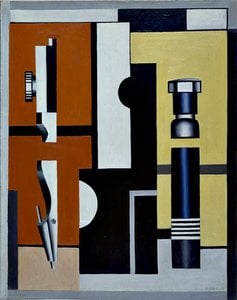
A Fragmented Reality: Léger’s ‘Painting’ (1926) – An Exploration of Modernity
Fernand Léger's 1926 work, simply titled 'Painting,' is a captivating and unsettling meditation on the burgeoning world of industrial modernity. This intimate canvas, measuring 65 x 46 cm, immediately draws the viewer into a carefully constructed tableau – a collision of domestic objects and human figures that speaks volumes about the anxieties and aspirations of the interwar period. The composition itself feels deliberately fragmented, mirroring the sense of dislocation experienced as traditional ways of life were irrevocably altered by technological advancement. Léger wasn't simply depicting machinery; he was attempting to capture its *spirit*, a restless energy that permeated every aspect of urban existence.
- Subject Matter: The painting’s subject matter is deliberately ambiguous, presenting a collection of tools – a knife, scissors, and pliers – alongside two human figures. This juxtaposition immediately raises questions about labor, utility, and the increasingly mechanized nature of work.
- Compositional Dynamics: The placement of these objects and figures creates a dynamic tension. The knife’s assertive presence on the left, contrasted with the more passive positioning of the scissors and pliers, suggests a struggle between control and vulnerability.
The Language of Cubism and Machine Aesthetics
Léger's style is firmly rooted in the principles of Cubism, but he pushed beyond its purely analytical concerns. While Picasso and Braque sought to dissect objects into geometric forms, Léger embraced a more constructive approach, integrating these fractured elements back together to represent not just form, but also movement and energy. The bold, angular shapes – particularly evident in the tools themselves – evoke the sharp lines of industrial machinery, reflecting Léger’s fascination with the dynamism of the machine age. Notice how he avoids smooth transitions; instead, he favors abrupt shifts in tone and texture, further amplifying the sense of disruption.
The clock, subtly placed on the left side, adds another layer of complexity. It's not merely a decorative element but a potent symbol of time – a relentless force accelerating towards an uncertain future. This detail underscores Léger’s concern with the impact of modernity on human experience and the potential for alienation within a rapidly changing world.
Symbolism and Emotional Resonance
The two figures, positioned at opposite ends of the canvas, are equally enigmatic. Their anonymity suggests that they represent humanity as a whole – individuals caught in the currents of industrialization. Their postures, though not overtly expressive, convey a sense of quiet contemplation or perhaps even apprehension. The overall effect is one of unease and disorientation, reflecting the anxieties of a society grappling with profound social and technological shifts.
Léger’s use of color – primarily muted tones punctuated by flashes of brighter hues – contributes to this emotional impact. The cool blues and grays evoke a sense of distance and detachment, while the occasional bursts of red or yellow inject moments of intensity and urgency. This careful manipulation of color further enhances the painting's symbolic weight.
A Legacy of Modern Art
Created in 1926, ‘Painting’ exemplifies Léger’s pivotal role in shaping modern art. His work bridged the gap between abstraction and representation, offering a uniquely insightful commentary on the challenges and possibilities of modernity. This hand-painted reproduction captures not only the visual details of the original but also the profound emotional and intellectual depth that makes it such a compelling masterpiece. It's a piece that invites contemplation – a reminder of our relationship with technology, time, and the ever-evolving nature of reality.
Obras relacionadas




Biografía del artista
vida temprana y formación
fernand léger, un pintor, escultor y cineasta francés, nació el 4 de febrero de 1881 en Argentán, Orne, Baja Normandía. Su padre criaba ganado, y Léger inicialmente se formó como arquitecto de 1897 a 1899. Luego se mudó a París en 1900, ganándose la vida como dibujante arquitectónico.desarrollo artístico
El trabajo temprano de Léger estuvo influenciado por el impresionismo, como se ve en le jardin de ma mère (mi madre's garden) (1905). Después de asistir a la escuela de artes decorativas y la academia Julian, comenzó a trabajar seriamente como pintor a los 25 años. Su estilo evolucionó hacia una forma personal del cubismo, que los críticos denominaron "tubismo" por su énfasis en las formas cilíndricas.cubismo y el grupo puteaux
En 1910, Léger expuso en el salón de otoño junto a jean metzinger y henri le fauconnier. Se unió al grupo puteaux, también conocido como la sección dorada (la sección de oro), junto con otros artistas como francis picabia y marcel duchamp.guerra y su influencia en el trabajo de léger
Las experiencias de Léger en la Primera Guerra Mundial impactaron significativamente su obra. Durante su tiempo en el frente, produjo dibujos de piezas de artillería, aviones y soldados compañeros. Su pintura soldier with a pipe (1916) refleja este período.obra posterior y legado
La obra posterior de Léger, caracterizada por formas mecánicas y elegantes, lo vinculó a la tradición de la pintura figurativa francesa. Sus paisajes animados de 1921 mostraron figuras y animales en formas armoniosas y aerodinámicas.- ver obras de fernand léger en ArtsDot
- más sobre fernand léger en wikipedia
- descubra el musée national fernand léger (francia) con ArtsDot
- la mujer sentada (100 x 81 cm, tubismo)
- elemento de máquina (cubismo)

Fernand Léger
1881 - 1955 , Francia
Datos clave
- Artistas Influenciados Por: ['Pop Art']
- Artistas Que Influyeron:
- Cézanne
- Impresionismo
- Fecha De Nacimiento: 4 de febrero de 1881
- Lugar De Nacimiento: Argentan, Francia
- Movimiento Artístico:
- Cubismo
- Tubismo
- Nacionalidad: Francés
- Nombre Completo: Fernand Léger
- Obras Notables:
- La Mujer Sentada
- Elemento de Máquina
- El Gran Desfile
- Paisajes Animados
Artículos relacionados

Fernand Léger: Las 25 Obras Maestras del Tubismo y la Vanguardia Francesa | ArtsDot
Descubre las 25 obras maestras de Fernand Léger, pionero del tubismo y la vanguardia francesa. Explora su estética industrial, composiciones geométricas y vibrantes colores. Reproducciones de arte exclusivas en ArtsDot.com.

Abstracción Geométrica: 10 Obras Maestras que Transformaron el Arte Moderno | ArtsDot
Descubre las 10 obras maestras de la abstracción geométrica que revolucionaron el arte moderno. Explora a Mondrian, Malevich y Kandinsky en ArtsDot.com. Reproducciones de alta calidad para tu hogar.

Kandinsky: Las 25 Obras Maestras del Pionero de la Abstracción | ArtsDot
Descubre las 25 obras maestras de Wassily Kandinsky, pionero del arte abstracto. Explora su expresionismo, composiciones únicas y la historia detrás de cada cuadro. Reproducciones de alta calidad para decorar tu hogar con arte moderno en ArtsDot.com.

Beyond Form & Color: Geometric Abstraction's Evolution in 20th/21st Century Art
Explore the evolution of geometric abstraction from Cubism to contemporary art. Discover key artists like Malevich & Mondrian, investment insights, and expert collecting advice at ArtsDot.

Beyond Form & Color: Geometric Abstraction's Enduring Legacy in Art History
Explore the captivating world of geometric abstraction! Discover its origins, key artists like Malevich & Mondrian, and why this movement remains highly valued by art collectors today. Expert insights at ArtsDot.



