


 Compartir
 Compartir
 Ver detalles
 Guía
Guía

 Descargar
 Ver artículos similares
 Presentación de diapositivas
 Estadísticas
Audincourt window
 Stained Glass
- Decor
- Cubist Expressionism
 Modern
 35.0 x 92.0 cm
 Leer más
Giclée / Impresión de arte
Impresiones giclée o en lienzo de calidad de museo con producción rápida y opciones de acabado flexibles. ( Encargar reproducción pintada a mano Ver versión en imagen digital)




































Elija entre nuestros tamaños predefinidos que respetan las proporciones originales de la obra.

Puede introducir sus propias dimensiones para adaptarse a un marco o espacio específico. Si el tamaño seleccionado no coincide con las proporciones de la imagen original, recortaremos la obra de arte o extenderemos la imagen con un borde con efecto espejo o de color sólido. Se enviará una maqueta digital para su aprobación antes de que comience la producción.
Tenga en cuenta que la vista previa en pantalla no refleja el recorte o la extensión real. Solo la maqueta mostrará con precisión la composición final.
Aunque existen tamaños personalizados, recomendamos seleccionar una dimensión de la lista predefinida para preservar las proporciones originales.
Envío a todo el mundo () en 2 semanas en lugar de las 4/5 semanas estándar. (13 octubre)

Envío exprés gratuito a todo el mundo

Lienzo de lino de alta calidad

Seguro de envío completo

Garantía de reembolso de impuestos aduaneros

Garantía de fidelidad cromática exacta

Política de devolución de 100 días (solo por defectos)

Garantía de devolución del 100% del dinero

Oferta por volumen
 La opción de vidrio solo está disponible en tamaños inferiores a 110 cm.

Audincourt window
Giclée / Impresión de arte
Tamaño de la reproducción
-


Precio total
€ 54
A Symphony of Light and Geometry
To step before Fernand Léger’s Audincourt Window is to witness a profound dialogue between the ancient tradition of stained glass and the relentless pulse of the modern age. Created in 1952, this masterpiece serves as a luminous manifesto of Purism, an artistic movement that sought to strip away the sentimental shadows of Impressionism in favor of the clean, structural clarity found in the industrial world. The window does not merely sit within its frame; it breathes with a rhythmic vitality, transforming light into a geometric symphony of primary colors. Through the meticulous arrangement of vibrant blues, sun-drenched yellows, and deep reds, Léger invites the viewer into a space where the boundaries between art and architecture dissolve, replaced by a mesmerizing dance of interlocking planes.
The composition is a masterclass in what Léger famously termed Tubism—a specialized evolution of Cubism that prioritizes cylindrical, robust forms and bold, tubular shapes. In this particular work, the artist eschews the delicate nuances of naturalistic detail to embrace a more powerful, simplified visual language. The eye is led through a labyrinth of thick black outlines and saturated hues, creating a sense of structural integrity that feels almost architectural in its strength. There is no attempt at illusionistic depth here; instead, Léical celebrates the two-dimensional surface, using the refraction of light through the glass to create a mosaic-like texture that shifts and evolves as the sun moves across the sky.
The Spirit of the Machine Age
Deeply rooted in the historical context of mid-20th-century France, the Audincourt Window reflects Léger’s lifelong fascination with the beauty of mechanization. Commissioned for the Église du Sacré-Cœur in Audincourt, the work represents a daring intersection of sacred space and secular modernity. While the setting is ecclesiastical, the visual vocabulary is decidedly industrial. The shapes evoke the rhythmic pulse of machinery, the strength of steel, and the organized energy of a city in motion. This was Léger’s unique gift: the ability to find the divine within the functional, and to see the poetic potential in the rigid lines of the modern landscape.
For the discerning collector or interior designer, this piece offers more than just aesthetic appeal; it provides an emotional anchor of strength and clarity. The bold, unapologetic use of color can serve as a striking focal point in a contemporary setting, injecting a sense of dynamism and intellectual rigor into a room. Whether viewed as a window into the past or a blueprint for a modern aesthetic, the Audincourt Window remains a timeless testament to the transformative power of form. It is an invitation to rediscover the world not through its fleeting shadows, but through its enduring, vibrant structures.
Preguntas y respuestas
¿Cuál es el color dominante de "Audincourt window" de Fernand Léger?
El color dominante de "Audincourt window" de Fernand Léger es Phthalo Green (#221b19).
¿Quién creó "Audincourt window"?
"Audincourt window" fue creada por Fernand Léger. La información en esta página describe la obra original de Fernand Léger.
¿Cómo equilibra la luz y la sombra "Audincourt window"?
"Audincourt window" tiene un brillo general de deep_shadow y su luminancia es Soft Shadow.
¿A qué se debe el estado de los derechos de autor de "Audincourt window"?
"Audincourt window" de Fernand Léger es de en el dominio público: sus derechos de autor han expirado. La duración de los derechos de autor comienza a partir del fallecimiento del artista, que ocurrió en 1955.
¿Está "Audincourt window" libre de derechos de autor?
La información sobre los derechos de autor de "Audincourt window" de Fernand Léger: la obra es en el dominio público: sus derechos de autor han expirado. Esto determina si las reproducciones de la imagen pueden realizarse libremente.
¿Muestra "Audincourt window" contrastes marcados entre luces y sombras?
"Audincourt window" de Fernand Léger muestra un contraste Statement entre sus zonas de luz y sombra.
¿Para qué estancia se recomienda "Audincourt window" de Fernand Léger?
El espacio recomendado para "Audincourt window" de Fernand Léger es un Living Room. Por supuesto, esta sugerencia puede adaptarse a su interiorismo.
¿Qué tan armoniosos son los colores de "Audincourt window" de Fernand Léger?
La armonía cromática de "Audincourt window" se describe como Discordant Palette.
Obras relacionadas


Biografía del artista
vida temprana y formación
fernand léger, un pintor, escultor y cineasta francés, nació el 4 de febrero de 1881 en Argentán, Orne, Baja Normandía. Su padre criaba ganado, y Léger inicialmente se formó como arquitecto de 1897 a 1899. Luego se mudó a París en 1900, ganándose la vida como dibujante arquitectónico.desarrollo artístico
El trabajo temprano de Léger estuvo influenciado por el impresionismo, como se ve en le jardin de ma mère (mi madre's garden) (1905). Después de asistir a la escuela de artes decorativas y la academia Julian, comenzó a trabajar seriamente como pintor a los 25 años. Su estilo evolucionó hacia una forma personal del cubismo, que los críticos denominaron "tubismo" por su énfasis en las formas cilíndricas.cubismo y el grupo puteaux
En 1910, Léger expuso en el salón de otoño junto a jean metzinger y henri le fauconnier. Se unió al grupo puteaux, también conocido como la sección dorada (la sección de oro), junto con otros artistas como francis picabia y marcel duchamp.guerra y su influencia en el trabajo de léger
Las experiencias de Léger en la Primera Guerra Mundial impactaron significativamente su obra. Durante su tiempo en el frente, produjo dibujos de piezas de artillería, aviones y soldados compañeros. Su pintura soldier with a pipe (1916) refleja este período.obra posterior y legado
La obra posterior de Léger, caracterizada por formas mecánicas y elegantes, lo vinculó a la tradición de la pintura figurativa francesa. Sus paisajes animados de 1921 mostraron figuras y animales en formas armoniosas y aerodinámicas.- ver obras de fernand léger en ArtsDot
- más sobre fernand léger en wikipedia
- descubra el musée national fernand léger (francia) con ArtsDot
- la mujer sentada (100 x 81 cm, tubismo)
- elemento de máquina (cubismo)

Fernand Léger
1881 - 1955 , Francia
Datos clave
- Artistas Influenciados Por: ['Pop Art']
- Artistas Que Influyeron:
- Cézanne
- Impresionismo
- Fecha De Nacimiento: 4 de febrero de 1881
- Lugar De Nacimiento: Argentan, Francia
- Movimiento Artístico:
- Cubismo
- Tubismo
- Nacionalidad: Francés
- Nombre Completo: Fernand Léger
- Obras Notables:
- La Mujer Sentada
- Elemento de Máquina
- El Gran Desfile
- Paisajes Animados
Artículos relacionados
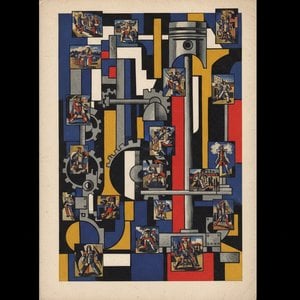
Fernand Léger: Las 25 Obras Maestras del Tubismo y la Vanguardia Francesa | ArtsDot
Descubre las 25 obras maestras de Fernand Léger, pionero del tubismo y la vanguardia francesa. Explora su estética industrial, composiciones geométricas y vibrantes colores. Reproducciones de arte exclusivas en ArtsDot.com.

Beyond Form & Color: Geometric Abstraction's Evolution in 20th/21st Century Art
Explore the evolution of geometric abstraction from Cubism to contemporary art. Discover key artists like Malevich & Mondrian, investment insights, and expert collecting advice at ArtsDot.

Arte Industrial: 10 Obras Maestras para un Hogar con Carácter | ArtsDot.com
Descubre 10 obras maestras que capturan la esencia del arte industrial. Explora la historia de Van Gogh, Hopper y Klimt, sus técnicas y paletas. Encuentra lienzos perfectos para un hogar con carácter en ArtsDot.com.
Geometric Design in Art: A Historical Survey & Contemporary Appeal for Collectors
Explore the enduring legacy of geometric abstraction! Discover key artists, historical movements & investment insights for discerning art collectors. Expert guidance from ArtsDot.

Abstracción Geométrica: 10 Obras Maestras que Transformaron el Arte Moderno | ArtsDot
Descubre las 10 obras maestras de la abstracción geométrica que revolucionaron el arte moderno. Explora a Mondrian, Malevich y Kandinsky en ArtsDot.com. Reproducciones de alta calidad para tu hogar.


