
- Inicio

- Reproducción al óleo
- edward thomas daniell
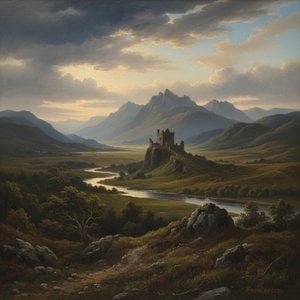
- Mountain Landscape, Castle Ruins

 Comprar impresión Comprar imagen en alta resolución
 Enviar
 Compartir
 Details
 Añadir a favoritos

 Descargar
 Similares
 X-Ray
X-Ray
 Presentación de diapositivas
Mountain Landscape, Castle Ruins
 Romanticism
 1842
1842 15.0 x 13.0 cm
Reproducción al óleo hecha a mano
Óleo sobre lienzo pintado a mano en el tamaño y marco de su elección, realizado por encargo por nuestros artistas.




































 Leer más información
Elija entre nuestros tamaños predefinidos que respetan las proporciones originales de la obra.

Puede ingresar sus propias dimensiones para adaptarse a un marco o espacio específico. Si el tamaño seleccionado no coincide con las proporciones de la imagen original, recortaremos la obra o extenderemos la pintura con elementos adicionales pintados a mano. Se le enviará una maqueta digital para su aprobación antes de comenzar la producción.
Tenga en cuenta que la vista previa en pantalla no refleja el recorte o la extensión reales. Solo la maqueta mostrará con precisión la composición final.
Si bien existen tamaños personalizados, recomendamos seleccionar una dimensión de la lista predefinida para preservar las proporciones originales.
Tras realizar el pedido, el equipo de ArtsDot.com enviará un correo electrónico al cliente para solicitar instrucciones y proporcionarle una vista previa del boceto.
Entrega mundial () en 3-4 semanas en lugar de las 5 semanas estándar. (1 julio). Sin compromisos con la calidad.

Envío exprés gratuito a todo el mundo

Lienzo de lino de alta calidad

Seguro de envío total

Garantía de reembolso de impuestos aduaneros

Garantía de fidelidad de color

Política de devolución de 60 días (solo por defectos)

Garantía de devolución del 100% del dinero

Descuento por pedido múltiple
 La opción de vidrio solo está disponible en tamaños inferiores a 110 cm.

Mountain Landscape, Castle Ruins
Técnica de reproducción
Tamaño de la reproducción
-


Precio total final
-
Obras similares


Biografía del artista
A Life Immersed in Light: The World of Edward Thomas Daniell
Edward Thomas Daniell, born in London on June 6th, 1804, was an artist whose life unfolded as a delicate interplay between scholarly pursuits and a profound passion for capturing the beauty of the natural world. Though his career was tragically cut short at the age of thirty-eight, Daniell left behind a remarkable body of work – exquisite watercolors and finely wrought etchings that offer a captivating glimpse into the landscapes of Norfolk and the exotic allure of the Middle East. He wasn’t merely documenting scenes; he was translating atmosphere, light, and a deep sense of place onto paper with an almost poetic sensibility. His story is one of quiet dedication, artistic influence, and a yearning for exploration that ultimately defined his legacy as a key figure within the Norwich School of painters.Early Years and Artistic Formation
Daniell’s formative years were steeped in the artistic traditions of Norfolk. Raised in a relatively affluent family, he benefited from early instruction in drawing by John Crome, a leading light of the Norwich School. This foundational training instilled in him an appreciation for direct observation and a commitment to representing the subtleties of the English countryside. He further honed his skills under the guidance of Joseph Stannard, another prominent member of the school, learning the techniques of watercolor painting that would become so central to his artistic expression. However, Daniell’s education wasn't solely focused on art; he pursued classical studies at Balliol College, Oxford, graduating in 1828 before taking holy orders and becoming a curate in Banham, Norfolk, in 1832. This dual path – the intellectual rigor of academia and the emotional pull of artistic creation – shaped his unique perspective. Even during his time as a clergyman, Daniell remained deeply engaged with the art world, acting as a patron to William Blake and fostering a close friendship with John Linnell, who would later paint his portrait.The Influence of Turner and Cotman
While firmly rooted in the Norwich School tradition, Daniell’s work also reveals the significant influence of J.M.W. Turner and John Sell Cotman. He developed a close relationship with Turner during his curacy in London, becoming one of the artist's confidants. Turner’s mastery of light and atmosphere, his ability to evoke emotion through color and composition, undoubtedly left an indelible mark on Daniell’s approach to landscape painting. Similarly, he admired Cotman’s emphasis on simplicity and tonal values, a characteristic that is evident in the refined clarity of his etchings. Daniell synthesized these influences, creating a style that was both deeply personal and distinctly modern for its time. He wasn't simply imitating; he was absorbing techniques and principles to develop his own visual language – one characterized by sensitivity, precision, and an almost ethereal quality.A Journey to the Middle East and Artistic Maturity
In 1840, Daniell made a pivotal decision that would profoundly impact his artistic output: he resigned his curacy and embarked on a journey to the Middle East. Traveling through Egypt, Palestine, and Syria, he was captivated by the exotic landscapes, ancient ruins, and vibrant cultures he encountered. This expedition culminated in his participation in Sir Charles Fellows’s archaeological dig in Lycia (modern-day Turkey) as an illustrator. It was during this period that Daniell produced some of his most celebrated works – watercolors and etchings depicting the dramatic scenery and historical remnants of the region. These images are not merely topographical records; they convey a sense of wonder, a fascination with the past, and a deep appreciation for the beauty of decay. He captured the play of light on crumbling architecture, the textures of ancient stone, and the atmosphere of these remote and historically rich locations with remarkable skill.Legacy and Historical Significance
Tragically, Daniell’s time in the Middle East was cut short by illness. He contracted malaria while in Lycia and died at Adalia on September 23rd, 1842, leaving behind a relatively small but highly significant body of work. His etchings, in particular, are prized for their exceptional quality and rarity – formal editions were rarely printed, making original impressions exceedingly scarce. Daniell’s contribution to the Norwich School lies not only in his skillful depictions of landscape but also in his pioneering approach to etching.- His works anticipated the ‘plein air’ techniques of the Etching Revival, emphasizing direct observation and a spontaneous rendering of light and atmosphere.
- He demonstrated an exceptional ability to capture the essence of place, conveying not just visual details but also the emotional resonance of his surroundings.
- His sensitivity to tonal values and refined clarity set him apart from many of his contemporaries.

edward thomas daniell
1804 - 1842
Datos clave
- Artistic Movement Or Style: Norwich School
- Artists Or Movements Influenced By This Artist:
- Turner Inspired Art
- Cotman Style Art
- Artists Who Influenced This Artist:
- John Crome
- J.M.W. Turner
- John Sell Cotman
- Date Of Birth: 6 June 1804
- Date Of Death: 24 September 1842
- Full Name: Edward Thomas Daniell
- Nationality: English
- Notable Artworks: ['Whitlingham Lane']
- Place Of Birth: London, United Kingdom
Artículos relacionados

Thomas Daniell: Navigating Light, Landscape & Cultural Exchange in Early 19th-Century India
Explore the captivating landscapes of Thomas Daniell, a pioneering artist who documented India's beauty in the 19th century. Discover his 'Oriental Scenery,' aquatint technique & lasting legacy. Hand-painted reproductions available at ArtsDot.

Alexander Nasmyth: Picturing Scotland's Romantic Landscape – Innovation & Identity
Explore the life & art of Alexander Nasmyth, a pivotal figure in Scottish Romantic landscape painting. Discover his iconic works, including portraits of Robert Burns, and learn about his lasting influence on national identity. Fine art reproductions available.

The Evocative Embrace of Reality: Exploring Romantic Realism in 19th-Century Painting
Explore the captivating world of Romantic Realism! Discover key artists like Courbet & Millet, masterpieces, and the social context behind this influential art movement. Expert insights for collectors at ArtsDot.

Thomas Hill: Luminosity, Landscape & the American Pastoral Ideal
Explore the luminous landscapes of Thomas Hill, a pivotal figure in the Hudson River School & Luminism movements. Discover his artistic journey, philosophical depth, and enduring legacy with ArtsDot.

Thomas Baines: Pioneering Landscape Art & Visual Documentation of 19th-Century Southern Africa
Explore the life & art of Thomas Baines, a pioneering British explorer and artist who documented 19th-century Southern Africa & Australia. Discover his stunning landscapes, war paintings, and invaluable cartographic contributions.

