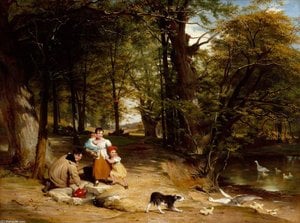
Stepping Stones On The Machno, North Wales - Study From Nature
Mid-Day Rest, Harvest
Stacking Hay,
Died: 1865
Nationality: United Kingdom
Movements: romanticism
Corpus themes: romantic landscape ideals
William Frederick Witherington (1785–1865): Painter of Tranquil English Landscapes
William Frederick Witherington RA was a distinguished English painter and academic who achieved renown for his serene depictions of rural England and intimate portrayals of family life. Born in London in 1785, he embarked on an artistic journey that began with enrollment at the Royal Academy Schools in 1805, establishing him firmly within the influential artistic circles of his time. Throughout his prolific career spanning over five decades, Witherington consistently exhibited annually at the Royal Academy from 1811 until his passing in 1865, cementing his reputation as a respected artist and contributing significantly to the visual record of Victorian Britain.
Early Life & Training: Witherington’s formative years were spent honing his artistic skills at the Royal Academy Schools, where he absorbed influences from prominent contemporaries like George Morland, whose emphasis on capturing the essence of rural landscapes profoundly impacted Witherington's stylistic approach.
Royal Academician Recognition: His election as A.R.A. in 1830 and subsequently R.A. in 1840 represented a pinnacle of artistic achievement, signifying his acceptance into the highest echelon of British art institutions and affording him considerable prestige within the scholarly community.
Notable Paintings & Subjects: Witherington’s oeuvre is characterized by meticulously rendered landscapes—particularly scenes of idyllic English countryside—that eschewed dramatic narratives in favor of capturing tranquil moments of domestic life. Works such as “The Ford” and “Noon Day Rest” exemplify his masterful technique and unwavering dedication to portraying the beauty of rural England with understated elegance.
Influence & Artistic Style: Like Augustus Wall Callcott, RA, Witherington skillfully blended vibrant foreground figures—often animals—with distant vistas to create compositions brimming with visual interest. His style mirrored Morland’s commitment to depicting realistic details while prioritizing emotional resonance, resulting in paintings that convey a palpable sense of peace and contentment.
Legacy & Historical Significance: Witherington's contribution to Victorian art is undeniable; he served as an academician until 1863, shaping the artistic landscape of his era and leaving behind a body of work that continues to inspire admiration for its sensitivity and accuracy. His paintings offer invaluable insights into the social customs and aesthetic sensibilities of the period.
Key Paintings & Artistic Techniques
Witherington’s artistic vision centered around capturing the subtle nuances of rural life, prioritizing observation and meticulous detail over grand theatrical displays. He skillfully employed oil paints—a favored medium during his time—to achieve remarkable tonal gradations and textural richness, mirroring Morland's influence in this regard. The artist’s compositions often featured balanced arrangements of figures and animals against expansive landscapes, creating a harmonious visual dialogue that conveyed both realism and emotional depth. “The Dancing Bear” stands as a testament to Witherington’s ability to convey emotion through careful observation and skillful brushwork.
Further Exploration
For a deeper understanding of William Frederick Witherington's artistic legacy, consider visiting the Marshall M. Fredericks Sculpture Museum in University Center, Michigan, where you can admire reproductions of his paintings alongside sculptures by other prominent artists. Alternatively, explore Knole House, a historic estate showcasing British art and history—a place where visitors can immerse themselves in the cultural context that shaped Witherington’s artistic sensibilities. Finally, delve into Frederick Douglass National Historic Site to gain insight into the artist's personal life and his engagement with social issues of his time.
By the ArtsDot.com Editorial Team
Quick quiz
There is only one correct answer for each question.
Explore the captivating landscapes of Alfred Worthington (1834-1927), a pivotal figure bridging Victorian realism & early Impressionism. Discover his Welsh hunting scenes, artistic evolution, and collecting guide.
Explore the life & art of Sir Frederic Leighton, a master of Victorian Aestheticism. Discover his academic training, sculptural innovations, and captivating depictions of beauty. Expert insights for collectors.