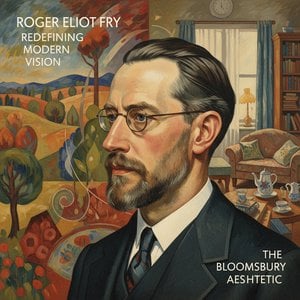
A Pioneer of Modern Vision: The Life and Legacy of Roger Fry
Roger Eliot Fry, a name synonymous with the introduction of modern art to Britain, was far more than simply a painter or critic; he was a cultural catalyst. Born in 1866 into a prosperous Quaker family in Highgate, London, Fry’s early life was steeped in intellectual curiosity and a liberal atmosphere that fostered his burgeoning artistic sensibilities. Though initially directed towards the sciences at Cambridge University – where he engaged with freethinking societies like the Conversazione Society – Fry's true calling lay in the realm of visual expression. He soon abandoned scientific pursuits to study painting in Paris and Italy, honing his skills primarily in landscape work, yet it was not as a practicing artist that he would leave his most indelible mark on the art world.
Championing the New: Post-Impressionism and Beyond
Fry’s enduring legacy rests upon his visionary role as an advocate for what he termed “Post-Impressionism.” Recognizing the profound shift occurring in French painting, he championed artists like Paul Cézanne, Vincent van Gogh, Paul Gauguin, and Henri Matisse – figures largely unknown or misunderstood by the British public at the turn of the 20th century. He perceived within their work a radical departure from traditional representational art, an emphasis on formal qualities—line, color, mass, and design—that resonated with his own evolving aesthetic principles. This wasn’t merely about appreciating beautiful pictures; it was about understanding a new visual language, one that prioritized the artist's subjective experience and the inherent properties of the medium itself.
This conviction culminated in two groundbreaking exhibitions at London’s Grafton Galleries in 1910 and 1912. These shows were nothing short of revolutionary, though initially met with considerable controversy and even ridicule. The British art establishment, accustomed to academic realism, was scandalized by the bold colors, distorted forms, and unconventional compositions on display. Yet, despite the initial uproar, these exhibitions proved instrumental in introducing Post-Impressionist ideas to a wider audience, planting the seeds for a fundamental shift in British taste. Fry didn’t just present these artists; he provided a critical framework for understanding them, articulating their significance in essays and lectures that became foundational texts for modern art appreciation.
A Multifaceted Artistic Voice
While celebrated primarily as a critic and curator, Roger Fry was also an active painter. His artistic output, though less widely recognized than his critical writings, reveals a thoughtful exploration of form and color. Early works often featured straightforward naturalistic portraits or landscapes, demonstrating a solid technical skill. However, influenced by the very artists he championed, Fry’s style gradually evolved towards greater abstraction. He didn't aspire to be a professional portraitist; rather, he sought to capture “the delight of unexpected beauty,” imbuing his subjects with an emotional resonance that transcended mere likeness.
Notable works include "Cowdray Park," which Fry himself considered his most complete artistic statement—a harmonious blend of observation and expressive color. His 1919 painting, “Still Life with T'ang Horse,” stands as a significant foray into abstraction, showcasing the influence of Cubism and Expressionism in its fragmented forms and dynamic composition. Fry also extended his creative energies to ceramics, producing pieces like “Blue glazed side or fruit plate,” demonstrating an interest in craftsmanship and formal design that complemented his broader artistic vision.
Lasting Influence and a Formalist Legacy
Roger Fry’s impact on the British art world is immeasurable. Kenneth Clark famously declared him "incomparably the greatest influence on taste since Ruskin," a testament to his ability to reshape aesthetic preferences within the Anglophone world. His writings, particularly his influential essay “An Essay in Aesthetics,” articulated a formalist approach to art appreciation—emphasizing the importance of visual elements over narrative content—that continues to resonate with scholars and artists today.
Beyond his critical contributions, Fry’s influence extended to the realm of design through his involvement with the Omega Workshops. Founded in 1913, this cooperative venture aimed to create affordable, aesthetically pleasing objects for everyday life, blurring the boundaries between fine art and applied arts. Fry's dedication to promoting modern art paved the way for greater acceptance and understanding of avant-garde movements in Britain, solidifying his place as a pivotal figure in art history—a visionary who dared to challenge conventional norms and open British eyes to the possibilities of a new artistic era.
Questions & Answers
Is there a complete list of Roger Fry's artworks?
Every work by Roger Fry on this website can be browsed from the artist's All Artworks page.
Can I explore Roger Fry's works by keyword?
Roger Fry's works can be explored by keyword on the artist's By Keywords page. Each keyword groups the related artworks.
Which artworks by Roger Fry are the most viewed?
The Stats page of Roger Fry presents statistics computed from the artist's artworks listed on this website.