In short
The Johan Per (Per) Sodermark painting most people know is Karl Jakob Johannes Lindhagen (1817-1857), chief physician at Pro Patria, battalion physician, medical doctor, Ph.D. in surgery (1848), and you can see it at the Nationalmuseum, Stockholm. Right after it come Portrait of Werner Holmberg (1853) and Christoffer Eichhorn (1837-1889), librarian, art historian (1889). Out of 3 works by Johan Per (Per) Sodermark in our catalogue, these 3 are the best known. Each one comes with its year, its museum and a short note on what makes it stand out.
Johan Per (Per) Sodermark's top 10: the pieces everyone knows
Where you can see Johan Per (Per) Sodermark's paintings
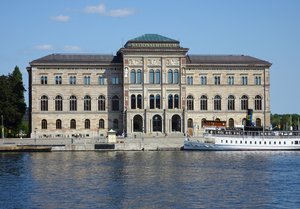
The 2 museums that hold the most of the paintings on this page.
| Museum | City | Works by Johan Per (Per) Sodermark | Paintings from this list |
|---|---|---|---|
| Stockholm | 2 | Karl Jakob Johannes Lindhagen (1817-1857), chief physician at Pro Patria, battalion physician, medical doctor, Ph.D. in surgery, Christoffer Eichhorn (1837-1889), librarian, art historian | |
| Helsinki | 1 | Portrait of Werner Holmberg |
One famous Johan Per (Per) Sodermark piece for every decade
Works per decade
Pick a decade to see its standout piece.
Karl Jakob Johannes Lindhagen (1817-1857), chief physician at Pro Patria, battalion physician, medical doctor, Ph.D. in surgery
Johan Per (Per) Sodermark paintings: what people want to know
What painting is Johan Per (Per) Sodermark best known for?See the answer
Top of the list is Karl Jakob Johannes Lindhagen (1817-1857), chief physician at Pro Patria, battalion physician, medical doctor, Ph.D. in surgery (1848), Nationalmuseum, Stockholm. Right behind it: Portrait of Werner Holmberg (1853) and Christoffer Eichhorn (1837-1889), librarian, art historian (1889).
How old was Johan Per (Per) Sodermark at the time of Karl Jakob Johannes Lindhagen (1817-1857), chief physician at Pro Patria, battalion physician, medical doctor, Ph.D. in surgery?See the answer
26 years old. Johan Per (Per) Sodermark was born in 1822, and Karl Jakob Johannes Lindhagen (1817-1857), chief physician at Pro Patria, battalion physician, medical doctor, Ph.D. in surgery dates from 1848.
How many Johan Per (Per) Sodermark works are there?See the answer
We have 3 works by Johan Per (Per) Sodermark in our catalogue, dated 1848 to 1889.
Which museums have Johan Per (Per) Sodermark's best-known paintings?See the answer
You'll find most of them in Nationalmuseum (Stockholm) and Finnish National Gallery (Helsinki). The museum list above has the full breakdown.
What are the oldest and newest famous paintings by Johan Per (Per) Sodermark?See the answer
The earliest piece here is Karl Jakob Johannes Lindhagen (1817-1857), chief physician at Pro Patria, battalion physician, medical doctor, Ph.D. in surgery (1848); the most recent is Christoffer Eichhorn (1837-1889), librarian, art historian (1889).
What can you see by Johan Per (Per) Sodermark at the Nationalmuseum?See the answer
You can see 2 of the pieces on this page at the Nationalmuseum, Stockholm, including Karl Jakob Johannes Lindhagen (1817-1857), chief physician at Pro Patria, battalion physician, medical doctor, Ph.D. in surgery and Christoffer Eichhorn (1837-1889), librarian, art historian.
Can I order a Johan Per (Per) Sodermark reproduction for my home?See the answer
Yes. Every painting on this page is available as a hand-painted oil reproduction or a print, in the size that suits you. Just open the painting's page to order.
Meet Johan Per (Per) Sodermark
The Soldier and the Studio
Johan Per Södermark stands at a crossroads between military duty and the fine arts. Born in Mossebro, Karlsborg Municipality, on 5 June 1822, his early life follows the disciplined path of his father, Olof Johan Södermark. He enters the military as an Underlöjtnant in 1843, a role that demands precision and observation. The rigidity of service defines his youth, yet the brush remains present. His training begins under his father's guidance before moving to the Royal Swedish Academy of Fine Arts, where he achieves the status of agré in 1848.
The year 1848 brings a sudden shift. He resigns from active military service. The death of his father leaves him with more than just a memory; he inherits a studio. At first, Södermark sustains himself through the labor of copying his father's existing works. This period of imitation acts as a bridge, transitioning him from a man of arms to a man of lithography and paint.
Travels and Technical Evolution
Movement defines his artistic development. He moves through the cultural landscapes of Europe, seeking new light and form. His path takes him to France and Italy, followed by stays in Düsseldorf between 1852 and 1854. In Paris, from 1855 to 1856, he studies under Thomas Couture. These travels expand his repertoire beyond the portraits of his early years.
His work begins to diversify into new territories:
- Portraits: Capturing notable figures such as Nils Blommér, Fritz von Dardel, and the composer Bedřich Smetana.
- Landscapes: Moving away from the strictures of portraiture to capture natural scenery.
- Genre Scenes: Depicting everyday life through narrative painting.
- Lithography: Creating prints that frequently feature Italian motifs.
Legacy in Stockholm
By 1874, Södermark reaches a professional peak as a full member of the Swedish Academy. His presence is felt in major exhibitions, from Copenhagen's Charlottenborg Palace in 1851 to various Nordic Art exhibitions held between 1872 and 1888. He leaves behind a tangible contribution to Swedish collections, having donated his original lithographs to the Nationalmuseum in 1868.
His life concludes in Stockholm on 16 November 1889. While he did not pursue the same level of realistic clarity as his father, his ability to navigate between the roles of officer and artist remains a distinct chapter in Swedish art history. His works remain accessible today through institutions such as the Academy's art gallery, Waldemarsudde, and the Nordic Museum.