In echtem Maßstab anzeigen
 Versenden als Grußkarte
 Teilen
 Details anzeigen
 Leitfaden öffnen

 Herunterladen
 Ähnliche Objekte
 Röntgenaufnahme
 Diashow
 Besucherstatistiken
Landscape Mural
 Oil On Canvas
- WallArt
- Hudson River School
 1852
1852 277.0 x 232.0 cm
 Taft Museum of Art
 Mehr anzeigen
Giclée / Kunstdruck
Giclée- oder Leinwanddruck in Museumsqualität mit schneller Produktion und flexiblen Veredelungsoptionen. ( Handgemalte Reproduktion kaufen Zum digitalen Bild wechseln)




P118B €10

P118H €10

P118W €10

P438Z €10

P508JH €12

P508YH €12

P805H €10

P805Z €10

P919BZ €10

P919G €10

P919XJ €10

P959ZH €10

P968JZ €12

W106C €8

W218G €10

W218JH €8

W218Y €10

W307PJ €10

W316G €10

W316PJ €8

W316Y €10

W398PJ €8

W4111J €10

W500HY €15

W500JH €15

W692G €12

W849H €8

W940BG €15

W953PJ €8




Wählen Sie aus unseren vordefinierten Formaten, die den ursprünglichen Proportionen des Kunstwerks entsprechen.

Geben Sie die Breite und die Höhe an, die Sie benötigen, damit der Druck perfekt in Ihren Rahmen oder an Ihre Wand passt. Ein Druck kann nur beschnitten werden und niemals größer als das Originalbild gemacht werden; daher verliert ein Format mit einer anderen Proportion einen Teil des Bildes. Wir senden Ihnen ein digitales Mockup zur Freigabe, bevor wir den Druck ausführen. Das auf dieser Seite gezeigte Bild zeigt nicht den tatsächlichen Beschnitt – dies ist nur im Mockup ersichtlich.
Weltweiter Versand () innerhalb von 2 Wochen statt der üblichen 4/5 Wochen. (21 Oktober)

Kostenloser weltweiter Expressversand

Hochwertige Leinenleinwand

Vollständiger Versicherungsschutz beim Versand

Zollgebühren-Rückerstattungsgarantie

Garantie für exakte Farbtreue

100-tägiges Rückgaberecht (nur bei Mängeln)

100% Geld-zurück-Garantie

Angebot für Mengenrabatt
 Die Glasoption ist nur für Größen unter 110 cm verfügbar.

Landscape Mural
Giclée / Kunstdruck
Format der Reproduktion
-


Gesamtpreis
€ 54
A Serene Vision of the Hudson Valley: Robert Seldon Duncanson’s “Landscape Mural”
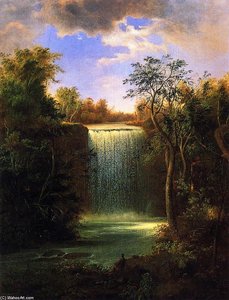
Robert Seldon Duncanson's "Landscape Mural," painted in 1852, isn’t merely a depiction of a river valley; it’s a carefully constructed meditation on nature, memory, and the burgeoning American identity. This monumental work, now residing within the Taft Museum of Art in Cincinnati, Ohio, stands as a pivotal piece of the Hudson River School—a movement that sought to capture the sublime beauty of America's landscapes with scientific precision and Romantic fervor. Duncanson, an African-American artist navigating a deeply segregated society, imbued this painting with layers of meaning, subtly reflecting on themes of race, spirituality, and the relationship between humanity and the natural world.
The scene unfolds beneath a brooding, yet ultimately benevolent, sky – a classic Hudson River School motif. A gently flowing river dominates the composition, its surface mirroring the clouds above in a delicate dance of reflection. The foreground is anchored by a cluster of trees, their branches reaching upwards like supplicating arms, while a distant bridge arches gracefully across the valley, hinting at civilization’s presence without overwhelming the scene's tranquility. Notice the meticulous detail with which Duncanson renders each element – the texture of bark, the ripples in the water, the subtle gradations of color in the foliage. This commitment to realism was paramount for the Hudson River School artists, who sought to elevate landscape painting to a level of scientific accuracy and artistic merit.
The Painter’s Palette: Technique and Materials
Duncanson employed the traditional technique of *fresco secco*, applying his pigments directly onto dry plaster. This method, favored by Renaissance masters, demanded both skill and speed – the artist had to work quickly before the plaster dried and the colors set. The resulting surface is remarkably durable, allowing the painting to retain its vibrancy across centuries. The color palette is predominantly cool—greens, blues, and grays—creating a sense of atmospheric depth and distance. Duncanson masterfully utilizes *chiaroscuro*, the dramatic contrast between light and shadow, to sculpt the forms and heighten the emotional impact of the scene. The subtle variations in tone suggest a soft, diffused light, characteristic of an overcast day – a common occurrence in the Ohio Valley during that period.
A Symbol of Progress and Identity
Beyond its aesthetic beauty, “Landscape Mural” carries significant historical weight. Duncanson’s work emerged during a time of profound social change in America—the abolitionist movement was gaining momentum, and discussions about race and equality were becoming increasingly urgent. While the painting itself doesn't explicitly address these issues, scholars have interpreted it as a subtle commentary on the African-American experience. The river, often associated with journeys and transitions, can be seen as a metaphor for the arduous path to freedom and self-determination. The bridge, representing connection and progress, symbolizes the hope for a more just and equitable future. Furthermore, Duncanson’s decision to depict a serene landscape—a departure from the often-grim realities of life in 19th-century America—suggests a yearning for spiritual renewal and harmony with nature.
Emotional Resonance: A Legacy of Tranquility
Looking at “Landscape Mural” today, one is immediately struck by its profound sense of tranquility. The painting invites the viewer to step into the scene, to breathe in the fresh air, and to lose oneself in the beauty of the natural world. It’s a testament to Duncanson's skill as an artist—his ability to capture not just the appearance of a landscape, but also its emotional essence. The painting’s enduring appeal lies in its capacity to evoke feelings of peace, contemplation, and connection to something larger than oneself. It remains a powerful reminder of the transformative power of art and the importance of preserving our natural heritage.
Fragen & Antworten
Welche Grundfarbe durchzieht "Landscape Mural" von Robert Seldon Duncanson?
"Landscape Mural" tendiert zu einem Green to Violet Spectrum Farbton.
Woraus besteht "Landscape Mural"?
"Landscape Mural" wurde in Oil On Canvas ausgeführt.
Wie gesättigt ist die Farbpalette von "Landscape Mural"?
Die Farben von "Landscape Mural" von Robert Seldon Duncanson weisen eine Balanced Soft Sättigung auf. Die Sättigung beschreibt, wie lebhaft oder gedämpft die Farben sind.
Ähnliche Kunstwerke


Biografie des Künstlers
Robert Seldon Duncanson: Ein Leben und Vermächtnis
- Geboren: Fayetteville, New York (um 1821)
- Gestorben: 21. Dezember 1872
- Herkunft: ArtsDot
Frühes Leben und künstlerische Entwicklung
- Duncansons Familie war von europäischer und afrikanischer Abstammung. Sein Vater, John Dean Duncanson, war ein freier Schwarzer Handwerker, der seinen Kindern den Wert von harter Arbeit und Bildung vermittelte.
- Die Familie zog nach Monroe, Michigan, wo Robert eine Lehre im Zimmermannshandtwerk und Malen absolvierte. Er zeigte frühzeitig Talent für Kunst, was ihn dazu veranlasste, die Porträtmalerei zu verfolgen.
- Im Jahr 1840 zog er nach Cincinnati, Ohio, einem aufstrebenden Kulturzentrum, das als "Athens of the West" bekannt war. Dieses Umfeld bot Möglichkeiten für künstlerisches Wachstum und Exposition.
- Duncanson war weitgehend autodidaktisch und studierte Drucke und Stiche, skizzierte aus der Natur und kopierte Werke anderer Künstler. Er hatte keine formale Ausbildung, entwickelte aber ein scharfes Auge und handwerkliches Geschick.
Künstlerischer Stil und Einflüsse
- Einfluss der Hudson River School: Duncansons Stil wurde stark von der Hudson River School der Landschaftsmalerei beeinflusst, die für ihre romantischen Darstellungen amerikanischer Wildnis bekannt ist. Künstler wie Thomas Cole waren bedeutende Inspirationen.
- Landschaftsfokus: Er verlagerte seinen Schwerpunkt von Porträts hin zur Landschaftsmalerei und fing Szenen des Ohio River Valley und darüber hinaus ein.
- Romantik: Seine Werke vermittelten oft ein Gefühl von Grandiosität, Ruhe und spiritueller Verbindung mit der Natur, was für den Romanticismus typisch ist.
- Farbpalette & Technik: Duncanson verwendete eine reiche Farbpalette und sorgfältige Details in seinen Gemälden und demonstrierte so die Beherrschung seiner Technik.
Wichtige Errungenschaften und Anerkennung
- Frühe Ausstellungen: Seine Werke wurden bereits 1842 an der Cincinnati Academy of Fine Arts ausgestellt, was ihm Anerkennung innerhalb der lokalen Kunstgemeinschaft einbrachte.
- Europäische Reise (1853-1854): Ein bedeutender Wendepunkt in seiner Karriere war eine Reise nach Europa, wo er europäische Meister studierte und seinen künstlerischen Horizont erweiterte.
- Internationale Anerkennung: Duncanson erlangte internationale Anerkennung und stellte seine Werke in England, Schottland, Kanada und den Vereinigten Staaten aus. Er wurde der erste afroamerikanische Künstler, der eine so breite Anerkennung fand.
- Ohio River Valley Tradition: Er spielte eine Schlüsselrolle bei der Entwicklung der Ohio River Valley Landschaftstradition und leistete einen bedeutenden Beitrag zu ihrer künstlerischen Identität.
Historische Bedeutung und Vermächtnis
- Pionier für Schwarze Künstler: Duncansons Erfolg brach Barrieren für afroamerikanische Künstler in einer Zeit des Rassismus und der Diskriminierung auf. Er diente zukünftigen Generationen als Inspiration.
- Racial Identity in Art: Kunsthistoriker diskutieren, inwieweit seine Rasse seinen künstlerischen Ausdruck beeinflusste, wobei einige subtile symbolische Darstellungen rassistischer Themen innerhalb seiner Landschaften vermuten.
- Vergessene Figur wiederentdeckt: Für viele Jahre wurde Duncansons Werk weitgehend übersehen. Jüngste Forschungen und Ausstellungen haben die Aufmerksamkeit auf seine Beiträge zur amerikanischen Kunstgeschichte neu gelenkt.
- Ein Beweis für Widerstandsfähigkeit: Sein Lebensweg ist ein Beweis für die Widerstandsfähigkeit und das Talent afroamerikanischer Menschen angesichts von Widrigkeiten und demonstriert ihre Fähigkeit, künstlerische Exzellenz trotz systemischer Herausforderungen zu erreichen.

Robert Seldon Duncanson
1821 - 1872 , Vereinigte Staaten von Amerika
Eckdaten zum Künstler
- Beeinflusste Künstler: ['Thomas Cole']
- Bemerkenswerte Werke:
- Rosen Stillleben
- Wasserfall Minnehaha
- Vulture and Its Prey
- Geburtsdatum: ca. 1821
- Geburtsort: Fayetteville, USA
- Künstlerische Bewegung: Hudson River School
- Nationalität: Amerikanisch
- Sterbedatum: 21. Dezember 1872
- Vollständiger Name: Robert Seldon Duncanson
Verwandte Artikel

Robert Spencer: Luminism, Narrative & the American Landscape Tradition
Explore the captivating world of Luminism & the Hudson River School with our expert analysis. Discover the history, artists, and enduring beauty of 19th-century American landscape painting. Find museum-quality reproductions at ArtsDot.

Echoes of Arcadia: Nostalgia & Transformation in Vintage Landscape Art
Explore the evocative world of vintage landscape art! Discover the history, artists & emotional power behind masterpieces from the Hudson River School & beyond. Expert insights for collectors & enthusiasts.
Robert Seldon Duncanson: Landscape, Abolitionism & Shaping American Identity
Discover Robert Seldon Duncanson, the first internationally acclaimed African American landscape artist. Explore his connection to the Hudson River School, abolitionism, and enduring legacy through serene vistas & powerful symbolism.

Die 10 Meisterwerke der Hudson River School: Kunst für Ihr Zuhause | ArtsDot
Entdecken Sie die 10 prägendsten Meisterwerke der Hudson River School! Erfahren Sie mehr über Thomas Cole, Frederic Church & Co. und ihre atemberaubenden Landschaftsbilder. Hochwertige Kunstdrucke für Ihr Zuhause – jetzt auf ArtsDot.com!
The Sublime Landscape: Exploring the Hudson River School Movement
Explore the captivating world of the Hudson River School! Discover the history, artists, and defining characteristics of this iconic American art movement. Learn about Romanticism's influence & find inspiration for your collection.