
 Oil On Canvas
- WallArt
- Cubism
 1934
1934 52.0 x 65.0 cm
 Walker Art Gallery

The picture follows your choices: , .
Beschreibung des Sammlerstücks
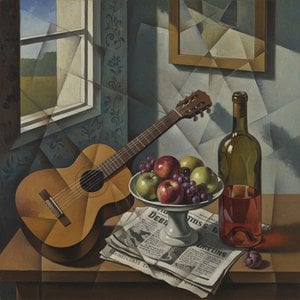
Discover Paul Nash’s "Telecommunications" (1934), a striking Cubist still life in grey & red. Explore this dynamic, geometric artwork – a unique piece of British Modernism.
 Weiterlesen
Künstlerbiografie
Entdecken Sie die eindringlichen Landschaften & ergreifende Kriegsdarstellungen von Paul Nash (1889-1946), Schlüsselfigur des britischen Modernismus! Kunst bei ArtsDot.
Handgefertigte Ölreproduktion
Handgemaltes Ölgemälde auf Leinwand in Ihrer Wunschgröße und mit Rahmen, auf Bestellung von unseren Künstlern angefertigt. ( Zum Druck wechseln Zum digitalen Bild wechseln)
More about this painting
 Vorschau anzeigen
 Versenden
 Teilen
 Details anzeigen
 Leitfaden

 Herunterladen
 Ähnliche Objekte
 Röntgenaufnahme
 Diashow
 Q&A
Q&A Statistiken
Order your painting in four simple steps
Take your time. You can change any answer; the price in your order card follows each choice.
1 Step one of four
Which size would you like?
These sizes keep the proportions of the original painting. The drawing shows your choice on a wall, above a two-metre sofa.
Or give your own measurements
Wählen Sie aus unseren vordefinierten Formaten, die den ursprünglichen Proportionen des Kunstwerks entsprechen.

Geben Sie die Breite und die Höhe an, die Sie für Ihren Rahmen oder Ihre Wand benötigen. Da dieses Werk handgemalt ist, kann der Künstler bei einer anderen Form etwas mehr um das Bild herum malen oder etwas abschneiden – Sie entscheiden. Wir senden Ihnen ein digitales Mockup zur Freigabe, bevor mit dem Malen begonnen wird. Das auf dieser Seite gezeigte Bild stellt nicht das tatsächliche Ergebnis dar – dies tut nur das Mockup.
2 Step two of four
How should it be prepared: rolled, stretched or framed?
The prices below are for the size you chose in step one.
Choose the edges of the stretched canvas
Choose your frame

White €1

Blurside €1

Extended €1

P118B €10

P118H €10

P118W €10

P438Z €10

P508JH €12

P508YH €12

P805H €10

P805Z €10

P919BZ €10

P919G €10

P919XJ €10

P959ZH €10

P968JZ €12

W106C €8

W218G €10

W218JH €8

W218Y €10

W307PJ €10

W316G €10

W316PJ €8

W316Y €10

W398PJ €8

W4111J €10

W500HY €15

W500JH €15

W692G €12

W849H €8

W940BG €15

W953PJ €8

H24-GOLD €30

H24-SILVER €30

H36-GOLD €45

H36-SILVER €45
Gerahmt
Moulding: . Overall size with the frame: .
3 Step three of four
Would you like anything changed in the painting?
Most people answer no. Because each painting is made by hand, our artist can also adapt it for you.
After order, ArtsDot.com team will email client for instructions and provide a mockup preview
4 Step four of four
A few finishing options
All of them are optional. The answers already selected cost nothing extra.
Who paints it?
Weltweiter Versand () in nur 3 bis 4 Wochen statt der üblichen 5 Wochen. (29 Oktober). Keine Kompromisse bei der Qualität.
A nameplate, as in a museum?
Details der gravierten Bronzetafel
This elegant plaque features the artist's name and the title of the artwork, finely engraved for a timeless presentation.
It is made from bronze with a refined, elegant finish. The text is precisely laser-engraved for a sharp and permanent result. Measuring 9x2 cm, the plaque is compact yet easy to read. It's built to be durable and scratch-resistant, offering a professional, museum-quality look. Mounting is simple thanks to the included adhesive backing.
Details zur Acrylglas-Plakette (transparent)
The plaque includes essential engraved details such as the artist's name, the title of the artwork, the date it was created, the type of media used-like oil on canvas or watercolor-a brief description of the piece, and a QR code that links to the complete artwork information.
It is crafted from clear acrylic, offering a sleek, modern appearance. The text is UV-engraved in black to ensure strong visual contrast. With a size of 10x15 cm, it ensures optimal readability. It comes equipped with two metal hooks for secure wall mounting. The plaque is designed to be weather-resistant, making it suitable for various environments, and it includes interactive features that work seamlessly with smartphone scanning.
Details zur schwarzen Acryltafel
This elegant plaque includes engraved information such as the artist's name, the title of the artwork, the date it was created, the type of media used (like oil on canvas or watercolor), a short description of the artwork, and a QR code for quick access to more information.
The plaque itself is made from refined black acrylic with a premium finish. The text is laser-engraved in white for high contrast and readability. Its size is 10x15 cm, designed to be easy to read. It comes with two metal hooks for professional mounting. The design is sleek and fits any interior style. It is also weather-resistant and durable, with built-in digital integration for mobile compatibility.
A protective varnish?
When do you need it?
✓ Check and order
Your painting, as you ordered it

Telecommunications
Art der Reproduktion
Format der Reproduktion
-

Erstklassige Meisterkünstler
Mehr Detailtiefe, Raffinesse und zusätzliche Produktionszeit
-

Rahmen für Reproduktionen
-
-
Bei Kunstwerken oder Reproduktionen, die an einer Seite größer als 105 cm (ca. 41 Zoll) sind, wird der Rahmen zerlegt als Bausatz geliefert. Diese Methode gewährleistet eine sichere Zustellung und verhindert Schäden während des Transports.
Professionelle Montage erforderlich – dies ist kein DIY-Produkt.
Der Bausatz muss von einem erfahrenen professionellen Rahmenmacher zusammengebaut und die Leinwand gespannt werden. Hierfür werden Holzleim (nicht im Lieferumfang enthalten), eine Leinwandspannzange sowie Klemmen benötigt, um die Keilleisten während des Trocknungsvorgangs rechtwinklig zu halten. Eine unsachgemäße Montage oder eine ungleichmäßige Spannung der Leinwand kann das Kunstwerk dauerhaft beschädigen und ist nicht durch unsere Garantie abgedeckt.
 Bei Kunstwerken oder Reproduktionen, die an einer Seite größer als 105 cm (ca. 41 Zoll) sind, wird der Rahmen zerlegt als Bausatz geliefert. Diese Methode gewährleistet eine sichere Zustellung und verhindert Schäden während des Transports.
Alle Vollholzkomponenten sind enthalten, präzise auf Maß zugeschnitten.
Der Zusammenbau erfolgt mit den mitgelieferten Schrauben sowie Holzkleber für die Eckverbindungen, der nicht im Lieferumfang enthalten ist und vom Rahmenbauer selbst beschafft werden muss.
Professionelles Werkzeug ist erforderlich und nicht im Lieferumfang enthalten: eine Keilrahmenzange (Spannwerkzeug) sowie Klammern, um die Leisten während der Trocknungszeit des Klebers rechtwinklig zu fixieren.
Wichtiger Hinweis:
Für die Eckverbindungen wird Holzleim benötigt, die Leisten müssen mit Zwingen fixiert werden, bis der Leim vollständig getrocknet ist, und das Spannen der Leinwand auf dem fertigen Rahmen erfordert eine Keilrahmen-Zange. Keines dieser Utensilien ist im Set enthalten. Bitte stellen Sie sicher, dass ein erfahrener Rahmenmacher zur Verfügung steht, bevor Sie diese Größe bestellen.

Beschriftung
-
-

Schutzlackierung
Glanzlack (verstärkt die Farben, schützt vor Licht und Feuchtigkeit)
-

Mein Kunstwerk personalisieren
Beispiele für Anpassungsmöglichkeiten: Gesicht durch Kundenfoto ersetzen; Haustier hinzufügen (z. B. Katze durch Hund ersetzen); Versteckte Nachricht im Hintergrund einfügen; Hintergrundlandschaft oder -elemente ändern.
-

Eilt sehr
Weltweiter Versand () in nur 3 bis 4 Wochen statt der üblichen 5 Wochen. (29 Oktober). Keine Kompromisse bei der Qualität.
-
Expressversand
Weltweiter Versand () innerhalb von 5 Wochen. (5 November).
Inklusive Versand
Endpreis
€ 232
Die Glasoption ist nur für Größen unter 110 cm verfügbar.
Included with every order
- Kostenloser weltweiter Expressversand
- Hochwertige Leinenleinwand
- Umfassender Versicherungsschutz beim Versand
- Zollgebühren-Rückerstattungsgarantie
- Garantie für exakte Farbtreue
- 100 Tage Rückgaberecht (nur bei Mängeln)
- 100% Geld-zurück-Garantie
- Mengenrabatt verfügbar


A Static Symphony: Unpacking Paul Nash's "Telecommunications"
Paul Nash’s 1934 painting, “Telecommunications,” isn’t merely a still life; it’s a carefully constructed visual argument about the burgeoning anxieties and promises of modernity. Rendered in a restrained palette of greys, blacks, whites, and muted reds – colors that evoke both industrial austerity and a subtle, melancholic beauty – the work immediately draws the viewer into a world where familiar objects are fractured, rearranged, and imbued with an unsettling sense of detachment. It’s a piece that speaks volumes about the era's fascination with technology while simultaneously hinting at its potential to alienate us from nature and ourselves.
The composition itself is deliberately asymmetrical, creating a dynamic tension that mirrors the rapid changes occurring in society during the 1930s. A table dominates the foreground, supporting a bowl, an apple (a potent symbol of temptation and knowledge), and a draped cloth – objects rendered with a Cubist sensibility; their forms are broken down into geometric shapes, overlapping and receding from view as if viewed through a distorted lens. The central element, a towering telecommunications tower, acts as both the focal point and the unsettling anchor of the piece. It’s not depicted realistically but rather as a rigid, almost menacing structure, its sharp angles cutting across the otherwise muted tones.
Cubism Meets Constructivism: A Hybrid Style
Nash's style is a fascinating blend of Cubist and Constructivist influences. The fragmentation of forms, reminiscent of Picasso and Braque, is combined with a deliberate emphasis on geometric shapes – rectangles, triangles, and lines – echoing the principles of Constructivism, which sought to reduce art to its essential elements. This fusion creates an image that feels both familiar and strangely alienating, reflecting the anxieties of a world grappling with rapid industrialization and technological advancement. The flattened perspective, characteristic of Cubism, further contributes to this sense of detachment, as if the objects are suspended in a timeless void.
The technique employed is remarkably controlled. Nash utilizes a brushstroke-based approach, creating a surface that appears smooth and almost graphic. However, closer inspection reveals subtle variations in texture and tone, suggesting a deliberate layering of paint – a testament to his skill as a painter. The limited color palette reinforces the painting’s overall mood, contributing to its sense of quiet intensity and underlying unease. The choice of materials—likely oil paints on canvas or board—adds to the work's durability and timeless quality.
Echoes of Blake and the British Landscape
To understand Nash’s artistic vision fully, it’s crucial to consider his early influences. Like William Blake before him, Nash was deeply fascinated by mythology and folklore, often incorporating symbolic elements into his work. His childhood spent in Buckinghamshire instilled a profound love for the English landscape, particularly ancient burial mounds and Iron Age hill forts – motifs that frequently appear in his paintings. “Telecommunications” can be interpreted as a meditation on this relationship between the natural world and the encroaching forces of modernity. The tower, a symbol of technological progress, stands in stark contrast to the implied tranquility of the surrounding landscape, suggesting a potential loss or disruption of connection.
A Timeless Reflection: Reproduction Possibilities
Reproductions of “Telecommunications” offer a remarkable opportunity to bring this evocative artwork into your home or office. ArtsDot’s high-quality reproductions capture the painting's nuanced details and atmospheric mood with exceptional fidelity. Whether you choose a canvas print, a framed giclée, or a metal print, you can experience the power of Nash’s vision firsthand. This piece is more than just decoration; it’s a conversation starter – a visual reminder of our complex relationship with technology and the enduring beauty of the natural world. Consider this artwork as an investment in both artistic appreciation and a thoughtful reflection on the modern condition.
Fragen & Antworten
Aus welchen Materialien besteht "Telecommunications" und in welchem Stil ist es gehalten?
In "Telecommunications" trifft die Oil On Canvas-Technik auf die Cubism-Strömung.
Welche Druckgröße wird für "Telecommunications" von Paul Nash empfohlen?
Die empfohlene Druckgröße für "Telecommunications" von Paul Nash ist Medium.
Inwiefern steht das Sujet von „Telecommunications“ in Beziehung zu den üblichen Themen von Paul Nash?
Unter den dokumentierten Themen von Paul Nash – war propaganda imagery, symbolic british art, early modernist style, cubism & constructivism, geometric abstraction, early 20th century art, modernity & technology, industrial age concerns – setzt „Telecommunications“ einen ganz eigenen Fokus auf geometric abstraction, modern composition, minimalist still life, cubist forms, abstract objects, graphic design art, 20th century art.
Ähnliche Kunstwerke


Paul Nash
1889 - 1946, Vereinigtes Königreich
Künstlerbiografie
Frühes Leben und Einflüsse
- Geboren: Kensington, Vereinigtes Königreich (1889)
- Gestorben: 1946
- Paul Nash wurde am 11. Mai 1889 in London geboren. Sein Vater, William Harry Nash, war Rechtsanwalt, und seine Mutter, Caroline Maude, zeigte von früher Kindheit an Anzeichen einer psychischen Erkrankung. Die Familie zog nach Iver Heath, Buckinghamshire, als Paul jung war, ein Umzug, der darauf abzielte, die Gesundheit seiner Mutter zu verbessern.
- Ausbildung: Er besuchte die Parsons School of Art und später die Slade School of Fine Art. Obwohl er in der Landschaftsmalerei kompetent war, hatte er Schwierigkeiten mit dem Aktzeichnen.
- Frühe Einflüsse: Nash wurde stark von William Blake und J.M.W. Turner beeinflusst, was sich in seinen frühen Werken widerspiegelt. Er ließ sich auch von Landschaften mit alten historischen Elementen wie Hügelgräbern und Steingräberfeldern inspirieren.
Künstlerischer Stil und Entwicklung
- Stil: Paul Nashs Stil vereinte Modernismus mit traditionellen Techniken. Er verwendete kräftige Farben, geometrische Formen und abstrakte Elemente, was ihn von seinen Zeitgenossen unterschied.
- Surrealistische Tendenzen: Obwohl er kein strikter Surrealist war, wurde Nash von der Bewegung beeinflusst, insbesondere nachdem er 1928 eine Ausstellung von Giorgio de Chirico gesehen hatte. Seine Arbeit enthielt symbolische Landschaften mit Alltagsgegenständen.
- Kriegskunst: Während des Ersten und Zweiten Weltkriegs diente Nash als offizieller Kriegskünstler. Seine Darstellungen von Schlachtfeldern waren bemerkenswert für ihre gespenstische Schönheit und die Erkundung der Auswirkungen des Konflikts auf die Landschaft. Bemerkenswerte Werke sind "The Menin Road".
- "Aerial Creatures": Eine Serie, die während des Zweiten Weltkriegs entstand und anthropomorphe Darstellungen von abgestürzten Flugzeugen in Landschaften zeigt, demonstriert seinen sich entwickelnden Stil und seine Symbolik.
Wichtige Errungenschaften und Anerkennung
- Pionier des britischen Modernismus: Nash spielte eine entscheidende Rolle bei der Gestaltung der britischen modernen Kunst und verband traditionelle Landschaftsmalerei mit modernistischer Ästhetik.
- Kriegskunst-Erbe: Seine Kriegsbilder gelten als ikonische Darstellungen der Auswirkungen des Konflikts sowohl auf Soldaten als auch auf die Umwelt.
- Unit One Group: Er gründete 1933 zusammen mit Ben Nicholson und Barbara Hepworth die Unit One, eine bedeutende Gruppe innerhalb der britischen Kunstszene.
- Schriftsteller und Designer: Abgesehen vom Malen war Nash auch ein angesehener Autor über Kunst und entwarf angewandte Künste wie Theaterdekorationen, Stoffe und Plakate.
Einflüsse und Vermächtnis
- Einfluss auf nachfolgende Künstler: Nashs einzigartiger Stil und seine Farbgebung beeinflussten Generationen von Künstlern, die ihm folgten.
- Verbindung zum Romantik: Seine Arbeit wird oft mit der englischen Romantik in Verbindung gebracht, insbesondere durch seine Verbindung zu William Blake und J.M.W. Turner.
- Erforschung des Verhältnisses Mensch-Natur: Ein wiederkehrendes Thema in Nashs späteren Werken war das Verhältnis zwischen Menschheit und Natur, erforscht durch symbolische Bildsprache.
- Fortwährende Relevanz: Seine Gemälde werden weiterhin für ihre Schönheit, Symbolik und historische Bedeutung gefeiert und bleiben ein zeitgenössisches Publikum relevant.
Ausstellungen und Sammlungen
- Ruskin Gallery: Nashs Werk wurde in der Ruskin Gallery im Vereinigten Königreich ausgestellt.
- Tate Britain: Seine Werke befinden sich in der Sammlung der Tate Britain.
- Imperial War Museum: Mehrere seiner Kriegsbilder sind im Imperial War Museum zu sehen.
- York Art Gallery: Seine Arbeit ist auch Teil der Sammlung der York Art Gallery.
- Government Art Collection: Eine Auswahl von Nashs Kunstwerken wird in der Government Art Collection ausgestellt.

Ähnliche Artikel
Deconstructing Reality: A Comprehensive Exploration of Cubist Still Life
Explore the revolutionary world of Cubist Still Life with ArtsDot. Discover Picasso & Braque's groundbreaking techniques, its philosophical roots, and lasting impact on modern art. Expert insights for collectors.

Geometrische Abstraktion: Die 10 Meisterwerke, die Kunstgeschichte prägten | ArtsDot.com
Entdecken Sie die 10 Meisterwerke der geometrischen Abstraktion! Von Kandinsky bis Mondrian – erleben Sie die Geschichte, Farben & Formen dieser revolutionären Kunstrichtung. Hochwertige Kunstreproduktionen auf ArtsDot.com

Die 25 besten Gemälde von Paul Cézanne: Meisterwerke der Form
Entdecken Sie die 25 Meisterwerke von Paul Cézanne und den Postimpressionismus. Alle Klassiker auf ArtsDot.com online erleben.