


 In echtem Maßstab anzeigen
 Versenden als Grußkarte
 Teilen
 Details anzeigen
 Leitfaden

 Herunterladen
 Ähnliche Objekte
 Röntgenaufnahme
 Diashow
 Besucherstatistiken
Bust of a man

 Mehr anzeigen
Giclée / Kunstdruck
Giclée- oder Leinwanddruck in Museumsqualität mit schneller Produktion und flexiblen Veredelungsoptionen. ( Handgemalte Reproduktion kaufen Zum digitalen Bild wechseln)




P118B $10

P118H $10

P118W $10

P438Z $10

P508JH $12

P508YH $12

P805H $10

P805Z $10

P919BZ $10

P919G $10

P919XJ $10

P959ZH $10

P968JZ $12

W106C $8

W218G $10

W218JH $8

W218Y $10

W307PJ $10

W316G $10

W316PJ $8

W316Y $10

W398PJ $8

W4111J $10

W500HY $15

W500JH $15

W692G $12

W849H $8

W940BG $15

W953PJ $8




Wählen Sie aus unseren vordefinierten Formaten, die den ursprünglichen Proportionen des Kunstwerks entsprechen.

Sie können Ihre eigenen Maße eingeben, um ein bestimmtes Format oder einen speziellen Platz einzupassen. Wenn das von Ihnen gewählte Format nicht den Proportionen des Originalbildes entspricht, werden wir das Kunstwerk entweder beschneiden oder das Bild mit einem gespiegelten oder einfarbigen Rand erweitern. Ein digitaler Entwurf wird Ihnen zur Genehmigung zugesandt, bevor die Produktion beginnt.
Bitte beachten Sie, dass die Vorschau auf dem Bildschirm nicht den tatsächlichen Zuschnitt oder die Erweiterung widerspiegelt. Nur der Entwurf zeigt die endgültige Komposition präzise an.
Obwohl Sondermaße verfügbar sind, empfehlen wir die Auswahl eines Maßes aus der vordefinierten Liste, um die ursprünglichen Proportionen zu bewahren.
Weltweiter Versand () innerhalb von 2 Wochen statt der üblichen 4/5 Wochen. (25 September)

Kostenloser weltweiter Expressversand

Hochwertige Leinenleinwand

Vollständiger Versicherungsschutz beim Versand

Zollgebühren-Rückerstattungsgarantie

Garantie für exakte Farbtreue

100-tägiges Rückgaberecht (nur bei Mängeln)

100% Geld-zurück-Garantie

Angebot für Mengenrabatt
 Die Glasoption ist nur für Größen unter 110 cm verfügbar.

Bust of a man
Giclée / Kunstdruck
Format der Reproduktion
-


Gesamtpreis
$ 62
The Enigmatic Figure: A Study in Cubist Disquiet
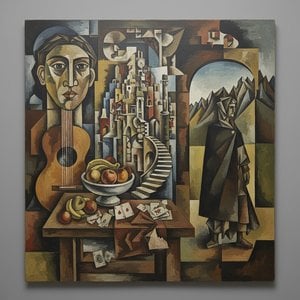
Pablo Picasso’s “Bust of a Man,” painted circa 1925, isn't merely a portrait; it’s an invitation to unravel a carefully constructed puzzle. The image presents a man – his identity deliberately obscured – rendered with the hallmarks of Picasso’s mature Cubist style. He sits within a stark, undefined space, seemingly caught in a moment of profound introspection or perhaps unsettling disorientation. The painting immediately commands attention not through idealized beauty, but through its deliberate fragmentation and manipulation of form. The blues and pinks that dominate the palette aren't cheerful; they evoke a sense of melancholy and quiet contemplation, hinting at an underlying sadness within the subject’s gaze.
Picasso’s technique is both precise and deliberately unsettling. He employs a meticulous geometric approach, breaking down the figure into interlocking planes and angles – a direct inheritance from his early Cubist explorations with Braque. However, unlike some of his more aggressively analytical works, this piece retains a surprising degree of emotional resonance. The sharp edges and fractured forms don’t simply represent visual reality; they seem to embody psychological states, suggesting a mind grappling with uncertainty or perhaps even trauma. Notice the subtle shifts in color – the way blue bleeds into pink, creating an almost bruised effect—a testament to Picasso's masterful control of hue and tone.
Echoes of Antiquity: A Roman Influence
The “Bust of a Man” reveals a fascinating dialogue with classical sculpture, particularly the tradition of Roman portraiture. The overall composition – a frontal pose, a focus on the face, and an attempt to capture a sense of individual character – clearly draws inspiration from the busts of emperors and prominent citizens that adorned Roman public spaces. However, Picasso doesn’t simply replicate these forms; he subverts them entirely. He strips away any semblance of idealized beauty or heroic grandeur, presenting instead a figure stripped bare, vulnerable, and undeniably human. The subtle suggestion of a profile within the frontal view is particularly intriguing, hinting at a deeper complexity beneath the surface.
Interestingly, recent archaeological discoveries – specifically, the “Arles Bust” unearthed in France – have fueled speculation about the potential identity of this figure. While scholars debate whether it represents Julius Caesar, the parallels between Picasso’s work and the Roman bust are undeniable. The emphasis on capturing a sense of inner life, rather than simply creating a likeness, is a key element shared by both artists. The Arles Bust's discovery adds another layer to the painting's historical context, suggesting that Picasso was consciously engaging with a tradition of portraiture that stretched back centuries.
Symbolism and Emotional Resonance
Beyond its formal elements, “Bust of a Man” is rich in symbolic potential. The man’s slightly downturned mouth suggests weariness or resignation, while his eyes hold a distant, almost haunted expression. The fragmented nature of the figure can be interpreted as representing the fractured experience of modern life – a world increasingly characterized by uncertainty and alienation. Picasso himself often used art to explore themes of mortality, loss, and the human condition, and this painting is no exception.
Furthermore, the deliberate use of color—the somber blues and muted pinks—contributes significantly to the work’s emotional impact. These colors aren't associated with joy or vitality; they evoke a sense of introspection, melancholy, and perhaps even a touch of despair. The painting invites viewers to contemplate not just the figure itself, but also the emotions and experiences that lie beneath its fragmented surface. It is a portrait that lingers in the mind long after it has been viewed, prompting reflection on the complexities of human existence.
A Timeless Masterpiece: Reproduction Possibilities
ArtsDot offers meticulously crafted reproductions of “Bust of a Man,” allowing art lovers to bring this iconic work into their homes or offices. Our high-quality prints are created using archival inks and premium canvas, ensuring that the colors and details remain vibrant for generations to come. Whether you’re an avid collector, an interior designer seeking to add a touch of artistic sophistication, or simply someone who appreciates the power of great art, a reproduction of this captivating Cubist portrait is sure to be a treasured addition to your collection.
Ähnliche Kunstwerke


Biografie des Künstlers
Pablo Picasso: Ein revolutionärer Künstler
Frühes Leben und Ausbildung (1881-1904)
- Geboren am 25. Oktober 1881 in Málaga, Spanien, zeigte Pablo Ruiz y Picasso von sehr jungem an sein künstlerisches Talent.
- Sein Vater, José Ruiz y Blasco, war Kunstlehrer und gab seinem Sohn eine frühe Ausbildung. Es heißt, Picassos erste Worte waren “piz, piz” – ein Versuch, ‘Bleistift’ zu sagen.
- Picasso übertraf seine Vaters Fähigkeiten schnell und zeigte bemerkenswerte Begabung in naturalistischen Darstellungen.
- Die Familie zog nach A Coruña und später nach Barcelona nach dem tragischen Verlust Picassos Schwester.
- In Barcelona besuchte er die Kunsthochschule, störte sich aber oft an der traditionellen akademischen Lehre. Er studierte kurzzeitig an der Königlichen Akademie San Fernando in Madrid und fand es beengend, bevorzugte aber das unabhängige Studium von Meistern wie Velázquez und Goya.
Die Blauen und Rosafarbenen Perioden (1901-1906)
- Die Blaue Periode (ungefähr 1901-1904) ist durch düstere Gemälde geprägt, die von Blautönen und Blaugrün dominiert werden.
- Diese Werke stellen oft marginalisierte Figuren dar – Bettler, blinde Menschen, Prostituierte – und spiegeln Melancholie und sozialen Kommentar wider. Wichtige Beispiele sind La Vie (1903) und Der alte Gitarrist (1903-1904).
- Nachfolgend entstand die Rosafarbene Periode (1904-1906) mit wärmeren Tönen – Rosa-, Orange- und Rottönen.
- Diese Periode spiegelt eine optimistischere Sichtweise wider und stellt oft Zirkusclowns, Harlekinen und Akrobaten dar. Familie der Saltimbanques (1905) ist ein Beispiel dafür.
Die revolutionären Jahre: Kubismus und darüber hinaus (1907-1919)
- 1907 markierte einen Wendepunkt mit Les Demoiselles d'Avignon, der von iberischer Skulptur und afrikanischen Masken beeinflusst wurde. Dieses Gemälde zerstörte die traditionelle Perspektive und ebnete den Weg für den Kubismus.
- Picasso arbeitete eng mit Georges Braque zusammen und gründete den Kubismus, der die Art und Weise, wie Künstler Realität darstellten, grundlegend veränderte.
- Analytischer Kubismus (1909-1912) zeichnete sich durch fragmentierte Formen, gedämpfte Farben und die Zerlegung von Objekten in geometrische Formen aus.
- Synthetischer Kubismus (1912-1919) integrierte Collagen – Zeitungsartikel, Stoffreste – um texturierte Oberflächen und neue visuelle Schichten zu schaffen.
Neoklassizismus und Surrealismus (1920er - 1930er Jahre)
- In den 1920er Jahren erkundete Picasso neoklasische Stile mit monumentalen Figuren, die klassische Formen betonten.
- Er beschäftigte sich auch mit dem Surrealismus, obwohl er sich nie vollständig mit dessen Prinzipien identifizierte. Seine Werke vermischten frühere Stile mit surrealistischer Bildsprache und verzerrten Perspektiven.
Spätere Jahre und Vermächtnis (1940-1973)
- Während des Zweiten Weltkriegs blieb Picasso in Frankreich und produzierte kraftvolle Antikriegserklärungen wie Guernica (1937), eine wirkliche Reaktion auf den Angriff auf Guernica während des Spanischen Bürgerkriegs.
- Guernica wurde zu einem bleibenden Symbol der Schrecken des Krieges und gilt als eines seiner bekanntesten Werke.
- In den 1950er und 60er Jahren experimentierte Picasso weiterhin mit verschiedenen Medien – Keramik, Skulptur, Druckgrafik – und demonstrierte bemerkenswerte Vielseitigkeit.
- Er heiratete Jacqueline Roque im Jahr 1961. Er starb am 8. April 1973 in Mougins, Frankreich.
Einflüsse und historische Bedeutung
- Picassos künstlerische Entwicklung wurde von spanischen Meistern wie Velázquez und Goya, iberischer Skulptur, afrikanischer Kunst und Henri Matisse geprägt.
- Sein Einfluss auf die Kunst des 20. Jahrhunderts ist unermesslich. Er gründete den Kubismus, pionierte Collagen und konstruktive Skulpturen und stellte traditionelle künstlerische Konventionen kontinuierlich in Frage.
- Picassos unerbittliche Experimentierfreude definierte die moderne Kunst neu und inspiriert Künstler bis heute.
- Seine fruchtbare Produktion – geschätzt auf über 50.000 Werke – festigt seine Position als einer der wichtigsten und einflussreichsten Künstler in der Geschichte.

Pablo Picasso
1881 - 1973 , Spanien
Eckdaten zum Künstler
- Beeinflusste Künstler:
- Velázquez
- Goya
- Henri Matisse
- Bemerkenswerte Werke:
- Les Demoiselles d'Avignon
- Guernica
- Der alte Gitarrist
- Familie der Saltimbanques
- Geburtsdatum: 25. Oktober 1881
- Geburtsort: Málaga, Spanien
- Künstlerische Richtung: Kubismus, Surrealismus
- Nationalität: Spanisch
- Sterbedatum: 8. April 1973
- Vollständiger Name: Pablo Picasso
- Von Künstlern Beeinflusst:
- Iberische Skulptur
- Afrikanische Kunst
Verwandte Artikel

Pablo Picasso: Eine revolutionäre Vision – Kubismus, Symbolik und bleibendes Erbe
Entdecken Sie Pablo Picassos revolutionäres Werk! Analysen zu Kubismus, Symbolik und seinem bleibenden Einfluss auf die moderne Kunst. Wertvolle Einblicke für Sammler & Kenner.

Deconstructing Reality: Cubism's Revolutionary Impact on 20th-Century Art
Explore the revolutionary world of Cubism with ArtsDot. Discover Picasso & Braque's groundbreaking techniques, its philosophical roots, and lasting impact on modern art. Expert insights for collectors.

Die 10 Meisterwerke des Kubismus: Revolutionäre Porträts für Ihr Zuhause | ArtsDot
Entdecken Sie die 10 revolutionärsten kubistischen Porträts von Picasso, Braque & Co.! Erfahren Sie die Geschichten hinter Meisterwerken der Moderne und lassen Sie sich für Ihre Wohnraumgestaltung inspirieren. Museum-Qualität bei ArtsDot.
Kubismus: Die 10 Meisterwerke, die eine Revolution definierten | ArtsDot
Entdecken Sie die 10 Meisterwerke des Kubismus! Von Picasso bis Braque – erleben Sie die Revolution abstrakter Kunst. Kunstdrucke & Wandbilder für Ihr Zuhause auf ArtsDot.com.

Die 10 Meisterwerke des Kubismus: Kunst für Ihr Zuhause | ArtsDot
Entdecken Sie die 10 bedeutendsten Meisterwerke des Kubismus von Picasso, Braque & Gris! Erfahren Sie mehr über Kunstgeschichte, Techniken und Farben. Hochwertige Kunstdrucke auf ArtsDot.com – für stilvolle Wandgestaltung.


