

- 150.0 x 182.0 cm


Das Bild passt sich Ihren Auswahlmöglichkeiten an: , .
Beschreibung des Sammlerstücks
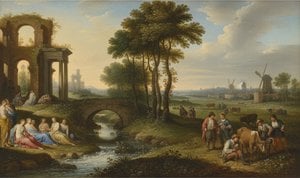
Explore Lucas van Leyden's 'Wandering Beggars,' a poignant Northern Renaissance engraving depicting poverty and resilience amidst a detailed landscape featuring animals and castle ruins.
 Weiterlesen
Künstlerbiografie
Entdecken Sie Lucas van Leyden: Ein Meister des niederländischen Malerei und Kupferstichs! Seine ikonischen Landschaftsbilder und innovativer Druckstil prägten die Kunstgeschichte.
Handgefertigte Ölreproduktion
Handgemaltes Ölgemälde auf Leinwand in Ihrer Wunschgröße und mit Rahmen, auf Bestellung von unseren Künstlern angefertigt. ( Zum Druck wechseln Zum digitalen Bild wechseln)
Mehr über dieses Gemälde
 Vorschau anzeigen
 Versenden
 Teilen
 Details anzeigen
 Leitfaden

 Herunterladen
 Ähnliche Objekte
 Röntgenaufnahme
 Diashow
 Fragen & Antworten
 Statistiken
Bestellen Sie Ihr Gemälde in vier einfachen Schritten
Lassen Sie sich Zeit. Sie können jede Antwort jederzeit ändern; der Preis in Ihrem Warenkorb passt sich jeder Auswahl automatisch an.
1 Schritt eins von vier
Welche Größe möchten Sie wählen?
Diese Formate bewahren die Proportionen des Originalgemäldes. Die Zeichnung zeigt Ihre Auswahl an einer Wand, oberhalb eines zwei Meter breiten Sofas.
Oder geben Sie Ihre eigenen Maße an
Wählen Sie aus unseren vordefinierten Formaten, die den ursprünglichen Proportionen des Kunstwerks entsprechen.

Geben Sie die Breite und die Höhe an, die Sie für Ihren Rahmen oder Ihre Wand benötigen. Da dieses Werk handgemalt ist, kann der Künstler bei einer anderen Form etwas mehr um das Bild herum malen oder etwas abschneiden – Sie entscheiden. Wir senden Ihnen ein digitales Mockup zur Freigabe, bevor mit dem Malen begonnen wird. Das auf dieser Seite gezeigte Bild stellt nicht das tatsächliche Ergebnis dar – dies tut nur das Mockup.
2 Schritt zwei von vier
Wie soll es vorbereitet werden: gerollt, auf Keilrahmen gespannt oder gerahmt?
Die unten aufgeführten Preise beziehen sich auf die in Schritt eins gewählte Größe.
Wählen Sie die Kanten der Leinwand aus
Wählen Sie Ihren Rahmen

Weißer Rand €1

verlaufende Kanten €1

Umrandung €1

P118B €10

P118H €10

P118W €10

P438Z €10

P508JH €12

P508YH €12

P805H €10

P805Z €10

P919BZ €10

P919G €10

P919XJ €10

P959ZH €10

P968JZ €12

W106C €8

W218G €10

W218JH €8

W218Y €10

W307PJ €10

W316G €10

W316PJ €8

W316Y €10

W398PJ €8

W4111J €10

W500HY €15

W500JH €15

W692G €12

W849H €8

W940BG €15

W953PJ €8

H24-GOLD €30

H24-SILVER €30

H36-GOLD €45

H36-SILVER €45
Gerahmt
Profil: . Gesamtgröße mit Rahmen: .
3 Schritt drei von vier
Möchten Sie am Gemälde noch etwas ändern?
Die meisten Menschen antworten mit Nein. Da jedes Gemälde von Hand gefertigt wird, kann unser Künstler es jedoch auch individuell für Sie anpassen.
Nach der Bestellung wird das Team von ArtsDot.com den Kunden per E-Mail kontaktieren, um Anweisungen einzuholen und eine Vorschau des Entwurfs bereitzustellen
4 Schritt vier von vier
Einige Veredelungsmöglichkeiten
Alle Angaben sind optional. Für bereits ausgewählte Antworten entstehen keine zusätzlichen Kosten.
Wer hat es gemalt?
Weltweiter Versand () in nur 3 bis 4 Wochen statt der üblichen 5 Wochen. (6 November). Keine Kompromisse bei der Qualität.
Ein Namensschild, wie im Museum?
Details der gravierten Bronzetafel
This elegant plaque features the artist's name and the title of the artwork, finely engraved for a timeless presentation.
It is made from bronze with a refined, elegant finish. The text is precisely laser-engraved for a sharp and permanent result. Measuring 9x2 cm, the plaque is compact yet easy to read. It's built to be durable and scratch-resistant, offering a professional, museum-quality look. Mounting is simple thanks to the included adhesive backing.
Details zur Acrylglas-Plakette (transparent)
The plaque includes essential engraved details such as the artist's name, the title of the artwork, the date it was created, the type of media used-like oil on canvas or watercolor-a brief description of the piece, and a QR code that links to the complete artwork information.
It is crafted from clear acrylic, offering a sleek, modern appearance. The text is UV-engraved in black to ensure strong visual contrast. With a size of 10x15 cm, it ensures optimal readability. It comes equipped with two metal hooks for secure wall mounting. The plaque is designed to be weather-resistant, making it suitable for various environments, and it includes interactive features that work seamlessly with smartphone scanning.
Details zur schwarzen Acryltafel
This elegant plaque includes engraved information such as the artist's name, the title of the artwork, the date it was created, the type of media used (like oil on canvas or watercolor), a short description of the artwork, and a QR code for quick access to more information.
The plaque itself is made from refined black acrylic with a premium finish. The text is laser-engraved in white for high contrast and readability. Its size is 10x15 cm, designed to be easy to read. It comes with two metal hooks for professional mounting. The design is sleek and fits any interior style. It is also weather-resistant and durable, with built-in digital integration for mobile compatibility.
Ein Schutzlack?
Bis wann benötigen Sie es?
✓ Prüfen und bestellen
Ihr Gemälde, wie von Ihnen bestellt

Wandering Beggars
Art der Reproduktion
Format der Reproduktion
-

Erstklassige Meisterkünstler
Mehr Detailtiefe, Raffinesse und zusätzliche Produktionszeit
-

Rahmen für Reproduktionen
-
-
Bei Kunstwerken oder Reproduktionen, die an einer Seite größer als 105 cm (ca. 41 Zoll) sind, wird der Rahmen zerlegt als Bausatz geliefert. Diese Methode gewährleistet eine sichere Zustellung und verhindert Schäden während des Transports.
Professionelle Montage erforderlich – dies ist kein DIY-Produkt.
Der Bausatz muss von einem erfahrenen professionellen Rahmenmacher zusammengebaut und die Leinwand gespannt werden. Hierfür werden Holzleim (nicht im Lieferumfang enthalten), eine Leinwandspannzange sowie Klemmen benötigt, um die Keilleisten während des Trocknungsvorgangs rechtwinklig zu halten. Eine unsachgemäße Montage oder eine ungleichmäßige Spannung der Leinwand kann das Kunstwerk dauerhaft beschädigen und ist nicht durch unsere Garantie abgedeckt.
 Bei Kunstwerken oder Reproduktionen, die an einer Seite größer als 105 cm (ca. 41 Zoll) sind, wird der Rahmen zerlegt als Bausatz geliefert. Diese Methode gewährleistet eine sichere Zustellung und verhindert Schäden während des Transports.
Alle Vollholzkomponenten sind enthalten, präzise auf Maß zugeschnitten.
Der Zusammenbau erfolgt mit den mitgelieferten Schrauben sowie Holzkleber für die Eckverbindungen, der nicht im Lieferumfang enthalten ist und vom Rahmenbauer selbst beschafft werden muss.
Professionelles Werkzeug ist erforderlich und nicht im Lieferumfang enthalten: eine Keilrahmenzange (Spannwerkzeug) sowie Klammern, um die Leisten während der Trocknungszeit des Klebers rechtwinklig zu fixieren.
Wichtiger Hinweis:
Für die Eckverbindungen wird Holzleim benötigt, die Leisten müssen mit Zwingen fixiert werden, bis der Leim vollständig getrocknet ist, und das Spannen der Leinwand auf dem fertigen Rahmen erfordert eine Keilrahmen-Zange. Keines dieser Utensilien ist im Set enthalten. Bitte stellen Sie sicher, dass ein erfahrener Rahmenmacher zur Verfügung steht, bevor Sie diese Größe bestellen.

Beschriftung
-
-

Schutzlackierung
Glanzlack (verstärkt die Farben, schützt vor Licht und Feuchtigkeit)
-

Mein Kunstwerk personalisieren
Beispiele für Anpassungsmöglichkeiten: Gesicht durch Kundenfoto ersetzen; Haustier hinzufügen (z. B. Katze durch Hund ersetzen); Versteckte Nachricht im Hintergrund einfügen; Hintergrundlandschaft oder -elemente ändern.
-

Eilt sehr
Weltweiter Versand () in nur 3 bis 4 Wochen statt der üblichen 5 Wochen. (6 November). Keine Kompromisse bei der Qualität.
-
Expressversand
Weltweiter Versand () innerhalb von 5 Wochen. (13 November).
Inklusive Versand
Endpreis
€ 347
Die Glasoption ist nur für Größen unter 110 cm verfügbar.
In jeder Bestellung enthalten
- Kostenloser weltweiter Expressversand
- Hochwertige Leinenleinwand
- Umfassender Versicherungsschutz beim Versand
- Zollgebühren-Rückerstattungsgarantie
- Garantie für exakte Farbtreue
- 100 Tage Rückgaberecht (nur bei Mängeln)
- 100% Geld-zurück-Garantie
- Mengenrabatt verfügbar


A Portrait of Poverty and Resilience: Exploring Lucas van Leyden’s “Wandering Beggars”
The engraving "Wandering Beggars" by Lucas van Leyden, created in 1520 during the height of the Northern Renaissance, transcends mere depiction; it's a poignant meditation on social realities and human dignity rendered with breathtaking precision. More than just an image, it’s a testament to Van Leyden’s unparalleled skill as both painter and printmaker—a mastery that continues to captivate audiences centuries later.Composition and Narrative Depth
At first glance, the scene presents itself as straightforward: a group of impoverished individuals traversing a landscape dominated by a distant castle perched atop a hill. However, Van Leyden's genius lies in his masterful compositional choices. The diagonal line formed by the beggars’ movement draws the viewer’s eye upwards towards the castle—a symbol often interpreted as representing aspiration and unattainable ideals – yet simultaneously grounding the figures within the harsh realities of their circumstances. Scattered trees and shrubs serve as framing elements, enhancing the sense of depth and contributing to the overall narrative atmosphere. The inclusion of animals—a dog, a cat, and a bird—adds an element of realism and subtly reinforces the theme of vulnerability amidst a challenging environment.The Art of Engraving: Technique and Detail
Van Leyden’s technique exemplifies the exacting standards of Northern Renaissance engraving. Executed on copper plate, the image was painstakingly etched with fine lines using mezzotint – a process that allowed for exceptional tonal control. This meticulous approach resulted in an astonishing level of detail—noticeable in the folds of clothing, the expressions on the beggars' faces, and the intricate textures of foliage. Hatching and cross-hatching techniques were skillfully employed to create subtle gradations of shading, capturing the diffused light of an overcast day and emphasizing the contours of form. The resulting monochrome print possesses a remarkable luminosity achieved through careful manipulation of ink density.Historical Context and Societal Commentary
“Wandering Beggars” emerged during a period marked by significant social upheaval—the Reformation was reshaping Europe’s religious landscape, and anxieties about poverty and social justice were palpable. Van Leyden's work reflects this intellectual climate, prompting viewers to confront uncomfortable truths about the human condition. The depiction of beggars wasn’t merely an aesthetic exercise; it served as a powerful commentary on societal inequalities and the plight of marginalized communities—a subject that resonated deeply with humanist thinkers of the time.Symbolism and Emotional Resonance
Beyond its formal qualities, “Wandering Beggars” communicates profound emotional resonance. The distant castle embodies hope amidst despair, representing ambitions pursued despite obstacles. Simultaneously, it underscores the vulnerability inherent in human existence – a vulnerability mirrored in the weary postures and expressions of the beggars themselves. Van Leyden’s masterful rendering captures not only the visual appearance of poverty but also its psychological impact—a reminder that beauty can coexist with sorrow and that art possesses the capacity to provoke contemplation on fundamental questions about morality and compassion.A Legacy of Precision and Emotion
Lucas van Leyden's "Wandering Beggars" stands as a cornerstone of Northern Renaissance engraving, demonstrating an unparalleled fusion of artistic skill and intellectual engagement. Its enduring appeal lies in its ability to convey complex ideas with breathtaking clarity—a testament to Van Leyden’s legacy as one of the most influential artists of his era and a timeless masterpiece that continues to inspire admiration for its technical brilliance and emotional depth.Fragen & Antworten
Was stellt "Wandering Beggars" dar und welche Atmosphäre vermittelt es?
"Wandering Beggars" von Lucas Van Leyden verbindet beggars, landscape, engraving, medieval, poverty, animals, castle mit einer Calm Atmosphäre.
Aus welchen Materialien besteht "Wandering Beggars" und in welchem Stil ist es gehalten?
"Wandering Beggars" ist in Acrylic On Canvas im Stil der Northern Renaissance-Epoche gefertigt.
Kann ich eine Röntgenaufnahme von "Wandering Beggars" von Lucas Van Leyden sehen?
Die Röntgenansicht von "Wandering Beggars" von Lucas Van Leyden finden Sie auf der Röntgenblick-Seite des Kunstwerks: eine interaktive Untersuchung des Bildes durch elf optische Schichten.
Ähnliche Kunstwerke


Lucas Van Leyden
1494 - 1533, Niederlande
Künstlerbiografie
early life and training
Lucas van Leyden (real name Lucas Hugensz or Jacobsz.), Netherlandish engraver and painter, born and mainly active in Leiden, who was among the first Dutch exponents of genre painting and is generally regarded as one of the finest engravers in the history of art. He was the pupil of his father, Huygh Jacobszoon; later, he entered the workshop of Cornelis Engelbrechtsz(oon), a painter of Leiden. His paintings, as well as his prints, reveal his unique approach to subject matter and style, though Lucas is more highly regarded today as a printmaker than as a painter. He was extraordinarily precocious. Even such early prints as *Muhammed and the Murdered Monk* (1508) are compositionally clear and direct and show great technical skill. Such engravings as *Susanna and the Elders* (1508), *St. George Liberating the Princess* (*c.* 1508–09), and his famous series *The Circular Passion* (1510) are notable for their accurate rendering of space and subtly composed landscapes. In 1514 he became a member of the Leiden painters' guild. He seems to have travelled a certain amount, and on a visit to Antwerp in 1521 he met Dürer, who drew his portrait (Mus.\n\nB.-A., Lille). An unbroken series of dated engravings makes it possible to follow his career as a printmaker and to date many of his paintings, but no clear pattern of stylistic development emerges. Dürer was the single greatest influence on him, but Lucas was less intellectual in his approach, tending to concentrate on the anecdotal features of the subject and to take delight in caricatures and genre motifs. Van Mander characterizes him as a pleasure-loving dilettante, who sometimes worked in bed, but he left a large œuvre, in spite of his fairly short life, and must have been a prodigious worker. Lucas had a great reputation in his day (Vasari even rated him above Dürer in certain respects) and he is universally regarded as one of the greatest figures in the history of graphic art (he made etchings and woodcuts as well as engravings and was a superb draughtsman). His status as a painter is less elevated, but he was nevertheless one of the outstanding Netherlandish painters of his period. He was a pioneer of the Netherlandish genre tradition, as witness his *Chess Players* (c.1508, Gemäldegalerie, Berlin)—which actually represents a variant game called ‘courier’—and his *Card Players* (c.1517, Wilton House, Wiltshire), while his celebrated *Last Judgement triptych* (1526–7, Lakenhal Mus., Leiden) shows the heights to which he could rise as a religious painter. It eloquently displays his vivid imaginative powers, his superb skill as a colourist, and his deft and fluid brushwork. Lucas left no pupils or direct followers, but his work was a stimulus to an even greater Leiden-born artist, Rembrandt.artistic development
Lucas van Leyden was among the first Dutch exponents of genre painting and a highly accomplished engraver. His early work, characterized by half-length figures (c. 1506-1512), showcases his precocious originality. As he matured, his landscapes developed, and he became skilled in engraving at a remarkably young age. The earliest known print by him, *Mohammed and the Murdered Monk* (1508), demonstrates his mastery of the medium. It reveals no trace of immaturity in inspiration or technique. Dürer was the single greatest influence on him, but Lucas was less intellectual in his approach, tending to concentrate on the anecdotal features of the subject and to take delight in caricatures and genre motifs.notable works and style
Seventeen paintings surely attributed to lucas van leyden survive, including:- The Healing of the Blind Man of Jericho, a masterpiece showcasing multiple figures against wooded landscapes.
- Saint Paul, attr. leyden, exemplifying his engraving prowess.
- The Milkmaid (engraving, 1510), highlighting his early skill in the medium.
museum collections and online presence
Lucas van Leyden's works can be found in various museums, including the Van Gogh Museum (Netherlands), which houses an extensive collection of his engravings and paintings. Online platforms like ArtsDot.com offer a comprehensive selection of his works, allowing art enthusiasts to explore his oeuvre in detail.


Ähnliche Artikel

Romantische Landschaften: Die 10 Meisterwerke, die eine Epoche prägten | ArtsDot
Entdecken Sie die 10 Meisterwerke der Romantischen Landschaftsmalerei! Von Caspar David Friedrich bis Turner – erleben Sie die Kunst, Emotion & Natur. Hochwertige Reproduktionen auf ArtsDot.com
Cornelis van Poelenburch: Bridging Mannerism & the Dutch Baroque Landscape
Discover Cornelis van Poelenburch, a pivotal Dutch Baroque landscape painter bridging Mannerism & Italianate styles. Explore his life, key works, and lasting influence on 17th-century art with ArtsDot.

Licht & Schatten: Die 25 größten Meisterwerke von Rembrandt
Entdecke Rembrandts 25 größte Meisterwerke des Barock. Erlebe Licht und Schatten auf ArtsDot.com – Jetzt die Kollektion entdecken!