


 In echtem Maßstab anzeigen
 Versenden als Grußkarte
 Teilen
 Details anzeigen
 Leitfaden öffnen

 Herunterladen
 Ähnliche Objekte
 Röntgenaufnahme
 Diashow
 Besucherstatistiken
Sunset
 Öl auf Leinwand
- Wandkunst
- Hudson River School
 1872
1872- 19. Jahrhundert
 46.0 x 76.0 cm
 Metropolitan Museum of Art
 Mehr anzeigen
Giclée / Kunstdruck
Giclée- oder Leinwanddruck in Museumsqualität mit schneller Produktion und flexiblen Veredelungsoptionen. ( Handgemalte Reproduktion kaufen Zum digitalen Bild wechseln)




P118B €10

P118H €10

P118W €10

P438Z €10

P508JH €12

P508YH €12

P805H €10

P805Z €10

P919BZ €10

P919G €10

P919XJ €10

P959ZH €10

P968JZ €12

W106C €8

W218G €10

W218JH €8

W218Y €10

W307PJ €10

W316G €10

W316PJ €8

W316Y €10

W398PJ €8

W4111J €10

W500HY €15

W500JH €15

W692G €12

W849H €8

W940BG €15

W953PJ €8




Wählen Sie aus unseren vordefinierten Formaten, die den ursprünglichen Proportionen des Kunstwerks entsprechen.

Sie können Ihre eigenen Maße eingeben, um ein bestimmtes Format oder einen speziellen Platz einzupassen. Wenn das von Ihnen gewählte Format nicht den Proportionen des Originalbildes entspricht, werden wir das Kunstwerk entweder beschneiden oder das Bild mit einem gespiegelten oder einfarbigen Rand erweitern. Ein digitaler Entwurf wird Ihnen zur Genehmigung zugesandt, bevor die Produktion beginnt.
Bitte beachten Sie, dass die Vorschau auf dem Bildschirm nicht den tatsächlichen Zuschnitt oder die Erweiterung widerspiegelt. Nur der Entwurf zeigt die endgültige Komposition präzise an.
Obwohl Sondermaße verfügbar sind, empfehlen wir die Auswahl eines Maßes aus der vordefinierten Liste, um die ursprünglichen Proportionen zu bewahren.
Weltweiter Versand () innerhalb von 2 Wochen statt der üblichen 4/5 Wochen. (11 Oktober)

Kostenloser weltweiter Expressversand

Hochwertige Leinenleinwand

Vollständiger Versicherungsschutz beim Versand

Zollgebühren-Rückerstattungsgarantie

Garantie für exakte Farbtreue

100-tägiges Rückgaberecht (nur bei Mängeln)

100% Geld-zurück-Garantie

Angebot für Mengenrabatt
 Die Glasoption ist nur für Größen unter 110 cm verfügbar.

Sunset
Giclée / Kunstdruck
Format der Reproduktion
-


Gesamtpreis
€ 53
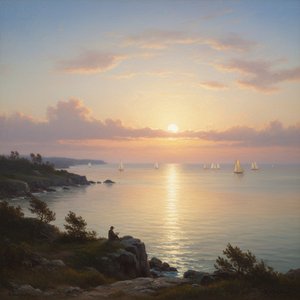
John Frederick Kensett’s Sunset on the Sea: A Luminist Meditation
The painting “Sunset on the Sea,” created by John Frederick Kensett in 1872, stands as a quintessential example of Luminism—a movement that championed atmospheric light and serene landscapes—and embodies Kensett's profound connection to the American wilderness. More than just a depiction of a coastal vista, it’s an exploration of mood, color, and the sublime beauty inherent in nature’s fleeting moments. ### Subject Matter and Composition Kensett meticulously captured the essence of Long Island Sound at dusk. The scene unfolds with remarkable clarity: a distant island punctuates the horizon line against a backdrop of expansive sky ablaze with hues of orange, crimson, and violet—colors painstakingly blended to convey the warmth and vibrancy of the setting sun. Foreground trees frame the composition, subtly guiding the viewer’s gaze towards the central vista. These trees aren't merely decorative; they serve as anchors for the eye, grounding the ethereal expanse above in a tangible reality. Scattered boats add a touch of human presence, emphasizing the scale of the landscape and hinting at the quiet contemplation of those observing it. ### Artistic Style and Technique – Luminist Philosophy Kensett’s approach aligns perfectly with the tenets of Luminism—a reaction against Romantic idealism that prioritized observation and accurate representation over dramatic emotion. Unlike his predecessors who sought to convey grandeur and awe, Kensett aimed for a more restrained aesthetic, focusing on capturing the subtle nuances of light and color as they interacted with the natural world. He achieved this remarkable feat through meticulous layering of thin glazes—a technique characteristic of Luminist painters—allowing him to build up luminous surfaces that shimmer with reflected light. This painstaking process resulted in an image that feels remarkably immediate and truthful, mirroring the experience of witnessing a sunset firsthand. ### Historical Context and Influences Kensett’s “Sunset on the Sea” emerged during a period of significant artistic innovation in America. The Hudson River School, which Kensett helped establish, championed idealized depictions of American landscapes—often infused with spiritual resonance—responding to the burgeoning Transcendentalist movement's emphasis on intuition and connection to nature. Turner’s atmospheric paintings profoundly impacted Luminist artists like Kensett, who sought to emulate Turner’s ability to convey emotion through color and light without resorting to overt narrative elements. The painting reflects a broader cultural preoccupation with capturing beauty and tranquility amidst the rapid industrialization of the era—a desire for respite from urban life and an appreciation for the enduring power of unspoiled wilderness. ### Symbolism and Emotional Impact Beyond its technical brilliance, “Sunset on the Sea” resonates deeply with viewers due to its symbolic significance. The sunset itself represents closure, transition, and the inevitable passage of time—themes explored extensively by Romantic poets and artists. However, Kensett’s Luminist style mitigates any sense of melancholy, presenting instead a vision of serene beauty and contemplative stillness. The radiant sun symbolizes hope and renewal, suggesting that even as day fades into night, light persists—a comforting reminder of the enduring presence of divine grace in the natural world. Viewing this painting evokes feelings of peace, wonder, and an appreciation for the sublime grandeur of nature—qualities that continue to captivate audiences today.Fragen & Antworten
Gibt es eine Diashow für "Sunset" von John Frederick Kensett?
Das Diaporama zu „Sunset“ kann auf der Diashow-Seite des Kunstwerks angesehen werden.
Wer ist der Künstler hinter "Sunset"?
"Sunset" wurde von John Frederick Kensett geschaffen. Die Informationen auf dieser Seite beschreiben das Originalwerk von John Frederick Kensett.
Welches Gefühl vermittelt "Sunset" von John Frederick Kensett?
Die festgehaltene Stimmung von "Sunset" von John Frederick Kensett ist Serenität, und ihr emotionaler Tonfall ist Beschaulich.
In welchem Jahr wurde "Sunset" von John Frederick Kensett geschaffen?
"Sunset" stammt aus dem Jahr 1872. Dieses Datum ordnet das Werk in die Schaffensperiode von John Frederick Kensett sowie in dessen Epoche ein.
Ist "Sunset" eine gute Geschenkidee?
Als Geschenk wird "Sunset" von John Frederick Kensett für Jahrestag empfohlen. Auch für andere Anlässe eignet es sich hervorragend.
Befindet sich "Sunset" von John Frederick Kensett im Heimatland des Künstlers?
Nein – das Kunstwerk wird im Ausland aufbewahrt. Der Künstler wurde in Vereinigte Staaten von Amerika geboren; das Originalwerk befindet sich in United States of America.
In welchem Alter schuf John Frederick Kensett „Sunset"?
John Frederick Kensett schuf „Sunset“ im Alter von 56. Der Künstler wurde 1816 geboren, und das Werk datiert auf 1872.
Ähnliche Kunstwerke


Biografie des Künstlers
Ein Leben in der Hingabe an friedliche Landschaften
John Frederick Kensett wurde am 22. März 1816 in Cheshire, Connecticut, geboren. Als Mitglied der zweiten Generation der Hudson River School Künstler sind Kensetts charakteristische Werke durch ihre friedlichen und leuchtenden Qualitäten gekennzeichnet, die die transzendenten Aspekte der Natur feiern.Frühes Leben und Ausbildung
Kensett besuchte die Cheshire Academy und studierte Gravur bei seinem Vater, Thomas Kensett. Er arbeitete später in New Haven als Graveur, bevor er 1838 nach New York City zog, um dort Banknotengravuren zu fertigen. Im Jahr 1840 reiste Kensett nach Europa, um seine Fähigkeiten im Malen zu verfeinern und lernte dabei Benjamin Champney kennen.Etablierter Stil und Luminismus
Nach der Eröffnung seines Ateliers in New York City bereiste Kensett ausgiebig die nordöstliche Region und die Colorado Rockies und hielt das Wesen dieser Landschaften fest. Sein Stil entwickelte sich von der traditionellen Hudson River School hin zu einem raffinierteren Luminismus, der durch unbefangene Pinselstriche gekennzeichnet ist, die die Qualitäten des atmosphärischen Lichts vermitteln.- Mount Washington from the Valley of Conway (1851), ein ikonisches Gemälde, wurde von der American Art Union erworben und an 13.000 Abonnenten verteilt.
- Eaton's Neck, Long Island (1872), ein Paradebeispiel für Kensetts Luminismus-Stil, befindet sich nun in der Sammlung des Metropolitan Museum of Art in New York.
Vermächtnis und Beiträge
Kensett war Mitbegründer des Metropolitan Museum of Art und Vollmitglied der National Academy of Design. Seine Arbeit, die zu Lebzeiten hoch angesehen war, beeinflusst weiterhin die Landschaftsmalerei. Wichtige Werke:- Sunset Sky (ca. 1870), The Metropolitan Museum of Art, New York
- Three Mile Harbor (ca. 1860), Museum of Fine Arts, Tallahassee

John Frederick Kensett
1816 - 1872 , Vereinigte Staaten von Amerika
Eckdaten zum Künstler
- Beeinflusste Künstler:
- Thomas Cole
- Benjamin Champney
- Bemerkenswerte Werke:
- Mount Washington from the Valley
- Eaton’s Neck, Long Island
- Sunset Sky
- Three Mile Harbor
- Geburtsdatum: 22. März 1816
- Geburtsort: Cheshire, USA
- Künstlerische Richtung: Hudson River School, Luminismus
- Nationalität: Amerikanisch
- Sterbedatum: 14. Dezember 1872
- Vollständiger Name: John Frederick Kensett
Verwandte Artikel

Sanford Robinson Gifford und die Luministische Tradition der Amerikanischen Landschaftsmalerei: Licht, Atmosphäre und die Erhabenheit der Natur
Entdecken Sie die faszinierende Welt von Sanford Robinson Gifford und dem Luminismus! Erfahren Sie mehr über Lichtmalerei, Atmosphäre und die Erhabenheit der amerikanischen Landschaftskunst. Expertenwissen & hochwertige Reproduktionen.

Katsushika Hokusai: Die 25 Meisterwerke des Ukiyo-e – Kunst für Ihr Zuhause | ArtsDot
Entdecken Sie die 25 Meisterwerke von Katsushika Hokusai! Tauchen Sie ein in die Welt des Ukiyo-e, berühmte Holzschnitte wie 'Die große Welle' & Fuji-Ansichten. Hochwertige Kunstdrucke für Ihr Zuhause – jetzt auf ArtsDot.com!
William Trost Richards: Luminismus, Spiritualität und die amerikanische Landschaftstradition
Entdecken Sie das Werk von William Trost Richards und die faszinierende Welt des Luminismus! Erfahren Sie mehr über seine einzigartige Aquarelltechnik, spirituelle Tiefe & Einfluss auf die amerikanische Landschaftsmalerei. Jetzt lesen!

John Frederick Kensett: Luministische Ästhetik und nationale Identität in der amerikanischen Landschaftsmalerei
Entdecken Sie das Werk von John Frederick Kensett und die Ästhetik des Luminismus! Erfahren Sie mehr über seine Bedeutung für die amerikanische Landschaftsmalerei und die Suche nach nationaler Identität. Expertenanalyse & Hintergrundinformationen.

Robert Spencer: Luminism, Narrative & the American Landscape Tradition
Explore the captivating world of Luminism & the Hudson River School with our expert analysis. Discover the history, artists, and enduring beauty of 19th-century American landscape painting. Find museum-quality reproductions at ArtsDot.


