

 Vorschau anzeigen
 Versenden
 Teilen
 Details anzeigen
 Leitfaden

 Herunterladen
 Ähnliche Objekte
 Röntgenaufnahme
 Diashow
 Q&A
Q&A Statistiken
Ice Scene

- 36.0 x 71.0 cm


 Weiterlesen
Giclée / Kunstdruck
Giclée- oder Leinwanddruck in Museumsqualität mit schneller Produktion und flexiblen Veredelungsoptionen. ( Handgemalte Reproduktion bestellen Zum digitalen Bild wechseln)




P118B €10

P118H €10

P118W €10

P438Z €10

P508JH €12

P508YH €12

P805H €10

P805Z €10

P919BZ €10

P919G €10

P919XJ €10

P959ZH €10

P968JZ €12

W106C €8

W218G €10

W218JH €8

W218Y €10

W307PJ €10

W316G €10

W316PJ €8

W316Y €10

W398PJ €8

W4111J €10

W500HY €15

W500JH €15

W692G €12

W849H €8

W940BG €15

W953PJ €8




Wählen Sie aus unseren vordefinierten Formaten, die den ursprünglichen Proportionen des Kunstwerks entsprechen.

Geben Sie die benötigte Breite und Höhe an, damit der Druck perfekt in Ihren Rahmen oder an Ihre Wand passt. Ein Druck kann nur beschnitten, aber niemals größer als das Originalbild angefertigt werden; daher verliert ein Format mit anderen Proportionen einen Teil des Bildes. Wir senden Ihnen ein digitales Mockup zur Freigabe, bevor wir den Druck ausführen. Das auf dieser Seite gezeigte Bild zeigt nicht den tatsächlichen Beschnitt – dies ist nur im Mockup ersichtlich.
Weltweiter Versand () innerhalb von 2 Wochen statt der üblichen 4/5 Wochen. (2 November)

Kostenloser weltweiter Expressversand

Hochwertige Leinenleinwand

Umfassender Versicherungsschutz beim Versand

Zollgebühren-Rückerstattungsgarantie

Garantie für exakte Farbtreue

100 Tage Rückgaberecht (nur bei Mängeln)

100% Geld-zurück-Garantie

Mengenrabatt verfügbar
 Die Glasoption ist nur für Größen unter 110 cm verfügbar.

Ice Scene
Giclée / Kunstdruck
Format der Reproduktion
-


Endpreis
€ 55
A Frozen Moment Captured: Hendrick Avercamp’s “Ice Scene”
Hendrik Avercamp's "Ice Scene," painted in 1610, stands as an emblem of the Dutch Golden Age—a testament to meticulous observation and a masterful depiction of winter life. Housed within the Mauritshuis museum in The Hague, Netherlands, this monumental panel offers more than just a visual spectacle; it invites contemplation on the intersection of daily existence and artistic brilliance. Avercamp’s unique perspective as a mute artist profoundly shaped his approach to portraying the world around him, fostering an unparalleled sensitivity to detail and capturing the essence of a particular time and place with remarkable precision.The Artist's Vision: Beyond Silence
Born in Amsterdam in 1585, Hendrick Avercamp defied societal expectations for individuals with disabilities—a fact that ironically fueled his artistic prowess. Despite his inability to speak or hear, Avercamp possessed an extraordinary capacity for visual perception, transforming his perceived limitations into a catalyst for heightened observation and artistic innovation. His formative years were spent studying under Pieter Isaacsz, absorbing the principles of portraiture, while also benefiting from guidance from David Vinckboons, whose influence can be discerned in Avercamp’s early stylistic explorations. This dual mentorship instilled in him a foundational understanding of artistic technique alongside an acute awareness of human behavior and environment—skills that would prove invaluable throughout his prolific career.A Symphony of Detail: Technique and Composition
“Ice Scene” exemplifies Avercamp's signature style – a genre painting characterized by panoramic vistas rendered with astonishing realism. Utilizing oil paint on panel, he achieved breathtaking luminosity and textural depth through layering techniques meticulously applied to capture the icy expanse of the frozen river and its surrounding landscape. The artist’s compositional choices are equally deliberate: a high vantage point elevates the scene, presenting it as a comprehensive tableau of human activity amidst the harsh winter conditions. Hundreds of figures populate the canvas—ranging from ice skaters engaged in playful pursuits to laborers hauling goods across the snow—each rendered with painstaking accuracy and imbued with palpable emotion. The inclusion of animals – crows scavenging on a frozen horse carcass – adds an element of grim realism, grounding the idyllic portrayal of human leisure within the broader context of survival.Historical Context: Holland's Winter Idyll
The painting’s creation coincided with a period of considerable prosperity and cultural dynamism in Dutch society—the zenith of the Golden Age. During this era, artists like Avercamp sought to depict not merely what they saw but also what they felt about their surroundings. “Ice Scene” reflects the prevailing mood of optimism and resilience characteristic of the time, portraying individuals embracing winter’s challenges with courage and camaraderie. Furthermore, it speaks to a broader fascination with capturing fleeting moments of everyday life—a trend that anticipated Impressionism decades later. The painting serves as an invaluable window into the social customs and artistic sensibilities of seventeenth-century Holland, offering insights into the values and priorities of its inhabitants.Symbolic Resonance: More Than Just Landscape
Beyond its stunning visual beauty, “Ice Scene” resonates with symbolic significance. The frozen river represents both physical hardship and spiritual purification—a motif prevalent in Northern European art during this period. The figures engaged in skating symbolize vitality and joy amidst adversity, embodying the humanist ideals that underpinned the Golden Age’s artistic endeavors. Even the inclusion of the horse carcass serves as a poignant reminder of mortality—a subtle yet powerful commentary on the cyclical nature of life and death. Avercamp's masterful rendering elevates this simple winter landscape into an enduring meditation on human experience and artistic expression.Emotional Impact: A Timeless Masterpiece
“Ice Scene” continues to captivate viewers today with its evocative atmosphere and profound emotional depth. The painting’s luminous palette—dominated by whites, blues, and browns—creates a sense of serene grandeur, transporting the viewer back to a bygone era. Yet, beneath the surface tranquility lies an underlying tension—a palpable awareness of the precariousness of existence amidst the unforgiving forces of winter. Avercamp's ability to convey both beauty and melancholy speaks to the enduring power of art to illuminate the human condition—making “Ice Scene” not merely a remarkable achievement of artistic technique but also a timeless masterpiece that resonates with audiences across generations.Fragen & Antworten
Kann ich "Ice Scene" von Hendrick Avercamp vor dem Kauf an meiner eigenen Wand sehen?
"Ice Scene" von Hendrick Avercamp kann mithilfe der AR-Vorschau-Seite des Kunstwerks mit Augmented Reality auf einem kompatiblen Gerät direkt an Ihrer eigenen Wand vorab betrachtet werden.
Welche Technik wurde für "Ice Scene" von Hendrick Avercamp verwendet?
Das Medium von "Ice Scene" von Hendrick Avercamp ist Oil On Canvas. Die Reproduktionen zielen darauf ab, die Optik dieser Technik wiederzugeben.
Welche Maße hat das Originalwerk "Ice Scene" von Hendrick Avercamp?
Die Maße von "Ice Scene" von Hendrick Avercamp betragen 36 x 71 cm. Reproduktionen können in anderen Größen bestellt werden, wobei die Proportionen beibehalten werden.
Ähnliche Kunstwerke


Künstlerbiografie
Hendrick Avercamp (1585–1634): A Pioneer of Dutch Winter Landscape
Hendrick Avercamp, born in Amsterdam in a house next to the Nieuwe Kerk („Neue Kirche“) on January 27, 1585, stands as one of the earliest landscape painters of the 17th-century Dutch school. His life story is interwoven with artistic innovation and personal resilience—a tale that reveals not only his mastery of technique but also a profound engagement with the spirit of his time. From an early age, Avercamp experienced the world differently than many others; he was mute and likely deaf, earning him the affectionate yet defining moniker “de Stomme van Kampen” – the Mute of Kampen. This perceived limitation didn’t stifle his creative impulse but perhaps sharpened his observational acuity, allowing him to translate the subtle nuances of Dutch winter onto canvas with unparalleled precision and vibrancy. He began his artistic journey under the tutelage of Pieter Isaacsz, a celebrated portrait painter in Amsterdam, and possibly benefited from guidance from David Vinckboons, whose stylistic influence can be discerned in Avercamp’s formative works.Early Influences and Artistic Training
Avercamp’s formative years were marked by exposure to Flemish artistic traditions—particularly those championed by Pieter Bruegel the Elder. Around 1565, Bruegel had already established a distinctive style characterized by detailed depictions of rural life and dramatic atmospheric effects. Avercamp absorbed these influences deeply, mirroring Bruegel’s penchant for portraying scenes brimming with human activity against a backdrop of wintry landscapes. This stylistic kinship is evident in Avercamp’s early paintings—particularly *Winter Landscape with Skaters*, where the bustling figures engaged in skating activities embody the spirit of Dutch winter culture. His apprenticeship with Isaacsz provided him with foundational skills in portraiture, complementing his burgeoning talent for landscape painting and fostering a balanced artistic vision.The Winter Landscape Genre: Innovation and Technique
Avercamp’s singular contribution to art history lies in his pioneering role as one of the first Dutch artists to dedicate himself exclusively to winter landscapes—a genre that had hitherto been largely neglected by painters. Unlike many contemporaries who sought to convey the grandeur or solemnity of winter, Avercamp focused on capturing its lively essence—the joyous activities of skaters, sledders, and villagers alike. He achieved this remarkable feat through masterful technique—primarily employing aerial perspective, a method pioneered by Bruegel himself. This technique subtly alters colors and tonal values across the canvas to simulate depth, drawing viewers into immersive winter scenes that pulsate with life. Avercamp’s palette was rich and vibrant, reflecting the luminosity of winter light and capturing the subtle hues of snow and ice. Furthermore, he skillfully utilized *repoussoir*, placing figures in the foreground on a slight elevation to heighten the illusion of three-dimensionality—a technique that underscores his meticulous attention to detail and artistic craftsmanship.Notable Works and Artistic Legacy
Hendrick Avercamp’s oeuvre comprises approximately 100 paintings, predominantly winter landscapes executed with remarkable precision and expressive power. Among his most celebrated masterpieces are *Winter Landscape with Skaters*, which exemplifies his mastery of capturing the atmosphere of a Dutch winter day; *Street in Delfi*, offering a rare glimpse into urban life during the frozen months; and *Enjoying the Ice near a Town*, showcasing Avercamp’s ability to create dynamic compositions filled with numerous figures engaged in festive activities. These paintings stand as testaments to his artistic vision—a fusion of observation, technique, and humanist sensibility that continues to inspire admiration centuries later. His work resides primarily in museums across Europe, including the Rijksmuseum in Amsterdam and the Mauritshuis in The Hague, where it remains a cornerstone of Dutch Golden Age art history. Avercamp’s legacy extends beyond his artistic achievements; he embodies the triumph of creativity amidst adversity—a symbol of unwavering dedication to craft and an enduring fascination with the beauty of the natural world frozen in time.
Hendrick Avercamp
1585 - 1634 , Niederlande
Kurzinfos
- Artistic Movement Or Style: Dutch Golden Age Malerei
- Artists Who Influenced This Artist:
- Pieter Isaacsz
- David Vinckboons
- Date Of Birth: Januar 27, 1585
- Date Of Death: Mai 15, 1634
- Full Name: Hendrick Avercamp
- Nationality: Niederländisch
- Notable Artworks:
- Winter Landschaft mit Schlittschuern
- Straß in Delfi
- Place Of Birth: Amsterdam, Niederlande
Ähnliche Artikel

Die 10 Meisterwerke des Goldenen Zeitalters der niederländischen Malerei |
Entdecken Sie die 10 Meisterwerke des Niederländischen Goldenen Zeitalters! Von Rembrandt bis Vermeer – erleben Sie Kunstgeschichte, Techniken & Emotionen. Hochwertige Gemäldereproduktionen für Ihr Zuhause auf .

Charles Leickert: Capturing the Dutch Golden Age Light – A Comprehensive Study of Technique, Context, and Legacy
Explore the captivating winter landscapes of Charles Leickert, a master of Dutch Golden Age light & atmosphere. Discover his techniques, symbolism, and lasting legacy – a comprehensive study for art enthusiasts and collectors.

Golden Age Reflections: Dutch Baroque Painting & Cultural Innovation
Explore the Dutch Golden Age of painting! Discover key artists like Vermeer & ter Borch, their innovative techniques, and the rich cultural context behind these Baroque masterpieces. Learn about collecting & appreciating this iconic art period.

Golden Light & Dutch Skies: Bringing the Magic of Dutch Golden Age Landscapes into Your Home
Transform your home with the breathtaking light of Dutch Golden Age landscapes. Discover how hand-painted oil reproductions of masterworks like Ruisdael and Vermeer bring timeless elegance, atmosphere, and soulful texture to modern interiors. Elevate your space with museum-quality art.
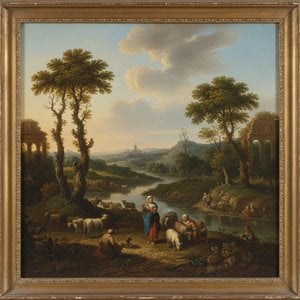
Nicolaes Berchem und das Goldene Zeitalter: Pastoralismus, Idealisierung & Künstlerische Innovation
Entdecken Sie die faszinierende Welt von Nicolaes Berchem und das Goldene Zeitalter der niederländischen Landschaftsmalerei. Expertenanalyse, Hintergrundinformationen & künstlerische Innovationen.


