


 In echtem Maßstab anzeigen
 Versenden als Grußkarte
 Teilen
 Details anzeigen
 Leitfaden öffnen

 Herunterladen
 Ähnliche Objekte
 Röntgenaufnahme
 Diashow
 Besucherstatistiken
untitled (6524)


 Mehr anzeigen
Giclée / Kunstdruck
Giclée- oder Leinwanddruck in Museumsqualität mit schneller Produktion und flexiblen Veredelungsoptionen. ( Handgemalte Reproduktion kaufen Zum digitalen Bild wechseln)




P118B $10

P118H $10

P118W $10

P438Z $10

P508JH $12

P508YH $12

P805H $10

P805Z $10

P919BZ $10

P919G $10

P919XJ $10

P959ZH $10

P968JZ $12

W106C $8

W218G $10

W218JH $8

W218Y $10

W307PJ $10

W316G $10

W316PJ $8

W316Y $10

W398PJ $8

W4111J $10

W500HY $15

W500JH $15

W692G $12

W849H $8

W940BG $15

W953PJ $8




Wählen Sie aus unseren vordefinierten Formaten, die den ursprünglichen Proportionen des Kunstwerks entsprechen.

Sie können Ihre eigenen Maße eingeben, um ein bestimmtes Format oder einen speziellen Platz einzupassen. Wenn das von Ihnen gewählte Format nicht den Proportionen des Originalbildes entspricht, werden wir das Kunstwerk entweder beschneiden oder das Bild mit einem gespiegelten oder einfarbigen Rand erweitern. Ein digitaler Entwurf wird Ihnen zur Genehmigung zugesandt, bevor die Produktion beginnt.
Bitte beachten Sie, dass die Vorschau auf dem Bildschirm nicht den tatsächlichen Zuschnitt oder die Erweiterung widerspiegelt. Nur der Entwurf zeigt die endgültige Komposition präzise an.
Obwohl Sondermaße verfügbar sind, empfehlen wir die Auswahl eines Maßes aus der vordefinierten Liste, um die ursprünglichen Proportionen zu bewahren.
Weltweiter Versand () innerhalb von 2 Wochen statt der üblichen 4/5 Wochen. (26 September)

Kostenloser weltweiter Expressversand

Hochwertige Leinenleinwand

Vollständiger Versicherungsschutz beim Versand

Zollgebühren-Rückerstattungsgarantie

Garantie für exakte Farbtreue

100-tägiges Rückgaberecht (nur bei Mängeln)

100% Geld-zurück-Garantie

Angebot für Mengenrabatt
 Die Glasoption ist nur für Größen unter 110 cm verfügbar.

untitled (6524)
Giclée / Kunstdruck
Format der Reproduktion
-


Gesamtpreis
$ 62
A Haunting Reverie: Exploring Giorgio de Chirico’s “Untitled (6524)”
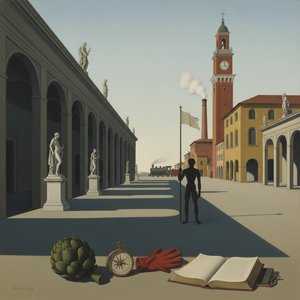
Giorgio de Chirico's "Untitled (6524)" is not merely a depiction of a scene; it’s an immersion into the unsettling realm of the subconscious, a quintessential example of the artist’s pioneering engagement with what he termed ‘metaphysical painting.’ This black and white composition immediately arrests the viewer with its stark geometry and disorienting perspective, hallmarks of de Chirico's unique vision. The dominant structure, a monumental edifice crowned with a prominent clock, commands attention – not as a functional timepiece, but as a symbol of time’s relentless march and the anxieties surrounding mortality that permeated his work. The unsettling stillness of the scene, punctuated by the solitary figure and the soaring bird, evokes a profound sense of isolation and contemplation.
The Roots of Disquiet: Historical Context and Influences
- Early 20th-Century Europe: De Chirico’s work emerged during a period of immense social and intellectual upheaval. The rapid industrialization, the rise of urban centers, and the questioning of traditional values created a fertile ground for artists seeking to explore new modes of expression.
- Philosophical Echoes: The artist was deeply influenced by the philosophies of Nietzsche, Schopenhauer, and Weininger, whose ideas about the irrationality of human desire, the subjective nature of reality, and the potential for existential dread resonated powerfully with his artistic concerns. The painting reflects a deep engagement with these themes, presenting a world stripped bare of comforting illusions.
- Symbolist Precursors: De Chirico’s aesthetic was also shaped by the works of Arnold Böcklin and Max Klinger, artists known for their evocative symbolic landscapes and haunting imagery – particularly the dreamlike quality of Böcklin's work which heavily influenced de Chirico’s early style.
Decoding the Symbolism: Structure, Form, and Narrative
The composition itself is laden with symbolism. The clock, a recurring motif in de Chirico’s oeuvre, represents not just time but also memory, loss, and the illusion of control. Its red face adds an element of dramatic intensity, perhaps hinting at suppressed emotions or impending doom. The smaller structures – the chair and bench – suggest a sense of abandonment and isolation, while the lone figure, positioned near the left side, could be interpreted as a representation of the viewer themselves, lost in contemplation within this unsettling space. The bird, soaring above, offers a fleeting moment of freedom against the backdrop of oppressive stillness.
Technique and Aesthetic: A Masterclass in Illusion
Executed in black and white, “Untitled (6524)” exemplifies de Chirico’s mastery of perspective and his ability to create a sense of unease through carefully constructed spatial illusions. The use of sharp angles, receding planes, and distorted proportions contributes to the painting's unsettling atmosphere. The meticulous attention to detail – from the texture of the building materials to the subtle nuances of light and shadow – further enhances the work’s impact. This technique, combined with his deliberate rejection of naturalistic representation, firmly established de Chirico as a key figure in the development of Surrealism, even before the movement formally emerged.
Emotional Resonance: A Portrait of Existential Anxiety
"Untitled (6524)" is more than just an aesthetically pleasing image; it’s a profound meditation on the human condition. The painting evokes a powerful sense of anxiety, alienation, and the inherent fragility of existence – emotions that continue to resonate with viewers today. Its enduring appeal lies in its ability to tap into our deepest fears and uncertainties, offering a glimpse into the hidden landscapes of the mind.
Ähnliche Kunstwerke


Biografie des Künstlers
frühes Leben und Einflüsse
Giorgio de Chirico, ein renommierter italienischer Künstler, wurde am 10. Juli 1888 in Volos, Griechenland, geboren, der Mutter war eine Genueserin und der Vater sizilianisch. Sein frühes Leben war geprägt von der Beschäftigung mit Kunst an der Athener Polytechnik unter der Anleitung griechischer einflussreicher Maler Georgios Roilos und Georgios Jakobides. Diese Grundlage prägte später seinen einzigartigen künstlerischen Stil.Die Metaphysche Kunstbewegung
Im Jahr 1910 gründete de Chirico die Metaphysche Kunstbewegung, die den Surrealisten nachhaltig beeinflusste. Seine Werke aus dieser Zeit, die von unheimlichen Stimmungen und traumhaften Szenarien geprägt sind, werden in Gemälden wie die Verwirrungen des Denkers (verfügbar auf ArtsDot's Plattform) und das Rätsel der Stunde (anschaulich auf ArtsDot) dargestellt. Diese Werke erwecken ein Gefühl von Geheimnis, oft mit scharfen Kontrasten von Licht und Schatten.Postmetaphysche Periode
Nach 1919 verschob sich de Chiricos Interesse hin zu traditionellen Maltechniken und übernahm einen neoklassischen oder neobarocken Stil. Diese Veränderung ist in seinen späteren Werken erkennbar, die zwar nicht die gleiche Kritikerlob wie seine früheren Werke erhielten, aber eine reife Entwicklung in seinem künstlerischen Ansatz demonstrieren.Vermächtnis und Einfluss
De Chiricos Einfluss auf den Surrealismus ist unbestreitbar, wobei Künstler wie André Breton von seinen metaphysischen Gemälden beeinflusst wurden. Obwohl sein späteres Werk nicht so breit gefeiert wurde, bleibt de Chirico eine zentrale Figur in der Geschichte der modernen Kunst. Sein Vermächtnis inspiriert weiterhin, und seine Werke sind in Sammlungen auf der ganzen Welt zu finden, darunter das Museum von Giorgio de Chirico, das sich in der Nähe der Spanischen Treppe in Rom befindet.- Erforsche mehr Werke von Giorgio de Chirico auf ArtsDot
- Entdecke die Metaphysche Kunstbewegung und ihren Einfluss auf Surrealismus durch dieses informative Artikel auf ArtsDot
- Lerne mehr über de Chiricos Leben und Werke auf Wikipedia

Giorgio de Chirico
1888 - 1978 , Griechenland
Eckdaten zum Künstler
- Beeinflusste Künstler: ['André Breton']
- Bemerkenswerte Werke:
- Die Verwirrungen des Denkers
- Das Rätsel der Stunde
- Das Lied der Liebe
- Geburtsdatum: 10. Juli 1888
- Geburtsort: Volos, Griechenland
- Künstlerische Bewegung: Metaphysische Kunst
- Künstlerische Einflüsse:
- Arnold Böcklin
- Max Klinger
- Friedrich Nietzsche
- Arthur Schopenhauer
- Nationalität: Italienisch
- Vollständiger Name: Giorgio de Chirico
Verwandte Artikel

Giclée Prints: Archival Quality & Aesthetic Nuances for the Discerning Collector
Explore the world of giclée prints with ArtsDot. Learn about archival quality, aesthetic nuances & investment potential. Expert guidance for discerning art collectors seeking museum-quality reproductions and lasting value.

Beyond Reality's Veil: Exploring the Enigmatic World of Metaphysical Art
Explore the captivating world of Metaphysical art with ArtsDot. Discover Giorgio de Chirico's iconic paintings, philosophical influences & lasting impact on Surrealism. Expert insights for collectors.
Giorgio de Chirico: Metaphysische Realitäten und die Poetik der Abwesenheit
Entdecken Sie Giorgio de Chiricos revolutionäre Metaphysische Malerei! Analysieren Sie seine Räume, Einflüsse und die Poetik der Abwesenheit. Expertenwissen & tiefe Kunstinterpretation.

Goya: Die 25 Meisterwerke des spanischen Genies – Kunst für Ihr Zuhause | ArtsDot
Entdecken Sie die 25 Meisterwerke von Francisco Goya! Tauchen Sie ein in die düstere Romantik spanischer Malerei, Porträts & Historienbilder. Hochwertige Kunstdrucke auf ArtsDot.com – für Kunstliebhaber und stilvolles Wohnen.

Weiße Meisterwerke: Die Top 10 berühmtesten Gemälde und ihre zeitlose Eleganz
Entdecken Sie die Top 10 berühmter Gemälde, dominiert von Weiß! Von Malewitsch bis Rothko – erfahren Sie Geschichten hinter ikonischen Kunstwerke und lassen Sie sich für Ihre Wohnraumgestaltung inspirieren. Kunstreproduktionen in Museumsqualiät auf


