

 Vorschau anzeigen
 Versenden
 Teilen
 Details anzeigen
 Leitfaden

 Herunterladen
 Ähnliche Objekte
 Röntgenaufnahme
 Diashow
 Fragen & Antworten
 Statistiken
The Stairway

- 144.0 x 118.0 cm


 Weiterlesen
Giclée / Kunstdruck
Giclée- oder Leinwanddruck in Museumsqualität mit schneller Produktion und flexiblen Veredelungsoptionen. ( Handgemalte Reproduktion bestellen Zum digitalen Bild wechseln)




P118B €10

P118H €10

P118W €10

P438Z €10

P508JH €12

P508YH €12

P805H €10

P805Z €10

P919BZ €10

P919G €10

P919XJ €10

P959ZH €10

P968JZ €12

W106C €8

W218G €10

W218JH €8

W218Y €10

W307PJ €10

W316G €10

W316PJ €8

W316Y €10

W398PJ €8

W4111J €10

W500HY €15

W500JH €15

W692G €12

W849H €8

W940BG €15

W953PJ €8




Wählen Sie aus unseren vordefinierten Formaten, die den ursprünglichen Proportionen des Kunstwerks entsprechen.

Geben Sie die benötigte Breite und Höhe an, damit der Druck perfekt in Ihren Rahmen oder an Ihre Wand passt. Ein Druck kann nur beschnitten, aber niemals größer als das Originalbild angefertigt werden; daher verliert ein Format mit anderen Proportionen einen Teil des Bildes. Wir senden Ihnen ein digitales Mockup zur Freigabe, bevor wir den Druck ausführen. Das auf dieser Seite gezeigte Bild zeigt nicht den tatsächlichen Beschnitt – dies ist nur im Mockup ersichtlich.
Weltweiter Versand () innerhalb von 2 Wochen statt der üblichen 4/5 Wochen. (4 November)

Kostenloser weltweiter Expressversand

Hochwertige Leinenleinwand

Umfassender Versicherungsschutz beim Versand

Zollgebühren-Rückerstattungsgarantie

Garantie für exakte Farbtreue

100 Tage Rückgaberecht (nur bei Mängeln)

100% Geld-zurück-Garantie

Mengenrabatt verfügbar
 Die Glasoption ist nur für Größen unter 110 cm verfügbar.

The Stairway
Giclée / Kunstdruck
Format der Reproduktion
-


Endpreis
€ 56
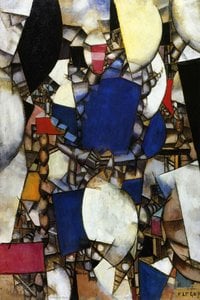
A Revolution in Form: Exploring Léger’s ‘The Stairway’ (1913)
Fernand Léger's *The Stairway*, painted in 1913, stands as a pivotal work bridging the gap between Cubism and his signature “Tubism.” This dynamic composition isn’t merely a depiction of figures on stairs; it’s a bold statement about modernity, mechanization, and the evolving relationship between humanity and the machine age.Deconstructing Reality: Style & Technique
The painting exemplifies Léger's move away from traditional representation towards geometric abstraction. Cubist principles are readily apparent in the fragmented forms and multiple perspectives presented simultaneously, yet *The Stairway* distinguishes itself through its emphasis on cylindrical and conical shapes – a hallmark of his developing style. The artist masterfully employs a limited but powerful palette of primary colors (red, blue, yellow) contrasted with stark blacks, whites, and greys. This deliberate contrast isn’t simply aesthetic; it embodies the dynamics of modern life, mirroring the energy and tension of an increasingly industrialized world. The technique involves layering paint to create a dense surface, with visible brushstrokes contributing to the painting's tactile quality despite its overall smoothness.A World in Flux: Historical Context & Influences
Created on the cusp of World War I, *The Stairway* reflects the anxieties and transformations of early 20th-century Europe. Léger, initially an Impressionist, embraced Cubism around 1909, but the war profoundly impacted his artistic vision. The ensuing sense of fragmentation and destabilization found expression in new art forms like collage and assemblage. Léger wasn’t simply reacting to destruction; he was fascinated by the mechanization of the world. He saw beauty and power in machines, believing they represented the future – a belief that permeated his work during this period. The painting embodies the spirit of innovation and change that defined the era.Beyond Representation: Subject & Symbolism
The subject matter appears to depict three figures engaged in some form of movement, possibly dancing or performing. However, their identities are deliberately obscured by the Cubist fragmentation. This isn’t a portrait of individuals; it's an exploration of humanity as part of a larger mechanical system. The angular steps contrast with the rounded appendages of the figures, further emphasizing this interplay between organic and inorganic forms. While lacking overt symbolism, the painting evokes a sense of energy, rhythm, and perhaps even alienation – emotions central to the modern experience.Emotional Resonance & Lasting Impact
*The Stairway* isn’t a comfortable or passive viewing experience. Its dynamic composition and bold colors create a feeling of instability and movement. The fragmented forms challenge conventional notions of beauty and representation, forcing the viewer to actively engage with the artwork. This painting is not just a visual statement; it's an intellectual one. Léger’s work paved the way for later movements like Pop Art, influencing artists who also explored the relationship between art, technology, and popular culture. Its architectural order within the visual arts makes it a striking piece suitable for modern interiors seeking a bold focal point. Measuring 144 x 118 cm, *The Stairway* commands attention and continues to resonate with audiences today as a powerful testament to the transformative power of modernity.Fragen & Antworten
Wie kann ich eine Vorschau einer Reproduktion von "The Stairway" von Fernand Léger aufrufen?
Eine Vorschau von "The Stairway" von Fernand Léger finden Sie auf der Vorschau im Raum-Seite des Kunstwerks.
Wer hat "The Stairway" geschaffen und in welchem Jahr?
"The Stairway" wurde von Fernand Léger im Jahr 1913 geschaffen.
Aus welcher Schaffensperiode von Fernand Léger stammt "The Stairway"?
"The Stairway" repräsentiert die Early Cubism von Fernand Léger.
Ähnliche Kunstwerke




Künstlerbiografie
frühes Leben und Ausbildung
Fernand Légér, ein französischer Maler, Bildhauer und Filmemacher, wurde am 4. Februar 1881 in Argentan, Orne, Niedergermanien geboren. Sein Vater züchtete Rinder, und Légér erhielt zunächst eine Ausbildung als Architekt von 1897 bis 1899. Er zog dann im Jahr 1900 nach Paris und unterstützte sich dort als Architektenzeichner.Künstlerische Entwicklung
Légers frühe Werke wurden vom Impressionismus beeinflusst, wie in Le Jardin de ma Mère (Mein Muttergarten) (1905) zu sehen ist. Nach dem Besuch der Schule für dekorative Künste und der Académie Julian begann er ab seinem 25. Lebensjahr ernsthaft als Maler zu arbeiten. Sein Stil entwickelte sich zu einer persönlichen Form des Kubismus, der von Kritikern als "Tubism" bezeichnet wurde, da er sich auf zylindrische Formen konzentrierte.Kubismus und die Puteaux-Gruppe
Im Jahr 1910 stellte Légér im Salon d’Automne zusammen mit Jean Metzinger und Henri Le Fauconnier aus. Er schloss sich der Puteaux-Gruppe an, auch bekannt als die Section d’Or (die Goldene Proportion), zusammen mit anderen Künstlern wie Francis Picabia und Marcel Duchamp.Krieg und seine Auswirkungen auf Légers Werk
Légers Erfahrungen im Ersten Weltkrieg hatten einen erheblichen Einfluss auf sein Werk. Während seiner Zeit an der Front produzierte er Skizzen von Artilleriegeschützen, Flugzeugen und Soldaten. Sein Gemälde Soldat mit Pfeife (1916) spiegelt diese Zeit wider.Spätere Werke und Vermächtnis
Légers Nachkriegszeitliche Arbeiten, die von glatten, maschinellen Formen geprägt waren, verknüpften ihn mit der Tradition der französischen figurativen Malerei. Seine "animierten Landschaften" von 1921 zeigten Figuren und Tiere in harmonischen, stromlinienförmigen Formen.- Fernand Légers Werke auf ArtsDot
- Mehr über Fernand Légér auf Wikipedia
- Entdecken Sie das Musée National Fernand Légér (Frankreich) mit ArtsDot
- Die Sitzende Frau (100 x 81 cm, Tubism)
- Maschinenelement (Kubismus)

Fernand Léger
1881 - 1955 , Frankreich
Kurzinfos
- Beeinflusste Kunstrichtungen: ['Pop Art']
- Beeinflusste Künstler: ['Paul Cézanne']
- Bemerkenswerte Werke:
- Die Sitzende Frau
- Maschinenelement
- Der Große Umzug
- Die Stadt
- Geburtsdatum: 04. Februar 1881
- Geburtsort: Argentan, Frankreich
- Künstlerische Richtung: Kubismus, Tubismus
- Nationalität: Französisch
- Sterbedatum: 1955
- Vollständiger Name: Fernand Léger
- Von Kunstbewegungen Beeinflusst: ['Cézannismus']
- Von Künstlern Beeinflusst: ['Impressionismus']
Ähnliche Artikel
The Allure of Azure: Exploring the Symbolic & Aesthetic Depths of Blue in Art History
Explore the rich history of blue in art! Discover its symbolism, from ancient pigments to modern masterpieces by Kandinsky & Seurat. Uncover the psychological impact and cultural meanings behind this captivating hue.

Die 25 besten Kunstwerke von Fernand Léger: Meister des Maschinenzeitalters
Entdecken Sie die 25 besten Werke von Fernand Léger und den Tubismus. Erleben Sie Meisterwerke auf ArtsDot.com.

Die Top 10 Gemälde in Schattierungen von 'Slate Blue': Kunst für Ihr Zuhause
Entdecken Sie die Top 10 Gemälde in faszinierenden 'Slate Blue' Tönen! Von Monet bis Manet – erleben Sie Kunstgeschichte und lassen Sie sich von Meisterwerken inspirieren. Hochwertige Kunstdrucke auf

Weiße Meisterwerke: Die Top 10 berühmtesten Gemälde und ihre zeitlose Eleganz
Entdecken Sie die Top 10 berühmter Gemälde, dominiert von Weiß! Von Malewitsch bis Rothko – erfahren Sie Geschichten hinter ikonischen Kunstwerke und lassen Sie sich für Ihre Wohnraumgestaltung inspirieren. Kunstreproduktionen in Museumsqualiät auf

Industrielle Ästhetik: 10 Meisterwerke für Ihr Zuhause | ArtsDot
Entdecken Sie 10 Meisterwerke der Industriekunst! Von Expressionismus bis Kubismus – erleben Sie die Ästhetik von Fabriken, Arbeitern & urbanen Landschaften. Hochwertige Reproduktionen auf ArtsDot.com.


