


 Vorschau anzeigen
 Versenden
 Teilen
 Details anzeigen

 Herunterladen
 Ähnliche Objekte
 Röntgenaufnahme
 Diashow
The Staircase2

 Weiterlesen
Giclée / Kunstdruck
Giclée- oder Leinwanddruck in Museumsqualität mit schneller Produktion und flexiblen Veredelungsoptionen. ( Handgemaltes Gemälde kaufen Bild kaufen)




P118B $10

P118H $10

P118W $10

P438Z $10

P508JH $12

P508YH $12

P805H $10

P805Z $10

P919BZ $10

P919G $10

P919XJ $10

P959ZH $10

P968JZ $12

W106C $8

W218G $10

W218JH $8

W218Y $10

W307PJ $10

W316G $10

W316PJ $8

W316Y $10

W398PJ $8

W4111J $10

W500HY $15

W500JH $15

W692G $12

W849H $8

W940BG $15

W953PJ $8




Wählen Sie aus unseren vordefinierten Formaten, die den ursprünglichen Proportionen des Kunstwerks entsprechen.

Sie können Ihre eigenen Maße eingeben, um ein bestimmtes Format oder einen speziellen Platz einzupassen. Wenn das von Ihnen gewählte Format nicht den Proportionen des Originalbildes entspricht, werden wir das Kunstwerk entweder beschneiden oder das Bild mit einem gespiegelten oder einfarbigen Rand erweitern. Ein digitaler Entwurf wird Ihnen zur Genehmigung zugesandt, bevor die Produktion beginnt.
Bitte beachten Sie, dass die Vorschau auf dem Bildschirm nicht den tatsächlichen Zuschnitt oder die Erweiterung widerspiegelt. Nur der Entwurf zeigt die endgültige Komposition präzise an.
Obwohl Sondermaße verfügbar sind, empfehlen wir die Auswahl eines Maßes aus der vordefinierten Liste, um die ursprünglichen Proportionen zu bewahren.
Weltweiter Versand () innerhalb von 2 Wochen statt der üblichen 4/5 Wochen. (13 August)

Kostenloser weltweiter Expressversand

Hochwertige Leinenleinwand

Umfassender Versicherungsschutz beim Versand

Zollgebühren-Rückerstattungsgarantie

Garantie für exakte Farbtreue

60 Tage Rückgaberecht (nur bei Mängeln)

100% Geld-zurück-Garantie

Mengenrabatt verfügbar
 Die Glasoption ist nur für Größen unter 110 cm verfügbar.

The Staircase2
Giclée / Kunstdruck
Format der Reproduktion
-


Gesamtpreis
$ 62
Sammlerstück-Beschreibung
A Moment Frozen in Time: Exploring Fernand Léger’s “The Staircase2”
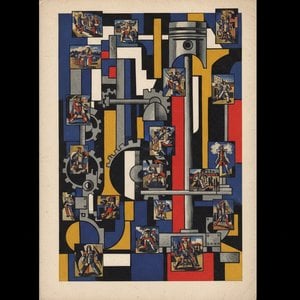
Fernand Léger's "The Staircase2" isn’t merely a depiction of a domestic scene; it’s a carefully constructed meditation on the intersection between human presence and industrial progress. Painted sometime around 1930, this artwork encapsulates the burgeoning Surrealist movement while simultaneously retaining Léger’s signature geometric abstraction—a stylistic choice that distinguishes him from many of his peers who sought refuge in pure abstraction as an escape from realism. The painting presents two figures – a man and a child – positioned against a backdrop of a simple stairwell, yet their interaction feels profoundly significant within the broader context of the era.- Subject Matter: Léger’s focus isn't on capturing an idyllic pastoral landscape but rather on portraying everyday life infused with the influence of machinery and urban environments. The stairwell itself serves as a visual metaphor for ascent – both physically and symbolically – representing aspiration, progress, and perhaps even the challenges inherent in navigating a rapidly changing world.
- Style: Léger’s style is undeniably geometric abstraction, characterized by bold lines and simplified forms. However, unlike purely conceptual abstractions that disregard visual perception, Léger meticulously observes and translates natural shapes into angular constructions. This technique reflects the artist's fascination with the underlying structure of objects – a preoccupation evident throughout his oeuvre.
Technique and Material Considerations
Léger employed oil paint on canvas—a standard medium for artists of his time—allowing for rich color saturation and textural depth. The artist’s meticulous attention to detail is particularly noticeable in the rendering of the stairwell walls, which are depicted with a deliberate flatness that emphasizes their geometric qualities. Furthermore, the inclusion of elements like a clock and a bowl adds subtle visual cues that contribute to the overall composition's complexity without detracting from Léger’s core aesthetic principles. The artist skillfully utilizes color palettes—primarily muted tones—to convey a sense of calm amidst the dynamism suggested by the architectural setting.- Historical Context: “The Staircase2” emerged during the height of Surrealism, though Léger resisted categorization within any particular movement. Nevertheless, the painting resonates with Surrealist ideas about dreamlike imagery and subconscious exploration—particularly in its depiction of a seemingly ordinary scene imbued with an underlying tension. The period was marked by anxieties surrounding technological advancement and societal transformation, themes that find expression in Léger’s visual language.
- Symbolism: Beyond the literal representation of figures and objects, “The Staircase2” carries symbolic weight. The staircase itself symbolizes upward movement, ambition, and overcoming obstacles—a motif frequently revisited by Léger throughout his artistic career. The child figure represents innocence and vulnerability juxtaposed against the adult’s presence, prompting contemplation on themes of legacy and continuity.
Emotional Resonance and Artistic Legacy
Ultimately, “The Staircase2” transcends its formal elements to evoke a feeling of quiet contemplation. Léger's masterful use of geometric abstraction doesn’t preclude conveying emotion; rather, it compels viewers to engage with the artwork on an intellectual level. The painting invites reflection on the relationship between humanity and technology—a dialogue that remains relevant today. Fernand Léger cemented his place as one of the most distinctive voices in modern art, demonstrating that innovation could coexist with profound sensitivity to human experience. Reproductions of “The Staircase2” offer a captivating glimpse into Léger’s artistic vision and provide an opportunity to appreciate the enduring power of geometric abstraction.Ähnliche Kunstwerke


Über den Künstler
frühes Leben und Ausbildung
Fernand Légér, ein französischer Maler, Bildhauer und Filmemacher, wurde am 4. Februar 1881 in Argentan, Orne, Niedergermanien geboren. Sein Vater züchtete Rinder, und Légér erhielt zunächst eine Ausbildung als Architekt von 1897 bis 1899. Er zog dann im Jahr 1900 nach Paris und unterstützte sich dort als Architektenzeichner.Künstlerische Entwicklung
Légers frühe Werke wurden vom Impressionismus beeinflusst, wie in Le Jardin de ma Mère (Mein Muttergarten) (1905) zu sehen ist. Nach dem Besuch der Schule für dekorative Künste und der Académie Julian begann er ab seinem 25. Lebensjahr ernsthaft als Maler zu arbeiten. Sein Stil entwickelte sich zu einer persönlichen Form des Kubismus, der von Kritikern als "Tubism" bezeichnet wurde, da er sich auf zylindrische Formen konzentrierte.Kubismus und die Puteaux-Gruppe
Im Jahr 1910 stellte Légér im Salon d’Automne zusammen mit Jean Metzinger und Henri Le Fauconnier aus. Er schloss sich der Puteaux-Gruppe an, auch bekannt als die Section d’Or (die Goldene Proportion), zusammen mit anderen Künstlern wie Francis Picabia und Marcel Duchamp.Krieg und seine Auswirkungen auf Légers Werk
Légers Erfahrungen im Ersten Weltkrieg hatten einen erheblichen Einfluss auf sein Werk. Während seiner Zeit an der Front produzierte er Skizzen von Artilleriegeschützen, Flugzeugen und Soldaten. Sein Gemälde Soldat mit Pfeife (1916) spiegelt diese Zeit wider.Spätere Werke und Vermächtnis
Légers Nachkriegszeitliche Arbeiten, die von glatten, maschinellen Formen geprägt waren, verknüpften ihn mit der Tradition der französischen figurativen Malerei. Seine "animierten Landschaften" von 1921 zeigten Figuren und Tiere in harmonischen, stromlinienförmigen Formen.- Fernand Légers Werke auf ArtsDot
- Mehr über Fernand Légér auf Wikipedia
- Entdecken Sie das Musée National Fernand Légér (Frankreich) mit ArtsDot
- Die Sitzende Frau (100 x 81 cm, Tubism)
- Maschinenelement (Kubismus)

Fernand Léger
1881 - 1955 , Frankreich
Kurzinfos
- Beeinflusste Kunstrichtungen: ['Pop Art']
- Beeinflusste Künstler: ['Paul Cézanne']
- Bemerkenswerte Werke:
- Die Sitzende Frau
- Maschinenelement
- Der Große Umzug
- Die Stadt
- Geburtsdatum: 04. Februar 1881
- Geburtsort: Argentan, Frankreich
- Künstlerische Richtung: Kubismus, Tubismus
- Nationalität: Französisch
- Sterbedatum: 1955
- Vollständiger Name: Fernand Léger
- Von Kunstbewegungen Beeinflusst: ['Cézannismus']
- Von Künstlern Beeinflusst: ['Impressionismus']
Ähnliche Artikel
Fernand Léger: Die 25 Meisterwerke des Kubismus für Ihr Zuhause | ArtsDot
Entdecken Sie die 25 Meisterwerke von Fernand Léger! Tauchen Sie ein in die Welt des Kubismus, Tubismus & der Avantgarde. Hochwertige Kunstreproduktionen für Ihr Zuhause – jetzt auf ArtsDot.com!

Geometrische Abstraktion: Die 10 Meisterwerke, die Kunstgeschichte prägten | ArtsDot.com
Entdecken Sie die 10 Meisterwerke der geometrischen Abstraktion! Von Kandinsky bis Mondrian – erleben Sie die Geschichte, Farben & Formen dieser revolutionären Kunstrichtung. Hochwertige Kunstreproduktionen auf ArtsDot.com

Industrielle Ästhetik: 10 Meisterwerke für Ihr Zuhause | ArtsDot
Entdecken Sie 10 Meisterwerke der Industriekunst! Von Expressionismus bis Kubismus – erleben Sie die Ästhetik von Fabriken, Arbeitern & urbanen Landschaften. Hochwertige Reproduktionen auf ArtsDot.com.

Beyond Form & Color: Geometric Abstraction's Evolution in 20th/21st Century Art
Explore the evolution of geometric abstraction from Cubism to contemporary art. Discover key artists like Malevich & Mondrian, investment insights, and expert collecting advice at ArtsDot.

Beyond Form & Color: Geometric Abstraction's Enduring Legacy in Art History
Explore the captivating world of geometric abstraction! Discover its origins, key artists like Malevich & Mondrian, and why this movement remains highly valued by art collectors today. Expert insights at ArtsDot.



