


 Vorschau anzeigen
 Versenden
 Teilen
 Details anzeigen

 Herunterladen
 Ähnliche Objekte
 Röntgenaufnahme
 Diashow
Painting
 Acrylic
- WallArt
- Cubist Abstraction
 1926
1926 65.0 x 46.0 cm
 Weiterlesen
Handgefertigte Ölreproduktion
Handgemaltes Ölgemälde auf Leinwand in Ihrer Wunschgröße und mit Rahmen, auf Bestellung von unseren Künstlern angefertigt. ( Druck bestellen Bild kaufen)




P118B $10

P118H $10

P118W $10

P438Z $10

P508JH $12

P508YH $12

P805H $10

P805Z $10

P919BZ $10

P919G $10

P919XJ $10

P959ZH $10

P968JZ $12

W106C $8

W218G $10

W218JH $8

W218Y $10

W307PJ $10

W316G $10

W316PJ $8

W316Y $10

W398PJ $8

W4111J $10

W500HY $15

W500JH $15

W692G $12

W849H $8

W940BG $15

W953PJ $8




Wählen Sie aus unseren vordefinierten Formaten, die den ursprünglichen Proportionen des Kunstwerks entsprechen.

Sie können Ihre eigenen Maße eingeben, um einen bestimmten Rahmen oder Platz auszufüllen. Wenn die gewählte Größe nicht den Proportionen des Originalbildes entspricht, werden wir das Kunstwerk entweder beschneiden oder das Gemälde durch zusätzliche, handgemalte Elemente erweitern. Ein digitales Mockup wird Ihnen zur Genehmigung zugesandt, bevor die Produktion beginnt.
Bitte beachten Sie, dass die Bildschirmvorschau nicht die tatsächliche Beschneidung oder Erweiterung widerspiegelt. Nur das Mockup zeigt die endgültige Komposition exakt an.
Obwohl Sondermaße verfügbar sind, empfehlen wir, eine Größe aus der vordefinierten Liste zu wählen, um die ursprünglichen Proportionen beizubehalten.
Nach der Bestellung wird das ArtsDot.com-Team dem Kunden Anweisungen per E-Mail zusenden und eine Mockup-Vorschau bereitstellen.
Weltweiter Versand () in nur 3 bis 4 Wochen statt der üblichen 5 Wochen. (15 August). Keine Kompromisse bei der Qualität.

Kostenloser weltweiter Expressversand

Hochwertige Leinenleinwand

Umfassender Versicherungsschutz beim Versand

Zollgebühren-Rückerstattungsgarantie

Garantie für exakte Farbtreue

60 Tage Rückgaberecht (nur bei Mängeln)

100% Geld-zurück-Garantie

Mengenrabatt verfügbar
 Die Glasoption ist nur für Größen unter 110 cm verfügbar.

Painting
Art der Reproduktion
Format der Reproduktion
-


Gesamtpreis
$ 263
Beschreibung des Kunstwerks
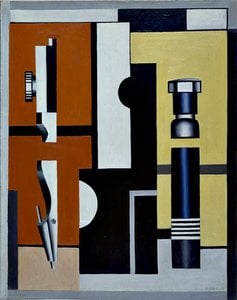
A Fragmented Reality: Léger’s ‘Painting’ (1926) – An Exploration of Modernity
Fernand Léger's 1926 work, simply titled 'Painting,' is a captivating and unsettling meditation on the burgeoning world of industrial modernity. This intimate canvas, measuring 65 x 46 cm, immediately draws the viewer into a carefully constructed tableau – a collision of domestic objects and human figures that speaks volumes about the anxieties and aspirations of the interwar period. The composition itself feels deliberately fragmented, mirroring the sense of dislocation experienced as traditional ways of life were irrevocably altered by technological advancement. Léger wasn't simply depicting machinery; he was attempting to capture its *spirit*, a restless energy that permeated every aspect of urban existence.
- Subject Matter: The painting’s subject matter is deliberately ambiguous, presenting a collection of tools – a knife, scissors, and pliers – alongside two human figures. This juxtaposition immediately raises questions about labor, utility, and the increasingly mechanized nature of work.
- Compositional Dynamics: The placement of these objects and figures creates a dynamic tension. The knife’s assertive presence on the left, contrasted with the more passive positioning of the scissors and pliers, suggests a struggle between control and vulnerability.
The Language of Cubism and Machine Aesthetics
Léger's style is firmly rooted in the principles of Cubism, but he pushed beyond its purely analytical concerns. While Picasso and Braque sought to dissect objects into geometric forms, Léger embraced a more constructive approach, integrating these fractured elements back together to represent not just form, but also movement and energy. The bold, angular shapes – particularly evident in the tools themselves – evoke the sharp lines of industrial machinery, reflecting Léger’s fascination with the dynamism of the machine age. Notice how he avoids smooth transitions; instead, he favors abrupt shifts in tone and texture, further amplifying the sense of disruption.
The clock, subtly placed on the left side, adds another layer of complexity. It's not merely a decorative element but a potent symbol of time – a relentless force accelerating towards an uncertain future. This detail underscores Léger’s concern with the impact of modernity on human experience and the potential for alienation within a rapidly changing world.
Symbolism and Emotional Resonance
The two figures, positioned at opposite ends of the canvas, are equally enigmatic. Their anonymity suggests that they represent humanity as a whole – individuals caught in the currents of industrialization. Their postures, though not overtly expressive, convey a sense of quiet contemplation or perhaps even apprehension. The overall effect is one of unease and disorientation, reflecting the anxieties of a society grappling with profound social and technological shifts.
Léger’s use of color – primarily muted tones punctuated by flashes of brighter hues – contributes to this emotional impact. The cool blues and grays evoke a sense of distance and detachment, while the occasional bursts of red or yellow inject moments of intensity and urgency. This careful manipulation of color further enhances the painting's symbolic weight.
A Legacy of Modern Art
Created in 1926, ‘Painting’ exemplifies Léger’s pivotal role in shaping modern art. His work bridged the gap between abstraction and representation, offering a uniquely insightful commentary on the challenges and possibilities of modernity. This hand-painted reproduction captures not only the visual details of the original but also the profound emotional and intellectual depth that makes it such a compelling masterpiece. It's a piece that invites contemplation – a reminder of our relationship with technology, time, and the ever-evolving nature of reality.
Ähnliche Kunstwerke




Über den Künstler
frühes Leben und Ausbildung
Fernand Légér, ein französischer Maler, Bildhauer und Filmemacher, wurde am 4. Februar 1881 in Argentan, Orne, Niedergermanien geboren. Sein Vater züchtete Rinder, und Légér erhielt zunächst eine Ausbildung als Architekt von 1897 bis 1899. Er zog dann im Jahr 1900 nach Paris und unterstützte sich dort als Architektenzeichner.Künstlerische Entwicklung
Légers frühe Werke wurden vom Impressionismus beeinflusst, wie in Le Jardin de ma Mère (Mein Muttergarten) (1905) zu sehen ist. Nach dem Besuch der Schule für dekorative Künste und der Académie Julian begann er ab seinem 25. Lebensjahr ernsthaft als Maler zu arbeiten. Sein Stil entwickelte sich zu einer persönlichen Form des Kubismus, der von Kritikern als "Tubism" bezeichnet wurde, da er sich auf zylindrische Formen konzentrierte.Kubismus und die Puteaux-Gruppe
Im Jahr 1910 stellte Légér im Salon d’Automne zusammen mit Jean Metzinger und Henri Le Fauconnier aus. Er schloss sich der Puteaux-Gruppe an, auch bekannt als die Section d’Or (die Goldene Proportion), zusammen mit anderen Künstlern wie Francis Picabia und Marcel Duchamp.Krieg und seine Auswirkungen auf Légers Werk
Légers Erfahrungen im Ersten Weltkrieg hatten einen erheblichen Einfluss auf sein Werk. Während seiner Zeit an der Front produzierte er Skizzen von Artilleriegeschützen, Flugzeugen und Soldaten. Sein Gemälde Soldat mit Pfeife (1916) spiegelt diese Zeit wider.Spätere Werke und Vermächtnis
Légers Nachkriegszeitliche Arbeiten, die von glatten, maschinellen Formen geprägt waren, verknüpften ihn mit der Tradition der französischen figurativen Malerei. Seine "animierten Landschaften" von 1921 zeigten Figuren und Tiere in harmonischen, stromlinienförmigen Formen.- Fernand Légers Werke auf ArtsDot
- Mehr über Fernand Légér auf Wikipedia
- Entdecken Sie das Musée National Fernand Légér (Frankreich) mit ArtsDot
- Die Sitzende Frau (100 x 81 cm, Tubism)
- Maschinenelement (Kubismus)

Fernand Léger
1881 - 1955 , Frankreich
Kurzinfos
- Beeinflusste Kunstrichtungen: ['Pop Art']
- Beeinflusste Künstler: ['Paul Cézanne']
- Bemerkenswerte Werke:
- Die Sitzende Frau
- Maschinenelement
- Der Große Umzug
- Die Stadt
- Geburtsdatum: 04. Februar 1881
- Geburtsort: Argentan, Frankreich
- Künstlerische Richtung: Kubismus, Tubismus
- Nationalität: Französisch
- Sterbedatum: 1955
- Vollständiger Name: Fernand Léger
- Von Kunstbewegungen Beeinflusst: ['Cézannismus']
- Von Künstlern Beeinflusst: ['Impressionismus']
Ähnliche Artikel

Fernand Léger: Die 25 Meisterwerke des Kubismus für Ihr Zuhause | ArtsDot
Entdecken Sie die 25 Meisterwerke von Fernand Léger! Tauchen Sie ein in die Welt des Kubismus, Tubismus & der Avantgarde. Hochwertige Kunstreproduktionen für Ihr Zuhause – jetzt auf ArtsDot.com!

Geometrische Abstraktion: Die 10 Meisterwerke, die Kunstgeschichte prägten | ArtsDot.com
Entdecken Sie die 10 Meisterwerke der geometrischen Abstraktion! Von Kandinsky bis Mondrian – erleben Sie die Geschichte, Farben & Formen dieser revolutionären Kunstrichtung. Hochwertige Kunstreproduktionen auf ArtsDot.com

Kandinsky: Die 25 Meisterwerke des Abstrakten – Kunst für Ihr Zuhause | ArtsDot
Entdecken Sie die 25 bedeutendsten Gemälde von Wassily Kandinsky! Tauchen Sie ein in die Welt der abstrakten Kunst, des Expressionismus und der Farbkomposition. Hochwertige Kunstdrucke & Inspiration für Ihr Zuhause auf ArtsDot.com.

Beyond Form & Color: Geometric Abstraction's Evolution in 20th/21st Century Art
Explore the evolution of geometric abstraction from Cubism to contemporary art. Discover key artists like Malevich & Mondrian, investment insights, and expert collecting advice at ArtsDot.

Beyond Form & Color: Geometric Abstraction's Enduring Legacy in Art History
Explore the captivating world of geometric abstraction! Discover its origins, key artists like Malevich & Mondrian, and why this movement remains highly valued by art collectors today. Expert insights at ArtsDot.



