

 In echtem Maßstab anzeigen
 Versenden als Grußkarte
 Teilen
 Details anzeigen
 Leitfaden öffnen

 Herunterladen
 Ähnliche Objekte
 Röntgenaufnahme
 Diashow
 Besucherstatistiken
Die Lampe

 Mehr anzeigen
Handgefertigte Ölreproduktion
Handgemaltes Ölgemälde auf Leinwand in Ihrer Wunschgröße und mit Rahmen, auf Bestellung von unseren Künstlern angefertigt. ( Zum Druck wechseln Zum digitalen Bild wechseln)




P118B €10

P118H €10

P118W €10

P438Z €10

P508JH €12

P508YH €12

P805H €10

P805Z €10

P919BZ €10

P919G €10

P919XJ €10

P959ZH €10

P968JZ €12

W106C €8

W218G €10

W218JH €8

W218Y €10

W307PJ €10

W316G €10

W316PJ €8

W316Y €10

W398PJ €8

W4111J €10

W500HY €15

W500JH €15

W692G €12

W849H €8

W940BG €15

W953PJ €8




Wählen Sie aus unseren vordefinierten Formaten, die den ursprünglichen Proportionen des Kunstwerks entsprechen.

Geben Sie die Breite und die Höhe an, die Sie für Ihren Rahmen oder Ihre Wand benötigen. Da dieses Werk handgemalt ist, kann der Künstler bei einer anderen Form etwas mehr um das Bild herum malen oder etwas abschneiden – Sie entscheiden. Wir senden Ihnen ein digitales Mockup zur Freigabe, bevor mit dem Malen begonnen wird. Das auf dieser Seite gezeigte Bild stellt nicht das tatsächliche Ergebnis dar – dies tut nur das Mockup.
Nach der Bestellung wird das ArtsDot.com-Team dem Kunden Anweisungen per E-Mail zusenden und eine Mockup-Vorschau bereitstellen.
Weltweiter Versand () in nur 3 bis 4 Wochen statt der üblichen 5 Wochen. (21 Oktober). Keine Kompromisse bei der Qualität.

Kostenloser weltweiter Expressversand

Hochwertige Leinenleinwand

Vollständiger Versicherungsschutz beim Versand

Zollgebühren-Rückerstattungsgarantie

Garantie für exakte Farbtreue

100-tägiges Rückgaberecht (nur bei Mängeln)

100% Geld-zurück-Garantie

Angebot für Mengenrabatt
 Die Glasoption ist nur für Größen unter 110 cm verfügbar.

Die Lampe
Reproduktionsmedium
Format der Reproduktion
-


Gesamtpreis
€ 230
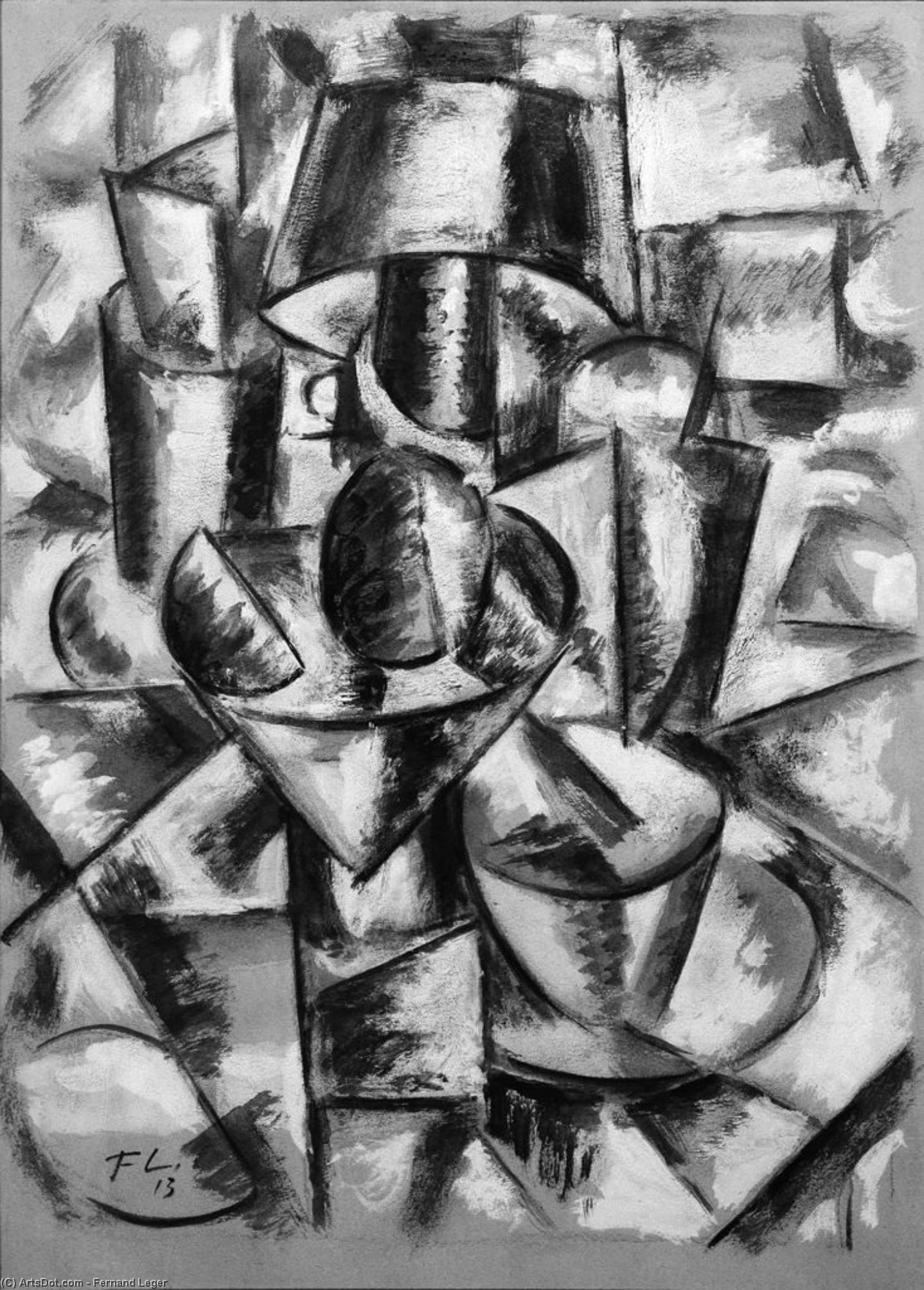
A Symphony of Geometric Form: Exploring Fernand Léger’s ‘The Lamp’
Fernand Léger's 'The Lamp,' created in 1951, transcends mere representation; it embodies the very essence of Cubism and its fascination with capturing the dynamism of modern life. This striking monochrome still life—featuring a perfume bottle alongside a single flower—isn’t simply an object depicted on paper; it’s a deliberate challenge to traditional artistic conventions, reflecting Léger's unwavering belief in integrating the visual language of the machine age into a profoundly expressive artwork.Composition and Technique: Fractured Reality
The image immediately captivates with its fractured perspective—a hallmark of Cubism pioneered by Picasso and Braque. Léger abandons linear perspective entirely, opting instead for a multi-faceted view where objects are dissected into overlapping planes and angular forms. The lamp itself is meticulously broken down into numerous facets, creating an illusion of depth without resorting to conventional shading techniques. Thick hatching—likely executed in charcoal or pencil—dominates the surface texture, emphasizing the geometric abstraction and lending it a palpable physicality. This technique isn’t merely about replicating visual information; it's about conveying movement and disrupting our accustomed way of perceiving space.Historical Context: Embracing Industrial Progress
Léger’s artistic vision emerged during a period marked by rapid industrialization and technological advancement—a time when artists wrestled with how to depict the burgeoning influence of machines on human experience. Unlike many contemporaries who sought refuge in escapism, Léger actively embraced this new reality, translating its rhythms and forms into his distinctive visual vocabulary. The monochrome palette – predominantly grayscale tones – serves not only to heighten the focus on form but also subtly underscores the austerity and precision associated with industrial production.Symbolic Resonance: Beyond Literal Representation
While devoid of overt narrative symbolism, ‘The Lamp’ possesses a deeper resonance rooted in its conceptual framework. The fragmentation of objects—the lamp, the bottle, the flower—can be interpreted as representing the dismantling of established structures and traditions, mirroring Léger's broader critique of bourgeois values. Simultaneously, it speaks to a more fundamental shift in perception: an acceptance of multiple viewpoints and an embrace of intellectual engagement rather than sentimental emotion. The deliberate flatness of the image contributes to this effect, inviting contemplation on the nature of reality itself.Emotional Impact: Quiet Dynamism
Despite its austere aesthetic, ‘The Lamp’ exudes a subtle dynamism—a feeling conveyed through the assertive angular lines and textured hatching. Léger doesn't aim for emotional catharsis; instead, he invites viewers to consider the beauty inherent in geometric abstraction and the transformative power of confronting new perspectives. It’s a piece that lingers in the mind long after viewing, prompting reflection on how art can capture not just what we see but also how we *think*.Fragen & Antworten
Wie fügt sich „Die Lampe“ in die Themen und den Stil von Fernand Léger ein?
Innerhalb des Œuvres von Fernand Léger steht „Die Lampe“ im Stil der Cubist Still Life, geprägt von den Themen machine age reflection, geometric form emphasis, modern aesthetic vision, exploring spatial depth, cubist legacy statement.
Wer ist der Künstler hinter "Die Lampe"?
"Die Lampe" wurde von Fernand Léger geschaffen. Die Informationen auf dieser Seite beschreiben das Originalwerk von Fernand Léger.
Wer hat "Die Lampe" geschaffen und in welchem Stil ist es gehalten?
Hinter "Die Lampe" stehen Fernand Léger und die Cubist Still Life-Bewegung.
Ähnliche Kunstwerke




Biografie des Künstlers
frühes Leben und Ausbildung
Fernand Légér, ein französischer Maler, Bildhauer und Filmemacher, wurde am 4. Februar 1881 in Argentan, Orne, Niedergermanien geboren. Sein Vater züchtete Rinder, und Légér erhielt zunächst eine Ausbildung als Architekt von 1897 bis 1899. Er zog dann im Jahr 1900 nach Paris und unterstützte sich dort als Architektenzeichner.Künstlerische Entwicklung
Légers frühe Werke wurden vom Impressionismus beeinflusst, wie in Le Jardin de ma Mère (Mein Muttergarten) (1905) zu sehen ist. Nach dem Besuch der Schule für dekorative Künste und der Académie Julian begann er ab seinem 25. Lebensjahr ernsthaft als Maler zu arbeiten. Sein Stil entwickelte sich zu einer persönlichen Form des Kubismus, der von Kritikern als "Tubism" bezeichnet wurde, da er sich auf zylindrische Formen konzentrierte.Kubismus und die Puteaux-Gruppe
Im Jahr 1910 stellte Légér im Salon d’Automne zusammen mit Jean Metzinger und Henri Le Fauconnier aus. Er schloss sich der Puteaux-Gruppe an, auch bekannt als die Section d’Or (die Goldene Proportion), zusammen mit anderen Künstlern wie Francis Picabia und Marcel Duchamp.Krieg und seine Auswirkungen auf Légers Werk
Légers Erfahrungen im Ersten Weltkrieg hatten einen erheblichen Einfluss auf sein Werk. Während seiner Zeit an der Front produzierte er Skizzen von Artilleriegeschützen, Flugzeugen und Soldaten. Sein Gemälde Soldat mit Pfeife (1916) spiegelt diese Zeit wider.Spätere Werke und Vermächtnis
Légers Nachkriegszeitliche Arbeiten, die von glatten, maschinellen Formen geprägt waren, verknüpften ihn mit der Tradition der französischen figurativen Malerei. Seine "animierten Landschaften" von 1921 zeigten Figuren und Tiere in harmonischen, stromlinienförmigen Formen.- Fernand Légers Werke auf ArtsDot
- Mehr über Fernand Légér auf Wikipedia
- Entdecken Sie das Musée National Fernand Légér (Frankreich) mit ArtsDot
- Die Sitzende Frau (100 x 81 cm, Tubism)
- Maschinenelement (Kubismus)

Fernand Léger
1881 - 1955 , Frankreich
Eckdaten zum Künstler
- Beeinflusste Kunstrichtungen: ['Pop Art']
- Beeinflusste Künstler: ['Paul Cézanne']
- Bemerkenswerte Werke:
- Die Sitzende Frau
- Maschinenelement
- Der Große Umzug
- Die Stadt
- Geburtsdatum: 04. Februar 1881
- Geburtsort: Argentan, Frankreich
- Künstlerische Richtung: Kubismus, Tubismus
- Nationalität: Französisch
- Sterbedatum: 1955
- Vollständiger Name: Fernand Léger
- Von Kunstbewegungen Beeinflusst: ['Cézannismus']
- Von Künstlern Beeinflusst: ['Impressionismus']
Verwandte Artikel

Georges Braque: Die 25 Meisterwerke des Kubismus für Ihr Zuhause | ArtsDot
Entdecken Sie die 25 bedeutendsten Kunstwerke von Georges Braque – vom Kubismus bis zum Fauvismus. Erfahren Sie die Geschichten hinter den Meisterwerken und finden Sie hochwertige Reproduktionen für Ihr Zuhause auf ArtsDot.com.

Beyond Form & Color: Geometric Abstraction's Evolution in 20th/21st Century Art
Explore the evolution of geometric abstraction from Cubism to contemporary art. Discover key artists like Malevich & Mondrian, investment insights, and expert collecting advice at ArtsDot.

Geometrische Abstraktion: Die 10 Meisterwerke, die Kunstgeschichte prägten | ArtsDot.com
Entdecken Sie die 10 Meisterwerke der geometrischen Abstraktion! Von Kandinsky bis Mondrian – erleben Sie die Geschichte, Farben & Formen dieser revolutionären Kunstrichtung. Hochwertige Kunstreproduktionen auf ArtsDot.com

Beyond Form & Color: Geometric Abstraction's Enduring Legacy in Art History
Explore the captivating world of geometric abstraction! Discover its origins, key artists like Malevich & Mondrian, and why this movement remains highly valued by art collectors today. Expert insights at ArtsDot.

Fernand Léger: Die 25 Meisterwerke des Kubismus für Ihr Zuhause | ArtsDot
Entdecken Sie die 25 Meisterwerke von Fernand Léger! Tauchen Sie ein in die Welt des Kubismus, Tubismus & der Avantgarde. Hochwertige Kunstreproduktionen für Ihr Zuhause – jetzt auf ArtsDot.com!


