


 Versenden als Grußkarte
 Teilen
 Details anzeigen
 Leitfaden öffnen

 Herunterladen
 Ähnliche Objekte
 Diashow
 Besucherstatistiken
Audincourt window
 Stained Glass
- Decor
- Cubist Expressionism
 Modern
 35.0 x 92.0 cm
 Mehr anzeigen
Giclée / Kunstdruck
Giclée- oder Leinwanddruck in Museumsqualität mit schneller Produktion und flexiblen Veredelungsoptionen. ( Handgemalte Reproduktion kaufen Zum digitalen Bild wechseln)




































Wählen Sie aus unseren vordefinierten Formaten, die den ursprünglichen Proportionen des Kunstwerks entsprechen.

Sie können Ihre eigenen Maße eingeben, um ein bestimmtes Format oder einen speziellen Platz einzupassen. Wenn das von Ihnen gewählte Format nicht den Proportionen des Originalbildes entspricht, werden wir das Kunstwerk entweder beschneiden oder das Bild mit einem gespiegelten oder einfarbigen Rand erweitern. Ein digitaler Entwurf wird Ihnen zur Genehmigung zugesandt, bevor die Produktion beginnt.
Bitte beachten Sie, dass die Vorschau auf dem Bildschirm nicht den tatsächlichen Zuschnitt oder die Erweiterung widerspiegelt. Nur der Entwurf zeigt die endgültige Komposition präzise an.
Obwohl Sondermaße verfügbar sind, empfehlen wir die Auswahl eines Maßes aus der vordefinierten Liste, um die ursprünglichen Proportionen zu bewahren.
Weltweiter Versand () innerhalb von 2 Wochen statt der üblichen 4/5 Wochen. (13 Oktober)

Kostenloser weltweiter Expressversand

Hochwertige Leinenleinwand

Vollständiger Versicherungsschutz beim Versand

Zollgebühren-Rückerstattungsgarantie

Garantie für exakte Farbtreue

100-tägiges Rückgaberecht (nur bei Mängeln)

100% Geld-zurück-Garantie

Angebot für Mengenrabatt
 Die Glasoption ist nur für Größen unter 110 cm verfügbar.

Audincourt window
Giclée / Kunstdruck
Format der Reproduktion
-


Gesamtpreis
€ 53
A Symphony of Light and Geometry
To step before Fernand Léger’s Audincourt Window is to witness a profound dialogue between the ancient tradition of stained glass and the relentless pulse of the modern age. Created in 1952, this masterpiece serves as a luminous manifesto of Purism, an artistic movement that sought to strip away the sentimental shadows of Impressionism in favor of the clean, structural clarity found in the industrial world. The window does not merely sit within its frame; it breathes with a rhythmic vitality, transforming light into a geometric symphony of primary colors. Through the meticulous arrangement of vibrant blues, sun-drenched yellows, and deep reds, Léger invites the viewer into a space where the boundaries between art and architecture dissolve, replaced by a mesmerizing dance of interlocking planes.
The composition is a masterclass in what Léger famously termed Tubism—a specialized evolution of Cubism that prioritizes cylindrical, robust forms and bold, tubular shapes. In this particular work, the artist eschews the delicate nuances of naturalistic detail to embrace a more powerful, simplified visual language. The eye is led through a labyrinth of thick black outlines and saturated hues, creating a sense of structural integrity that feels almost architectural in its strength. There is no attempt at illusionistic depth here; instead, Léical celebrates the two-dimensional surface, using the refraction of light through the glass to create a mosaic-like texture that shifts and evolves as the sun moves across the sky.
The Spirit of the Machine Age
Deeply rooted in the historical context of mid-20th-century France, the Audincourt Window reflects Léger’s lifelong fascination with the beauty of mechanization. Commissioned for the Église du Sacré-Cœur in Audincourt, the work represents a daring intersection of sacred space and secular modernity. While the setting is ecclesiastical, the visual vocabulary is decidedly industrial. The shapes evoke the rhythmic pulse of machinery, the strength of steel, and the organized energy of a city in motion. This was Léger’s unique gift: the ability to find the divine within the functional, and to see the poetic potential in the rigid lines of the modern landscape.
For the discerning collector or interior designer, this piece offers more than just aesthetic appeal; it provides an emotional anchor of strength and clarity. The bold, unapologetic use of color can serve as a striking focal point in a contemporary setting, injecting a sense of dynamism and intellectual rigor into a room. Whether viewed as a window into the past or a blueprint for a modern aesthetic, the Audincourt Window remains a timeless testament to the transformative power of form. It is an invitation to rediscover the world not through its fleeting shadows, but through its enduring, vibrant structures.
Fragen & Antworten
Was ist die dominierende Farbe von "Audincourt window" von Fernand Léger?
Die dominante Farbe von "Audincourt window" von Fernand Léger ist Phthalo Green (#221b19).
Wer hat "Audincourt window" erschaffen?
"Audincourt window" wurde von Fernand Léger geschaffen. Die Informationen auf dieser Seite beschreiben das Originalwerk von Fernand Léger.
Wie schafft "Audincourt window" das Gleichgewicht zwischen Hell und Dunkel?
"Audincourt window" weist eine Gesamthelligkeit von deep_shadow auf, und die Luminanz beträgt Soft Shadow.
Warum ist der Urheberrechtsstatus von "Audincourt window" so, wie er ist?
"Audincourt window" von Fernand Léger ist gemeinfrei – das Urheberrecht ist abgelaufen. Die Dauer des Urheberrechts beginnt mit dem Tod des Künstlers, der im Jahr 1955 verstarb.
Ist "Audincourt window" urheberrechtlich frei?
Die urheberrechtliche Situation für "Audincourt window" von Fernand Léger: Das Werk ist gemeinfrei – das Urheberrecht ist abgelaufen. Dies bestimmt, ob Reproduktionen des Bildes frei erstellt werden dürfen.
Zeigt "Audincourt window" starke Hell-Dunkel-Kontraste?
"Audincourt window" von Fernand Léger zeigt einen Statement Kontrast zwischen seinen hellen und dunklen Bereichen.
Für welchen Raum wird "Audincourt window" von Fernand Léger empfohlen?
Der empfohlene Raum für "Audincourt window" von Fernand Léger ist ein Living Room. Dieser Vorschlag kann natürlich an Ihr Interieur angepasst werden.
Wie harmonisch sind die Farben von "Audincourt window" von Fernand Léger?
Die Farbharmonie von „Audincourt window“ wird als Discordant Palette beschrieben.
Ähnliche Kunstwerke


Biografie des Künstlers
frühes Leben und Ausbildung
Fernand Légér, ein französischer Maler, Bildhauer und Filmemacher, wurde am 4. Februar 1881 in Argentan, Orne, Niedergermanien geboren. Sein Vater züchtete Rinder, und Légér erhielt zunächst eine Ausbildung als Architekt von 1897 bis 1899. Er zog dann im Jahr 1900 nach Paris und unterstützte sich dort als Architektenzeichner.Künstlerische Entwicklung
Légers frühe Werke wurden vom Impressionismus beeinflusst, wie in Le Jardin de ma Mère (Mein Muttergarten) (1905) zu sehen ist. Nach dem Besuch der Schule für dekorative Künste und der Académie Julian begann er ab seinem 25. Lebensjahr ernsthaft als Maler zu arbeiten. Sein Stil entwickelte sich zu einer persönlichen Form des Kubismus, der von Kritikern als "Tubism" bezeichnet wurde, da er sich auf zylindrische Formen konzentrierte.Kubismus und die Puteaux-Gruppe
Im Jahr 1910 stellte Légér im Salon d’Automne zusammen mit Jean Metzinger und Henri Le Fauconnier aus. Er schloss sich der Puteaux-Gruppe an, auch bekannt als die Section d’Or (die Goldene Proportion), zusammen mit anderen Künstlern wie Francis Picabia und Marcel Duchamp.Krieg und seine Auswirkungen auf Légers Werk
Légers Erfahrungen im Ersten Weltkrieg hatten einen erheblichen Einfluss auf sein Werk. Während seiner Zeit an der Front produzierte er Skizzen von Artilleriegeschützen, Flugzeugen und Soldaten. Sein Gemälde Soldat mit Pfeife (1916) spiegelt diese Zeit wider.Spätere Werke und Vermächtnis
Légers Nachkriegszeitliche Arbeiten, die von glatten, maschinellen Formen geprägt waren, verknüpften ihn mit der Tradition der französischen figurativen Malerei. Seine "animierten Landschaften" von 1921 zeigten Figuren und Tiere in harmonischen, stromlinienförmigen Formen.- Fernand Légers Werke auf ArtsDot
- Mehr über Fernand Légér auf Wikipedia
- Entdecken Sie das Musée National Fernand Légér (Frankreich) mit ArtsDot
- Die Sitzende Frau (100 x 81 cm, Tubism)
- Maschinenelement (Kubismus)

Fernand Léger
1881 - 1955 , Frankreich
Eckdaten zum Künstler
- Beeinflusste Kunstrichtungen: ['Pop Art']
- Beeinflusste Künstler: ['Paul Cézanne']
- Bemerkenswerte Werke:
- Die Sitzende Frau
- Maschinenelement
- Der Große Umzug
- Die Stadt
- Geburtsdatum: 04. Februar 1881
- Geburtsort: Argentan, Frankreich
- Künstlerische Richtung: Kubismus, Tubismus
- Nationalität: Französisch
- Sterbedatum: 1955
- Vollständiger Name: Fernand Léger
- Von Kunstbewegungen Beeinflusst: ['Cézannismus']
- Von Künstlern Beeinflusst: ['Impressionismus']
Verwandte Artikel
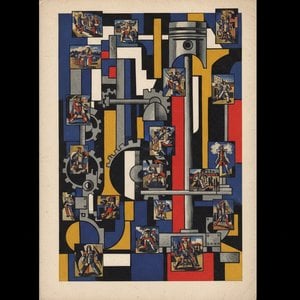
Fernand Léger: Die 25 Meisterwerke des Kubismus für Ihr Zuhause | ArtsDot
Entdecken Sie die 25 Meisterwerke von Fernand Léger! Tauchen Sie ein in die Welt des Kubismus, Tubismus & der Avantgarde. Hochwertige Kunstreproduktionen für Ihr Zuhause – jetzt auf ArtsDot.com!

Beyond Form & Color: Geometric Abstraction's Evolution in 20th/21st Century Art
Explore the evolution of geometric abstraction from Cubism to contemporary art. Discover key artists like Malevich & Mondrian, investment insights, and expert collecting advice at ArtsDot.

Industrielle Ästhetik: 10 Meisterwerke für Ihr Zuhause | ArtsDot
Entdecken Sie 10 Meisterwerke der Industriekunst! Von Expressionismus bis Kubismus – erleben Sie die Ästhetik von Fabriken, Arbeitern & urbanen Landschaften. Hochwertige Reproduktionen auf ArtsDot.com.
Geometric Design in Art: A Historical Survey & Contemporary Appeal for Collectors
Explore the enduring legacy of geometric abstraction! Discover key artists, historical movements & investment insights for discerning art collectors. Expert guidance from ArtsDot.

Geometrische Abstraktion: Die 10 Meisterwerke, die Kunstgeschichte prägten | ArtsDot.com
Entdecken Sie die 10 Meisterwerke der geometrischen Abstraktion! Von Kandinsky bis Mondrian – erleben Sie die Geschichte, Farben & Formen dieser revolutionären Kunstrichtung. Hochwertige Kunstreproduktionen auf ArtsDot.com


