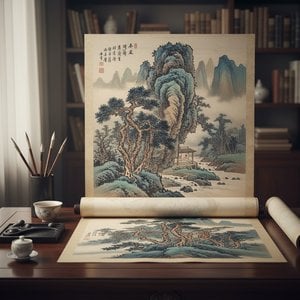
The Quiet Life of a Scholar-Painter
Born in the Shandong province, Zeng Yangdong moved through a world of shifting social structures during the Qing dynasty. He was the son of an official, a background that likely provided him with the refined education and access to the scholarly traditions of his era. While his roots were in the north, his life and artistic development took him toward the south of China. This movement between regions allowed him to absorb the subtle nuances of the landscape and the human form, shaping a perspective that was both deeply rooted in tradition and uniquely his own.
His work emerged during the Qianlong reign, a period of immense cultural activity. Rather than seeking the grand scale of imperial court paintings, he often turned his attention to the intimate. He worked with ink and color on paper, creating pieces that demanded a close, personal connection between the viewer and the object. These were not works meant for a distant hall, but for the private contemplation of a scholar's study.
The Art of the Miniature
Much of his legacy resides in the delicate format of the miniature album. These small treasures were designed to be held, unfolded, and savored in a moment of quiet solitude. The physical presentation of his work was as important as the ink itself, often housed in protective layers of wood, fabric, and specialized boxes. This careful preservation reflects a devotion to the object as a precious, tactile entity.
His compositions often blended the human figure with the natural world, creating scenes that felt both populated and peaceful. Some of his notable subjects included:
- Landscapes featuring hills, houses, boats, and bridges.
- Groups of figures, such as three men captured in a singular moment.
- Detailed studies of human forms and their interactions with the environment.
In these works, such as his 1822 album, he demonstrated a command over scale. Even within a tiny frame, he could suggest the breadth of a landscape or the weight of a human presence. His style was noted for being unusual and bold, a quality that would later find echoes in the work of 20th-century painters like Feng Zikai.
A Legacy in Ink
The influence of Zeng Yangdong stretches forward through the centuries, reaching into the modern era. His ability to distill complex emotions and scenes into small, potent images provided a bridge between the classical traditions of the Qing dynasty and the more modern sensibilities of later Chinese art. He did not merely record what he saw; he captured a specific way of seeing that favored clarity and a certain rhythmic strength in his line work.
Today, his surviving albums remain vital pieces of history. They offer a glimpse into the refined connoisseurship of his time, where the act of viewing art was a ritual of unwrapping and discovery. Through his ink and color, he ensured that the quiet elegance of his vision would endure long after the era of the scholar-official had passed.
Spørgsmål og svar
Hvilke andre navne er Zeng Yangdong kendt under?
Zeng Yangdong er også kendt som Zeng Yandong.
Kan jeg gennemse Zeng Yangdongs værker efter medie?
Se Zeng Yangdongs værker opdelt efter medie på kunstnerens Alle medier side.
Hvor mange kunstværker af Zeng Yangdong er tilgængelige at gennemse?
Du kan gennemse 5 kunstværker værker af Zeng Yangdong på siden Alle kunstværker.
Kan jeg gennemse Zeng Yangdongs værker efter stemning?
Zeng Yangdongs værker kan udforskes efter stemning på kunstnerens Stemningsfulde rum-side, hvor kunstværkerne er sorteret efter deres registrerede stemninger.