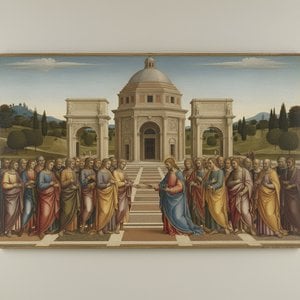
The Life and Origins of Xia Yong
Xia Yong was a Chinese painter who lived during the late Yuan dynasty. A native of Qian Tang, in the region known today as Hangzhou within the Zhejiang province, he moved through a period of significant transition in Chinese history. While his specific dates of birth and death remain unknown to history, his presence is felt through the records of the mid-14th century. He was a man of his time, active during a century that saw the shifting foundations of imperial rule.
In the circles of the learned, he was also recognized by his style name, Ming Yuan. This secondary identity offers a glimpse into the formal traditions of the era, even as the exact details of his personal biography remain obscured by the passage of centuries. Much of what is understood about his origins and his existence is derived from inscriptions left upon his own works, specifically those documenting the Yueyang Tower. These inscriptions provide the primary link between the man and the history he helped to visualize.
Artistic Style and Specialized Subjects
The brushwork of Xia Yong followed the established traditions of his era, drawing heavily from the style of Wang Zhenpeng. He found his primary purpose in the depiction of grand architecture, focusing his attention on the intricate details of palaces and temples. These subjects allowed him to explore the structural elegance of Chinese monumental buildings through ink on silk.
His compositions often engaged with the complexities of pictorial and architectural replication. Rather than mere imitation, his work functioned as a sophisticated form of reenactment, where the act of reproducing a subject was a deliberate artistic choice. This approach highlighted the tension between the original structure and the painted representation, emphasizing how visual motifs could be reinterpreted through the medium of the album leaf.
In his depictions of famous landmarks, he frequently blended historical events with mythical motifs. This method added a layer of auspiciousness to his scenes, weaving together the physical reality of a building with the cultural narratives surrounding it. His ability to navigate these layers of meaning made him a significant figure in the late Yuan dynasty's approach to architectural painting.
Notable Works and Famous Paintings
Xia Yong’s brush was frequently directed toward the grand architecture of the Chinese landscape, specifically the storied pavilions and temples that defined the era. His compositions often sought to capture the structural dignity of these landmarks. Among his most significant contributions is The Yellow Pavilion, an album leaf rendered in ink on silk. This work, dating to about 1350, utilizes a minute script in its inscription to obliquely reference historical floods and the shifting social landscape of the late Yuan dynasty.
His interest in architectural subjects extended to several other legendary sites. He produced depictions of the Yueyang Tower and the Yellow Crane Tower, works that required a precise understanding of both physical form and historical weight. These paintings were not merely studies of buildings but were deeply connected to the literary and cultural traditions of the time. His ability to translate these massive structures onto silk allowed for a detailed examination of their silhouettes and the spaces they occupied.
The artist also turned his attention to the Pavilion of Prince Teng, further establishing his reputation for portraying the monumental. Through these various subjects, Xia Yong maintained a consistent focus on the intersection of built environments and the natural world. His works remain central to the study of mid-14th-century Chinese painting, particularly regarding how architectural motifs were used to signal contemporary social realities.
Where to See His Works Today
The physical remnants of Xia Yong's hand are rare, preserved largely through the careful stewardship of major institutions. For those seeking to encounter his brushwork, the Metropolitan Museum of Art in New York offers a significant connection to his era. Within the museum's Asian Art collection, a specific ink on silk album leaf remains a primary point of contact with his mid-14th-century vision.
This particular work, titled The Yellow Pavilion, measures 8 1/8 x 10 1/2 in. (20.6 x 26.7 cm). It is cataloged under object number 1991.438.3. The piece arrived at the museum through the C. C. Wang Family, following the collection of the P. Y. and Kinmay W. Tang Family. Such preservation allows a direct view of the architectural precision that defined his career during the late Yuan dynasty.
Spørgsmål og svar
Hvordan er Xia Yongs karriere opdelt i perioder?
En kronologisk gennemgang af Xia Yongs værker er tilgængelig på kunstnerens Kronologi-side, hvor værkerne præsenteres i rækkefølge efter deres skabelse, kapitel for kapitel.
Hvilke farver brugte Xia Yong oftest?
Farvepalettens DNA for Xia Yong er en side, der præsenterer farveprofilen i kunstnerens samlede værk.
Hvor kan jeg se alle værker af Xia Yong?
Se alle værker af Xia Yong på denne hjemmeside på kunstnerens Alle kunstværker-side.
Hvor mange kunstværker af Xia Yong er tilgængelige at gennemse?
Du kan gennemse 1 kunstværker værker af Xia Yong på siden Alle kunstværker.