The Scholar and the Court
Born in the city of Taiyuan, Wang Shen lived a life that bridged the gap between the rigid structures of the Song dynasty court and the quiet, contemplative world of the literati. He was a man of many roles, rising through the ranks of the military to hold senior positions before his life took a turn toward the domestic and the political through his marriage to Princess Shuguo. This union placed him at the very heart of imperial power, as the Emperor Shenzong was his brother-in-law. Yet, the proximity to the throne brought its own perils. In 1079, a political scandal known as the Crow Terrace Poetry Trial, fueled by his close friendships with prominent statesmen, led to his demotion and a three-year exile from the capital. These years of displacement likely deepened the introspective qualities that would define his creative output.
He was a man who moved through the highest circles of society, yet his heart seemed to reside in the stillness of the landscape. His existence was a delicate balance between the duties of a politician and the temperament of an artist. He was a poet, a calligrapher, and a painter, participating in a cultural dialogue with the most celebrated minds of his era. Through his verses and his brush, he sought a way to express the subtle shifts of nature and the internal state of the scholar.
The Language of Ink and Snow
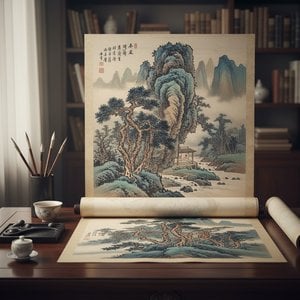
In his paintings, Wang Shen demonstrated a profound ability to marry two distinct traditions of Chinese art. He often utilized a blue-and-green palette, a method associated with the Tang dynasty, to bring a sense of mineral clarity to his compositions. However, he infused this technique with the more restrained, ink-heavy style of the Northern Song. This fusion allowed him to depict scenes that felt both ancient and immediate. His work often focused on the handscroll format, where the viewer's eye is led through a sequence of unfolding landscapes.
His technical approach relied heavily on the use of negative space to convey atmosphere. In his depictions of winter, he understood that the absence of ink could represent the presence of snow more effectively than any heavy pigment. He used light ink to create a sense of mist and distance, making the mountains and rivers appear to emerge from a dreamlike haze. His compositions often featured intermittent paths—sometimes a boat on a river, sometimes a road blocked by massive rocks—that forced the viewer to navigate the landscape with a sense of discovery.
The themes he chose to explore include:
- The quietude of a fishing village under a light dusting of snow.
- Misty river scenes characterized by layered, receding peaks.
- The interplay between poetic verse and visual imagery on silk scrolls.
- The use of blue mineral pigments to highlight distant forests.
A Legacy of Poetic Landscapes
The historical significance of Wang Shen lies in his role as a bridge between the formal traditions of the past and the emerging literati ideals of his time. He was part of a movement where the scholar-official was redefining the purpose of art, moving away from the purely decorative toward a more personal, expressive medium. His ability to trade rhymes with the great poets of his age shows that his visual art was deeply intertwined with his literary pursuits. He did not merely paint a scene; he composed a visual poem.
His surviving works, such as those held in the Palace Museum in Beijing, continue to offer insight into the aesthetic values of the Song dynasty. By choosing to paint humble subjects like a fishing village rather than grand imperial vistas, he signaled a shift toward a more intimate and observant way of seeing the world. His work remains a vital link to an era when the brush and the poem were seen as two sides of the same soul.
Spørgsmål og svar
Hvor kan jeg finde statistik om Wang Shens værker?
Der findes en Statistik-side for Wang Shen, som præsenterer statistikker om kunstnerens værker på denne hjemmeside.
Kan jeg gennemse Wang Shens værker efter kunstretning?
Siden Alle kunstretninger grupperer Wang Shens værker efter kunstretning.
Hvor kan jeg opleve Wang Shens kunstværker i et 3D-galleri?
Wang Shens værker kan opleves i et 3D-galleri på kunstnerens 3D-galleri-side.
Kan jeg gennemse Wang Shens værker efter stemning?
Wang Shens værker kan udforskes efter stemning på kunstnerens Stemningsfulde rum-side, hvor kunstværkerne er sorteret efter deres registrerede stemninger.