Early Life, Family and Training
Valentin Metzinger was born on 19 April 1699 in Saint-Avold, France. He entered a large family as one of twelve children born to François Metzinger and Maria Magdalena née Valentini. His twin brother, Jean-Philippe, was part of this household. While his lineage traces back to Italy, his early years were rooted in the Lorraine region. The specific location where he received his first painting lessons remains unknown, leaving a gap in the record of his formative years.
His development as a Baroque painter required movement across the major artistic centers of Europe. He eventually traveled to study in Bologna, Venice, and Rome. These travels provided the technical foundation for a career that would eventually span the Holy Roman Empire. He did not follow the traditional academic route, as there is no record of his attendance at any formal academies during his training. Instead, his skill was forged through direct exposure to the Italian traditions of the period.
Activity in Ljubljana and the Adriatic
Metzinger’s presence in Ljubljana is anchored by a 1727 municipal revenue book, where he was explicitly identified as a professional painter. This was no mere transient stay; he remained active in the city from 1727 until his death in 1759. During this period, he established a successful painting workshop that functioned as a central hub for his production. His personal life during this era included a marriage in 1731 to an older woman, a union that preceded his own death by only six months.
His influence extended far beyond the walls of his Ljubljana workshop, reaching into the northern Adriatic. This sustained activity began with commissions in Trsat, which helped integrate his work into the liturgical and devotional programs of the region. His reach was not limited to a single city but spanned a network of religious orders and individual patrons across the Adriatic coast. This geographic spread ensured his presence in the visual landscape of the time.
- Altarpiece and cycle of saints' portraits in the Franciscan monastery at Trsat
- Altarpiece for the monastery of St. Francis in Senj
- Altarpieces for the Jesuit Church of St. Vitus in Rijeka
- Altarpieces for the Collegiate Church of the Assumption of Mary in Rijeka
Patrons, Workshop and Commissions
Metzinger’s professional standing was built on a steady stream of religious and ecclesiastical commissions that spanned the southeastern Alpine region. His early career was anchored by the Franciscans, who commissioned several works between 1727 and 1730 in Novo mesto and Brežice. This religious network expanded as he secured work from the Capuchins and the Jesuit Church of St. Vitus in Rijeka. His reach extended through the complex networks of religious orders, securing his presence in the liturgical programs of the northern Adriatic.
Beyond the monasteries, Metzinger navigated a landscape of influential individual and high-ranking patrons. He executed commissions for Bishop Ernst Gottlieb von Attems and worked for theologians such as Anton Erberg and Maximilian Leopold Rasp. His ability to satisfy these clients allowed him to maintain a successful painting workshop in Ljubljana. This workshop was essential for managing the high volume of work required by his diverse clientele across Carniola and Styria.
Technique, Style and Legacy
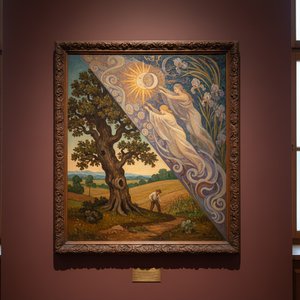
Metzinger’s aesthetic is defined by a distinctive religious sentiment paired with dynamic composition. His canvases frequently employ imaginary and celestial landscapes, unified by a deliberate colour harmony. While his earlier output adheres to the structural demands of the Baroque, his late phase shifts toward a Rococo playfulness of colour and light. This transition demonstrates a technical flexibility that allowed him to move beyond rigid religious iconography into more decorative, luminous territory.
The scale of his output is substantial. Over 500 works have been attributed to him, many of which were produced within a successful workshop. More than 350 oils survive today, distributed across churches, monasteries, and castles in Slovenia and Croatia. These surviving works provide a clear record of his influence on the regional development of art, specifically impacting the work of Anton Cebej and Janez Potočnik. His ability to maintain a high standard of quality ensured his style remained a source of inspiration deep into the 19th century.
Spørgsmål og svar
Hvor kan jeg finde statistik om Valentin Metzingers værker?
Der findes en Statistik-side for Valentin Metzinger, som præsenterer statistikker om kunstnerens værker på denne hjemmeside.
Hvor mange kunstværker af Valentin Metzinger er tilgængelige at gennemse?
Du kan gennemse 1 kunstværker værker af Valentin Metzinger på siden Alle kunstværker.
Findes der en virtuel 3D-tour af Valentin Metzingers værker?
Besøg galleriet virtuelt: 3D-galleri-siden for Valentin Metzinger præsenterer kunstnerens værker i et tredimensionelt galleri.
Kan jeg udforske Valentin Metzingers værker via nøgleord?
Udforsk Valentin Metzingers værker via nøgleord på kunstnerens Efter nøgleord-side, hvor hvert nøgleord samler de relaterede kunstværker.