Early Life, Family and Training
Thomas Richmond was born in 1771 in Kew. His father, also named Thomas Richmond, was the proprietor of the Coach and Horses at Kew, having previously served as the groom of the stables to the Duke of Gloucester. His mother, Ann Bone, was a cousin of George Engleheart, who held the position of miniature-painter to the king. This family connection placed the young artist in a specific circle from his earliest years.
The path of his training was set by these ties. Thomas Richmond became the pupil of George Engleheart. Through this apprenticeship, he learned the delicate requirements of the miniature format. His education was rooted in the traditions of his master, focusing on the small-scale precision required for portraiture on ivory and paper.
Technique and Style
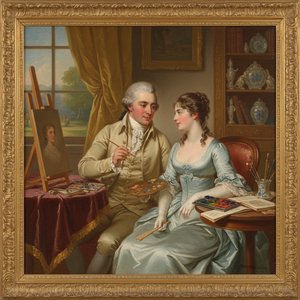
Richmond’s hand is most often seen in his numerous original and unsigned miniatures. He worked across different surfaces, choosing ivory for some pieces and paper for others. His approach to the miniature format often involved a specific division of media; he frequently rendered the head in full color while leaving the rest of the figure in pencil. These figures often appear in full or half-length poses. While the stance of some subjects follows the stiff manner common to the period, the actual drawing remains precise. The expressions captured in these small works are lifelike.
His technical skill is evident in the way he handled the delicate balance between color and line. By using pencil for the body and color for the face, he drew the viewer's eye directly to the sitter's expression. This method required a steady hand to ensure the transition between the colored head and the monochromatic limbs felt natural. The result is a collection of portraits where the character of the individual is held clearly in the eyes and facial features.
Later Years and Death
In his later years, Richmond moved to the center of fashion, settling at 42 Half-Moon Street in Mayfair. His family life continued to expand during this period; his eldest son, also named Thomas Richmond, was born in 1802. This son would eventually follow a similar path, practicing as a miniature-painter in Sheffield and later in London, often working among the hunting fraternity. His younger son, George Richmond, also became a noted artist and eventually inherited many of his father's works.
Richmond died in 1837. He was buried in Paddington churchyard, a site that later became part of a public park known as St Marys Gardens. His grave remains in the north-west section of the area, though it is now enclosed within a metal cage.
Spørgsmål og svar
Hvor kan jeg se alle værker af Thomas Richmond?
Se alle værker af Thomas Richmond på denne hjemmeside på kunstnerens Alle kunstværker-side.
Kan jeg udforske Thomas Richmonds værker efter farvespektrum?
Farveindeks for Thomas Richmond er en side, der organiserer kunstnerens værker efter farve.
Hvor kan man finde Thomas Richmonds kunstværker grupperet efter nøgleord?
Udforsk Thomas Richmonds værker via nøgleord på kunstnerens Efter nøgleord-side, hvor hvert nøgleord samler de relaterede kunstværker.
Hvor kan man finde Thomas Richmonds værker grupperet efter kunstretning?
Se Thomas Richmonds værker opdelt efter stilart på kunstnerens Alle kunstretninger side.