Early Life and Artistic Training
Rudolf Bergander was born on 22 May 1909 in Meißen, Germany. His early years were shaped by the precise, disciplined work of a porcelain painter. After graduating in 1923, he spent time working at the Meissen state porcelain manufactory, where the focus was on the fine, steady application of color to ceramic surfaces.
In 1928, he moved toward a different kind of study, entering the Dresden Academy of Fine Arts. He remained there until 1932, refining his technique under the guidance of Richard Müller and Otto Dix. These years in Dresden provided the foundation for his later development as a painter and graphic artist.
Political Affiliations and War Years
The political landscape of Bergander's early adulthood was marked by shifting allegiances and the heavy weight of German history. In 1928, he joined the KPD, and by the following year, he was a member of the Association of Revolutionary Visual Artists. These affiliations placed him within the circles of those seeking radical social change through their work. However, the stability of these convictions was tested by the changing tides of the era. In 1940, he joined the Nazi Party, a move that coincided with the deepening involvement of Germany in the Second World War.
As the conflict progressed, his role shifted from the studio to the technical demands of the military. By 1945, he was serving as a cartographer in the Wehrmacht. This period required a different kind of precision, moving away from the expressive possibilities of painting toward the rigid, exacting lines of map-making. The war years left him navigating a fractured landscape of ideology and duty before the eventual restructuring of his life in the post-war period.
Academic Career and Professional Roles
After the war, Bergander's life became closely tied to the institutional structures of the Dresden Academy of Fine Arts. In 1949, he began teaching as a lecturer on painting at the Academy of Fine Arts DDR. His position within the academy grew steadily; by 1951, he was appointed as a professor. This period of his life was marked by a deep involvement in the formal training of others, moving from the studio to the lecture hall.
His leadership roles at the academy were significant and occurred in two distinct stretches. He served as the rector of the Dresden Academy of Fine Arts from 1952 to 1958, and later returned to this position from 1964 to 1965. These years saw him managing the direction of the institution during a transformative era for the region. Beyond the academy, his influence extended to the German Academy of Arts, where he became a member and served as the Permanent Secretary of Fine Arts starting in 1961.
Awards and Recognition
The recognition Bergander received often mirrored the shifting landscape of the German Democratic Republic. In 1956, his realistic body of work was met with the National Prize of the German Democratic Republic. This period marked a steady accumulation of honors that acknowledged his presence within the state's cultural framework. By 1962, he was awarded the Patriotic Order of Merit, a distinction that would later be updated when he received the Silver Patriotic Order of Merit in 1969.
His contributions to the cultural field were further noted by the state through the awarding of the Banner of Labor in 1964. These honors arrived alongside his various academic responsibilities and his position within the German Academy of Arts. The medals and prizes reflect a life deeply embedded in the institutional structures of his time, marking his progression from a working artist to a central figure in the academic and political life of the GDR.
Artistic Style and Notable Works
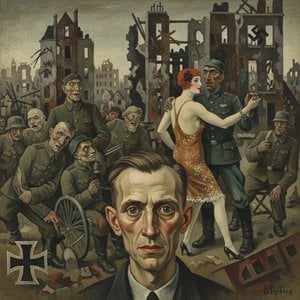
Bergander’s work is rooted in realism. His approach focuses on the tangible details of his subjects, a quality that earned him the National Prize of the German Democratic Republic in 1956. His training as a porcelain painter in Meissen likely contributed to this precise way of seeing, where the weight and texture of a subject are given careful attention. This focus on the physical presence of people and objects defines much of his output, whether through painting or graphic works.
In his graphic work, such as the 1968 etching Akt, sich abtrocknend, there is a quiet study of the human form. The piece captures a woman in a moment of simple, everyday movement. His ability to translate form into line is evident in these smaller, more intimate studies. He also moved between different modes of expression, from the large-scale concerns of his era to the specific, individual details of a portrait.
His catalog includes several significant pieces held in the Staatliche Kunstsammlungen Dresden. These include Prof. Dr. Josef Schintlmeister from about 1959 and Solidarity from about 1966. These works reflect a career spent observing the people and the social structures around him, translating those observations into a visual language that remains grounded in the reality of the human experience.
Spørgsmål og svar
Hvordan finder jeg alle værker af Rudolf Bergander inden for et bestemt medie?
Se Rudolf Berganders værker opdelt efter medie på kunstnerens Alle medier side.
I hvilken historisk periode arbejdede Rudolf Bergander?
Rudolf Bergander var aktiv i Modern-perioden. Denne periode placerer kunstnerens virke i en historisk kontekst.
Hvilken by og hvilket land er Rudolf Bergander født i?
Rudolf Bergander blev født i Meissen, i Germany.
Hvor kan jeg se Rudolf Berganders værker opdelt efter stemning?
På kunstnerens Stemningsfulde rum side kan du finde Rudolf Berganders værker sorteret efter stemning.