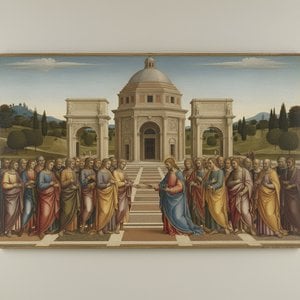
The Radiant Legacy of Pere Lembrí
In the twilight of the fourteenth century, a period defined by the delicate elegance of the International Gothic style, the name Pere Lembrí emerged as a luminous presence in the Iberian Peninsula. Active primarily between 1399 and 1421, Lembrí was a master whose brush captured the spiritual fervor and courtly grace of his era. His life and career were deeply rooted in the regions of Tortosa and Maestrazgo, moving from the historic capital of Morella to the vibrant artistic hub of Tortosa around 1407. This movement allowed him to weave together the local traditions of eastern Spain with the broader, more sophisticated influences flowing from across Europe, establishing him as a pivotal figure in late medieval Spanish painting.
Lembrí’s artistry was far more than mere religious documentation; it was an evocative dialogue between the earthly and the divine. His work is characterized by a profound Catalan Gothic sensibility, a style that favored dramatic narratives and a powerful emotional focus. To gaze upon his panels is to witness a rhythmic vitality, where bold colors dance across the surface to guide the viewer through sacred histories. He drew significant inspiration from the Siennese school, which infused his compositions with a lyrical sweetness and a sophisticated use of light, allowing him to transform heavy wooden altarpiements into windows of celestial splendor.
Mastery of the Altarpiece and Sacred Narrative
The true magnitude of Lembrí’s contribution lies in his command of the retablo, or altarpiece. These monumental structures were not merely decorations but complex theological instruments designed to instruct and inspire the faithful. His hand can be traced through several significant works that continue to haunt the halls of Europe's greatest museums:
- The Deposition of Saint Peter: A breathtaking panel currently held in the Montreal Museum of Fine Arts, which showcases his ability to blend intense human emotion with a structured, rhythmic composition.
- The Coronation of the Virgin: A work that exemplifies the celestial majesty and the delicate, flowing drapery characteristic of the International Gothic movement.
- The Altarpiece of the Hermitage of Los Santos Juanes: Located in Albocácer, this project stands as a testament to his role as a leading painter in the province of Castellón.
- Works attributed to the Prado Museum: His influence extends even to the most prestigious collections, including panels depicting the Virgin of Milk with Saint Bernard and Saint Benedict, which highlight his mastery of devotional intimacy.
Beyond the grand scale of altarpieces, Lembrí possessed a remarkable ability to render individual saints with a sense of living presence. Whether portraying the ascetic strength of Saint Antoine abbé or the apostolic gravity of Saint John the Evangelist, his figures possess a unique psychological depth. He utilized the iconography of the Golden Legend—the quintessential medieval compendium of saintly lives—to ground his imaginative compositions in a recognizable, sacred reality for his contemporary audience.
Historical Significance and Artistic Endurance
The historical importance of Pere Lembrí transcends the mere chronology of his active years. He served as a vital link in the evolution of Spanish religious art, bridging the gap between the rigid forms of earlier medieval traditions and the more fluid, emotive styles that would eventually pave the way for the Renaissance. His ability to synthesize the local Catalan aesthetic with the prestigious influences of Italy allowed him to create a visual language that was both regionally distinct and internationally relevant.
Today, the fragments of his oeuvre serve as precious relics of a lost world. Through the preservation of his panels in institutions like the Louvre, the Prado, and various Spanish diocesan museums, Lembrí’s legacy remains vibrant. He remains a master of the narrative, an artist who understood that to paint a saint was not just to depict a figure, but to invite the viewer into a profound encounter with the eternal. His work continues to resonate with a timeless beauty, reminding us of a period when art was the primary vessel for the human soul's longing for the divine.
Spørgsmål og svar
I hvilken historisk periode arbejdede Pere Lembrí?
Pere Lembrí var aktiv i Late Medieval-perioden. Denne periode placerer kunstnerens virke i en historisk kontekst.
Findes der en tidslinje over Pere Lembrís værker?
Se en tidslinje over Pere Lembrís værker på siden Tidslinje for kunstværker, hvor kunstværkerne er sorteret efter dato.
Hvor kan man finde Pere Lembrís værker grupperet efter teknik?
Siden Alle medier grupperer Pere Lembrís værker efter teknik.
Hvilke kunstværker af Pere Lembrí har flest visninger?
Siden Statistik for Pere Lembrí præsenterer statistikker beregnet ud fra kunstnerens værker, som er listet på denne hjemmeside.