A life of dual disciplines
Nikolai Ivanovich Kulbin lived through a period of intense change, moving between the precise world of medicine and the experimental edges of the Russian avant-garde. He began his professional path at the Imperial Military Medical Institute, graduating in 1893. His early years were spent in the study of science, specifically researching alcoholism and working as a lecturer at the Military Medical Attendants' School. Even as he practiced as a surgeon within the Russian Army Headquarters, his interests drifted toward the visual and the sonic.
The hands that once performed surgery also engaged with microphotography and microscopic drawing. This attention to the minute details of life found its way into his later artistic pursuits. By 1908, he had stepped into the center of the art scene in St. Petersburg. He did not merely observe these shifts; he organized them, arranging the Exhibition of Modern Trends in Art in May 1908, which brought new ways of seeing to the city.
The architecture of sound and sight
Kulbin's work was never confined to a single medium. He moved between painting, graphic art, and set design with a shared focus on harmony and dissonance. As a theorist, he explored the boundaries of music, developing ideas around "Free music" and advocating for the use of quarter and eighth-tone scales. This search for new structures mirrored his work in the visual arts, where he founded groups like Triangle: The Art and Psychology Group in 1907 and later the ARS alliance.
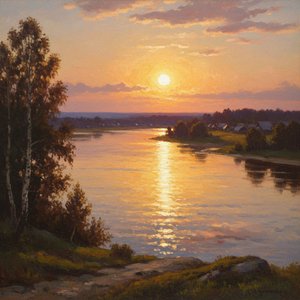
His canvases often captured specific moments or landscapes with a focus on light and texture:
- Taking the Sun (1916)
- Sea View, painted during the 1900s
- Crimea (1916)
- Mimosas and roses (1915), rendered in oil on brass
In his stage designs for the Terioki summer theatre and the Queen of Spades Theatre, he applied these same principles of movement and form. His portraits also documented the figures of his era, including sketches of Vladimir Mayakovsky and Filippo Tommaso Marinetti.
A legacy in fragments
The influence of Kulbin is found in the way he connected different artistic movements, from Symbolism to Futurism. He acted as a patron and a connector for many young artists who would go on to lead the local avant-garde. His presence was felt in the creation of various alliances and publications, such as Spectator, which helped sustain the momentum of new trends.
Though his life ended in Petrograd in 1917, the pieces he left behind remain in collections such as the State Russian Museum and the Museum of Modern Art. His work exists as a collection of studies—some in oil on canvas, others in pencil or brush drawing—that reflect a mind constantly seeking the underlying principles of the physical and sensory world.
Spørgsmål og svar
Kan jeg besøge et virtuelt museum med Nikolay Kulbins værker?
3D-galleri for Nikolay Kulbin er en side, der fremviser kunstnerens værker i et virtuelt tredimensionelt galleri.
Hvor og hvornår er Nikolay Kulbin født?
Nikolay Kulbin blev født i Helsinki i 1868.
Hvordan finder jeg alle værker af Nikolay Kulbin inden for et bestemt medie?
Se Nikolay Kulbins værker opdelt efter medie på kunstnerens Alle medier side.
Hvor kan man finde Nikolay Kulbins kunstværker grupperet efter nøgleord?
For at finde værker af Nikolay Kulbin inden for et specifikt tema kan du bruge kunstnerens Efter nøgleord-side, som grupperer værkerne efter nøgleord.