Early Life and Artistic Training
Morris Blackburn was born in Philadelphia in 1902. His early technical training began at the Philadelphia Trade School in 1918, where he focused on architectural drawing. This foundation in structure and line preceded his formal entry into the fine arts. By 1922, he was studying at the Graphic Sketch Club, now known as the Samuel S. Fleisher Art Memorial, marking a decisive shift toward a professional artistic practice.
His development accelerated during his years at the Pennsylvania Academy of Fine Arts between 1925 and 1929. This period provided him with rigorous instruction from several significant figures. He studied sketching under Arthur Carles, painting under Henry McCarter, and drawing under Daniel Garber. These mentors provided the technical scaffolding that would support his later experimentation with both printmaking and painting. His talent was recognized during this tenure when he won the prestigious Cresson Traveling Scholarship at PAFA.
Artistic Career and Teaching
Blackburn’s professional output was defined by a refusal to stay within a single medium. He operated as a painter, printmaker, and graphic designer, often pushing the technical boundaries of his tools. He was an early adopter of the silkscreen process, utilizing the method to develop compositions with a distinctively bright palette. During the mid-1930s, his work moved into the public sphere through two murals commissioned for the Works Progress Administration's Public Works Art Project. These pieces were located at Mastbaum Vocational School and Haverford High School.
His influence extended into the classroom through a long and steady teaching career. He began this work in 1932 at the Pennsylvania Museum School of Industrial Art. After a period at the Tyler School of Art from 1948 to 1952, he joined the faculty of the Pennsylvania Academy of Fine Arts. He remained a fixture at the Academy from 1952 until 1979. Students and colleagues often referred to him by the nickname "Blackie."
Technique and Artistic Style
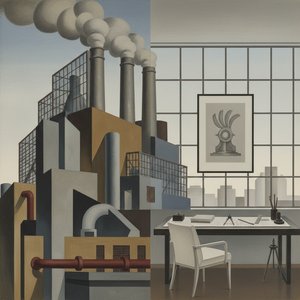
Blackburn’s technical significance lies in his early adoption of the silkscreen process. While many of his contemporaries remained tethered to traditional methods, he utilized the screenprint medium to construct abstract compositions defined by a bright palette. This experimentation was not merely a change in tool but a shift in visual language. By the 1930s, his work moved decisively toward abstraction, shedding literal representation for a more structured, modern sensibility. His compositions often balanced the tension between hard-edged Cubist forms and more fluid, organic, biomorphic shapes.
His subject matter frequently drew from specific geographies, including Philadelphia, New Jersey, and Taos, New Mexico. Even when working from these locations, the focus remained on the formal arrangement of space rather than mere topographical recording. This approach allowed him to merge the rhythmic qualities of modernism with the physical realities of his surroundings. The resulting works demonstrate a calculated control over color and geometry, moving away from the descriptive toward the structural.
Notable Works and Compositions
Blackburn’s output demonstrates a restless engagement with both medium and form. His 1941 screenprint, Still Life, marks an early commitment to the silkscreen process, a technique he would refine throughout his career. This interest in texture and layered composition is evident in his 1952 print North Shore, where the physical act of mark-making creates a tactile sense of light and shadow. In this work, the dark ink catches in fine lines, mimicking the way rain gathers in cracks, while vertical elements provide a structural counterpoint to more chaotic, grainy textures.
His ability to synthesize disparate visual languages is most apparent in Orchestration. This composition merges the hard-edged geometry of Cubism with organic, biomorphic forms, a tension that mirrors the rhythmic complexity of modern music. This structural awareness extends to his oil on canvasboard work DRAGGERS (1957) and his etching Society Hill. Even in his larger-scale paintings, such as Appalachian Spring I (1946-1947), the influence of his training is visible through a specific use of color and geometric structure that avoids mere imitation of his predecessors.
- Still Life (1941)
- North Shore (1952)
- DRAGGERS (1957)
Legacy and Professional Recognition
Blackburn’s standing in the mid-century American art scene was cemented by consistent institutional validation. He secured two Cresson Traveling Scholarships in 1928 and 1929, honors that signaled his early technical proficiency. His professional trajectory reached a significant milestone in 1952 when he was awarded a John Simon Guggenheim Fellowship. This recognition coincided with his long-term tenure as a faculty member at the Pennsylvania Academy of Fine Arts, where he was a fixture of the academic community.
His presence in the annual exhibition circuit was nearly constant for decades. Between 1930 and 1968, his work appeared in almost every Annual Exhibition at the Pennsylvania Academy of Fine Arts. This sustained visibility reflects a career built on technical rigor rather than fleeting trends. His influence extended beyond his own canvases and prints through his commitment to the institutions that trained him. Upon his death, he left a legacy to benefit the Scholarship Fund of the School of the Pennsylvania Academy of Fine Arts, ensuring his professional impact continued through the support of subsequent generations of students.
Where to See His Works Today
Blackburn’s presence in major institutional collections confirms his standing in American printmaking and painting. His works are held by the Smithsonian American Art Museum and the National Gallery of Art. The Metropolitan Museum of Art also maintains pieces from his output. These collections provide the primary physical record of his technical experimentation with silkscreen and abstraction.
His reach extends beyond American borders, with his work held in the British Museum. Locally, the Philadelphia Museum of Art maintains a significant presence of his art. For those interested in his professional history and archival materials, his papers are held by the Pennsylvania Academy of the Fine Arts.
Spørgsmål og svar
Hvor mange kunstværker af Morris Blackburn er tilgængelige at gennemse?
Du kan gennemse 2 kunstværker værker af Morris Blackburn på siden Alle kunstværker.
Hvilke andre navne er Morris Blackburn kendt under?
Morris Blackburn er også kendt som M. Atkinson Blackburn, Blackie, Morris Atkinson Blackburn.
Hvordan finder jeg alle værker af Morris Blackburn inden for et bestemt medie?
For at finde alle værker af Morris Blackburn inden for et bestemt medie, kan du bruge kunstnerens Alle medier side.
Hvordan kan jeg se alle værker af Morris Blackburn?
Se alle værker af Morris Blackburn på denne hjemmeside på kunstnerens Alle kunstværker-side.