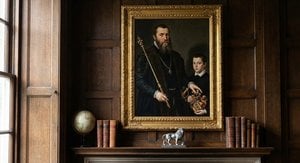
A Life in Portraiture
Matthew Ashton worked during a period of significant transition in British art, active primarily between 1718 and 1728. While the specific details of his early life remain quiet, his presence in the historical record is defined by his ability to capture the likenesses of the English gentry. He operated in an era where portraiture was the primary way to preserve a family's status and lineage, requiring a steady hand and an understanding of how light falls upon silk and skin.
His work reflects the visual language of his time, often following the established patterns of the great masters of the early eighteenth century. He was a painter who understood the importance of a sitter's gaze and the subtle textures of their clothing. His skill allowed him to translate the character of his subjects onto canvas, ensuring their presence remained felt long after they had passed.
The Art of the Likeness
Ashton's technique was deeply influenced by the prevailing styles of the London art scene. His approach to oil on canvas shows a clear connection to the methods used by the most successful portraitists of the age. He focused on the nuances of dress and the careful arrangement of the subject to convey a sense of dignity.
His surviving work provides a window into the social hierarchies of the early 1700s. Through his brush, we see the specific details of the era:
- The use of green velvet in men's coats.
- The precise rendering of white cravats and jabots.
- The depiction of shoulder-length, curled wigs with central partings.
- The formal, half-length composition common to aristocratic portraiture.
Legacy and Preservation
One of the most significant pieces attributed to Ashton is his portrait of The Hon. Henry Booth (1687-1726). This work, painted around 1710 to 1720, captures the third son of the 2nd Baron Delamere. The portrait shows the sitter in a green velvet coat, looking directly at the viewer with a calm expression. It remains a vital piece of English history, held within the Dunham Massey collection.
The survival of his work is largely due to the careful stewardship of great estates. This particular portrait was bequeathed to the National Trust by Roger Grey, the 10th Earl of Stamford. Because of this preservation, Ashton's hand remains visible to those who study the history of British painting, offering a glimpse into the faces of the eighteenth century.
Spørgsmål og svar
Hvor kan man finde Matthew Ashtons værker grupperet efter teknik?
Se Matthew Ashtons værker opdelt efter medie på kunstnerens Alle medier side.
Kan jeg udforske Matthew Ashtons værker efter emne?
Siden Emneoversigt kortlægger Matthew Ashtons kunstværker efter motiv.
Kan jeg gennemse Matthew Ashtons værker efter kunstretning?
Se Matthew Ashtons værker opdelt efter stilart på kunstnerens Alle kunstretninger side.
Hvor kan jeg se Matthew Ashtons værker i kronologisk rækkefølge?
Se kunstnerens Tidslinje for kunstværker for en kronologisk gennemgang af Matthew Ashtons værker, år for år.